



The food of Hue: where the royal kitchen, everyday dishes and small street stalls meet
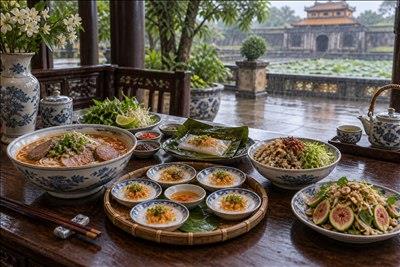
The food of Hue is usually introduced with the word “royal”, but the flavours of the old capital also grew out of markets, riverside villages, the lagoon and small street vendors. Its refinement lies not only in a beautiful plate but in the seasoning, the portioning and the turning of ordinary ingredients into layers of flavour.
The food in this article is seen as a living system: dishes are tied to climate, ingredients, labour, family memory and the ways people sit down together. So this is not a claim that an entire country has only one palate or one set of rituals. Every region, religion, community and household has its own versions, and each deserves respect.
Quick facts
- Setting: the Nguyen dynasty capital, a garden city, riverside villages and the lagoon region.
- Streams of cooking: royal, domestic, vegetarian and popular street food.
- Signature notes: shrimp paste, lemongrass, chilli, prawns, clams, herbs and many kinds of rice-flour cake.
- Presentation: small portions, clear colours and attention to the crockery.
- Do not equate every Hue dish with spicy food or a royal banquet.
How it came about
Its position as the capital from the early nineteenth century drew cooks, produce and serving rituals from many places. The royal kitchen developed techniques for selecting ingredients, shaping, combining colours and organising many dishes; part of that knowledge spread to the households of officials and then to ordinary residents, where it went on changing.
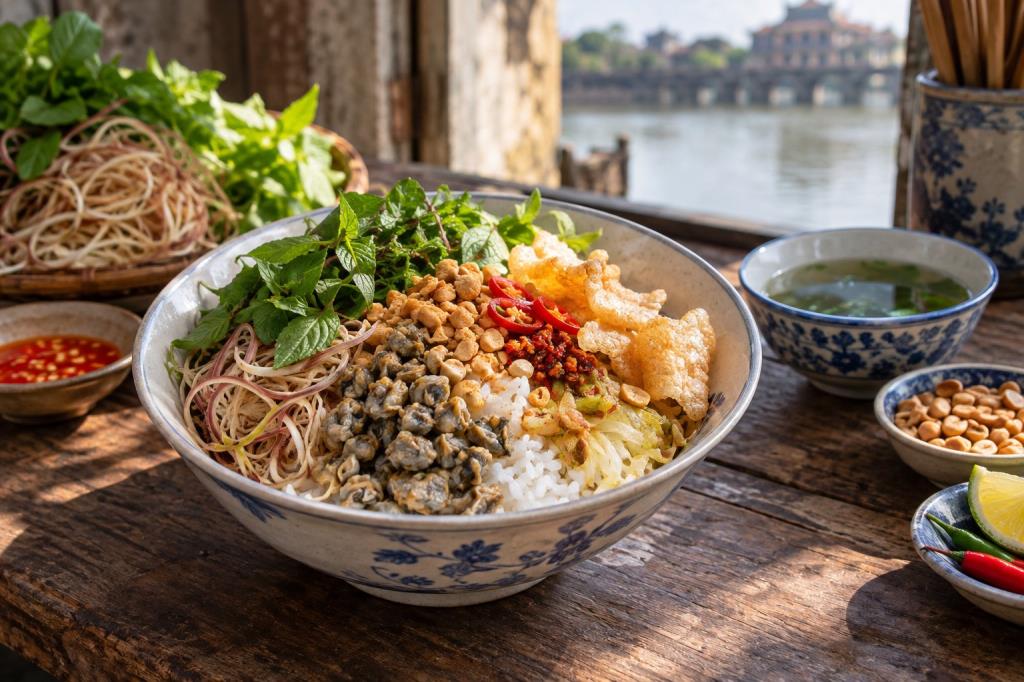
Alongside it runs a popular stream built on resourcefulness. Com hen makes use of cold rice, tiny clams, herbs, crisp elements and the clam broth; the various steamed and translucent cakes use rice flour, tapioca starch, prawns and leaves to create many forms from familiar ingredients.
The climate of central Vietnam is harsh and the land narrow between mountains and sea, yet Hue has the Perfume River, the Tam Giang-Cau Hai lagoon, its gardens and the coast. Both the constraint and the variety encourage a way of cooking that is economical, clear in flavour and moderate in portion.
How is a meal put together?
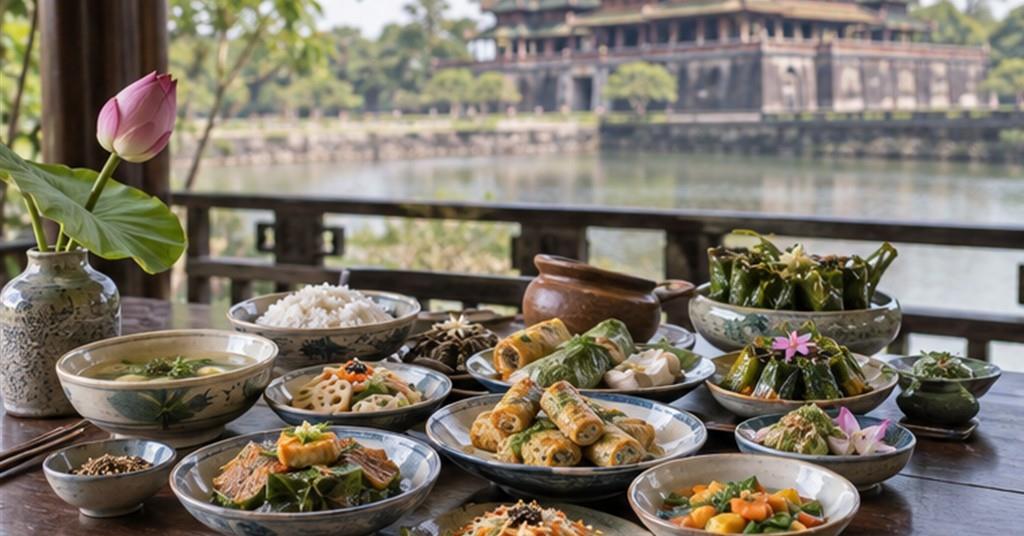
A Hue family meal still revolves around rice, a savoury dish, vegetables and soup; what makes it distinctive is the fermented sauces, the braised dishes, the garden greens and the seasoning. Vegetarian meals can be extremely varied thanks to Buddhist influence, but vegetarian life in homes and temples is not quite the same as the sculpted vegetarian dishes of a restaurant.
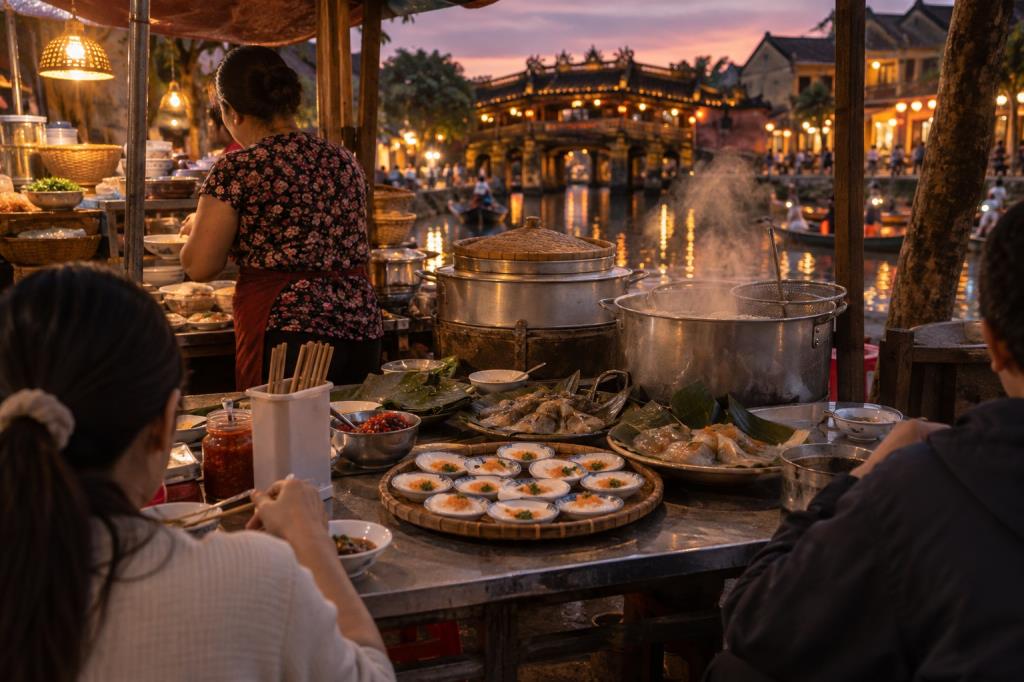
Among the street stalls, a diner may stop at several places: noodles in the morning, small rice cakes in the afternoon, sweet soup in the evening. Small portions make it possible to taste many things and also suit selling in batches and a compact shop.
The elements that make the character recognisable
- Fermented shrimp paste forms the flavour base for the noodle soup and for many seasoned dishes.
- Lemongrass, chilli and onion give a clear aroma but must be balanced against the broth.
- Clams, prawns and fish reflect the network of river, lagoon and coast.
- Rice flour, tapioca starch and banana leaves create a rich family of cakes.
- Fig, herbs, star fruit and green banana balance the richness and the heat.
- Sweet soups use pulses, seeds, roots and fruit according to the season.
The list above is a map for observing, not a formula that boxes anything in. An ordinary family meal may be far simpler, while a festival table is elaborate and full of symbolism. The cultural value lies as much in how things are chosen, prepared, divided and offered to one another as in the number of dishes.
Ingredients tell a story of geography
Con Hen islet is tied to com hen; the lagoon supplies seafood; the garden villages provide vegetables, fruit and seasonings. Each ingredient travels only a short distance from where it is gathered to the market and then to the kitchen, so freshness and the water season strongly affect the dishes.
Long rains and a hot season create a need both for warming spicy dishes and for cooling sweet soups and light food. Even so, taste should not be explained by weather alone: the history of the court, trade, religion and family custom all play a part.
The techniques that build the flavour
The broth needs the lemongrass and shrimp paste to dissolve into it rather than standing out harshly. The paste is diluted, allowed to settle or strained; the seasoning is adjusted step by step. Thick noodles, meat and the accompanying herbs create their own proportions, organised differently from a bowl of pho.
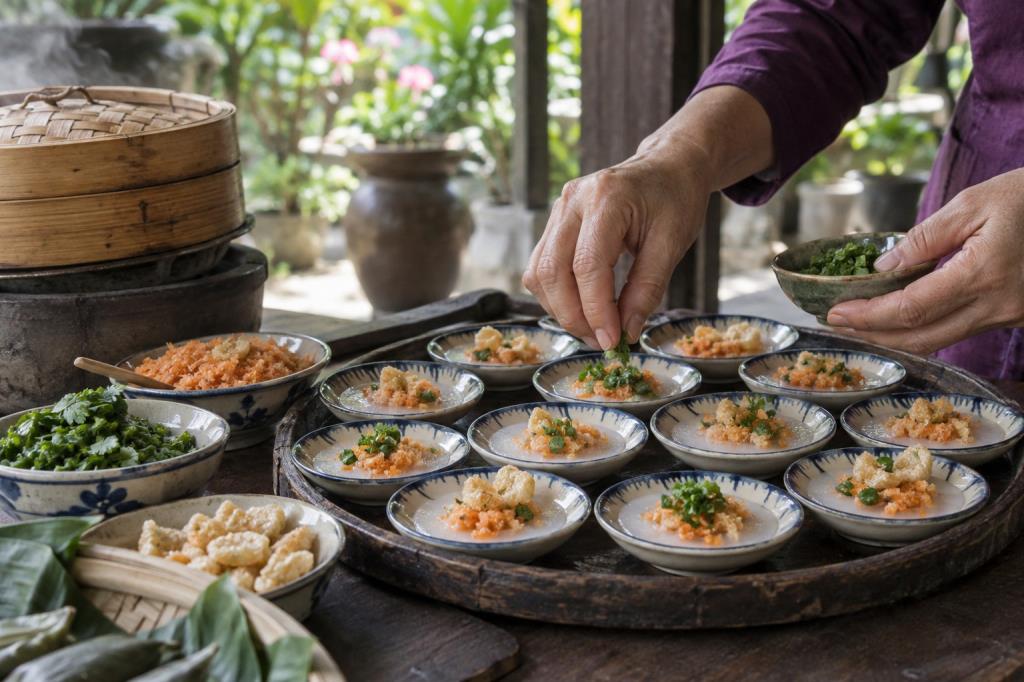
The steamed cakes are set in small dishes, thick enough to stay tender without crumbling; dried prawn, scallion oil and dipping sauce are added just before eating. The leaf-wrapped cakes need the batter spread thin inside the leaf; the translucent cakes depend on the clarity and chew of the starch and on a well-judged filling. These small items in fact demand very precise, repeated movements.
Seen from the kitchen, a traditional technique is usually a community's answer to a very practical problem: making grain easier to eat, using up a harvest, extending how long food keeps, or building layers of aroma from a limited supply of fuel. When modern technology shortens a stage, the flavour may still be good, but the rhythm of the work, the sensory knowledge and the space in which the craft is handed on all change too.
The table, hospitality and good manners
Eating in Hue suits a slow pace and attentive looking. A small dish does not mean a careless one; it may be the result of hours spent making the filling, steaming each portion and mixing the sauce. Tasting before adding chilli is a way of respecting the balance the cook has set.
- Order in rounds at a cake shop so each dish arrives hot.
- Use a small spoon to lift the cake neatly out of its dish.
- Ask about the heat and the shrimp paste if you are not used to them.
- Do not call every beautifully presented dish a royal one.
- In a garden house or a temple, keep your voice low and ask before taking photographs.
- Share dishes so you can try several kinds, but order within your appetite.
Differences between regions and families
The noodle soup, com hen and the dipping sauces vary between households, long-established shops and versions found in other provinces. Some places season them strongly with chilli, others leave the chilli on the side; the accompanying herbs also depend on the season.
Royal cuisine as reconstructed for tourism may rest on documents but also answers to modern demands for spectacle. It is worth distinguishing a historical dish, a dish inspired by one, and a restaurant menu, so that every decorative detail is not taken as evidence of antiquity.
The best approach is to use the name of the region, the community or the specific dish wherever you can. Very broad labels such as “Asian food”, “Middle Eastern cuisine” or “African dishes” are convenient in conversation but easily blur history and diversity. A dish that has crossed borders may also be kept alive by several communities at once; looking for a single “owner” is often less meaningful than understanding the branches along which it grew.
Common misconceptions
Hue's food is only royal cuisine
Com hen, the cakes, the noodles and the sweet soups all show a strong popular current. The royal and the popular exchanged techniques, but neither can stand in for the other.
Hue dishes have to be fiercely spicy
Chilli matters, but the depth also comes from shrimp paste, lemongrass, the broth, acidity and herbs. The actual heat varies with the dish and the cook.
Small dishes mean you will not be full
Small portions let a table carry many flavours and textures. A meal can be assembled from several dishes of cake or other items at its own pace.
A more respectful way to experience it while travelling
- Try both interpreted royal dishes and popular street food to get a broad view.
- Ask the shop about shrimp paste, prawns, peanuts and allergens.
- Do not tip in all the chilli before tasting the broth.
- Use the right name for each kind of cake instead of lumping them together as “Hue cakes”.
- Favour places that keep clean and cook in batches through the day.
- Respect the religious setting when eating a vegetarian meal at a temple.
If a host or someone serving shows you a way of eating that differs from your habits, watch first and then follow it as far as you are comfortable. You can politely ask about allergies, dietary needs or how hot something is. Ask permission before photographing people cooking, an altar, a ritual or a private space; prices and judgements about the food also belong in their local context.
Trying it at home without turning the dish into a stereotype
To understand Hue's food, learn one dish thoroughly. For the noodle soup, concentrate on the broth, the lemongrass and the shrimp paste; for the steamed cakes, control the batter and the steam. There is no need for elaborate decoration before you have mastered the base flavour.
Shrimp paste must come from a clear source, be stored properly and cooked according to the recipe. Adjust the chilli for whoever is eating, but say plainly what you changed. Wash raw herbs and drain them; cook clams and meat through, and avoid cross-contact.
A version cooked at home should honestly be called an adaptation when the equipment or the local ingredients are missing. Say clearly what you substituted and how it affects the aroma, the texture and the colour. If you want to go deeper, learn from the cooks, writers and communities attached to that tradition rather than relying on a short video or a commercialised version.
An observation checklist for the five senses
- At which stage does the aroma appear: toasting, grinding, fermenting, steaming or simmering?
- Is the dominant texture crisp, airy, chewy, smooth or juicy?
- Does the depth of flavour sit in the main dish, or does it come from the side dishes and the seasonings on the table?
- What part do the utensils, the crockery and the seating arrangement play?
- Who prepares the food, how is the knowledge passed on, and on what occasion does the meal take place?
Traditional food in modern life
Tourism has carried Hue's dishes far and at the same time created pressure to standardise and to decorate. The households that make the cakes, the markets and the small shops still hold the knowledge through their daily work; they deserve to be seen as the owners of the heritage, not merely as a place to be photographed.
Small portions have the advantage of reducing waste if you order in rounds. Leaf wrapping is meaningful but not automatically sustainable when a great deal of plastic is used alongside it; conservation should account for the source of ingredients, waste handling and the livelihoods of the makers.
Preserving heritage does not mean freezing a dish at some imagined moment in time. Young people, migrants, home cooks and restaurants all keep adjusting portions, equipment, sources of ingredients and ways of serving. What matters is recognising the core body of knowledge, acknowledging those who pass the craft on, and creating the conditions for a community to decide for itself how its heritage moves forward.
Terms worth remembering
- Mam ruoc: a fermented product made from tiny shrimp, used to build a base flavour.
- Com hen: rice with clams and many herbal, crisp and spicy elements.
- Banh beo: a rice-flour cake steamed in a small dish.
- Banh nam: a thin rice-flour cake wrapped in a leaf.
- Banh loc: a translucent tapioca cake, usually filled with prawn and pork.
- Va: a fig used in salads and among the herbs served alongside in Hue.
Conclusion
Hue's food is refined because it knows how to make much from little: one small clam, a cup of rice flour or a spoonful of shrimp paste is each given exactly the right role. Only when you look at the royal kitchen, the family meal, the vegetarian table and the street vendor together do you see the full inventiveness of the old capital.


 The food of Hue: where the royal kitchen, everyday dishes and small street stalls meet
 Hue vegetarian food: why is something so plain still so layered in flavour?
 How to cook hu tieu Nam Vang: a clear broth, sweet from the bones, with noodles that hold
 How to cook bun rieu cua: fragrant, with the crab curd in soft clouds and a clear broth
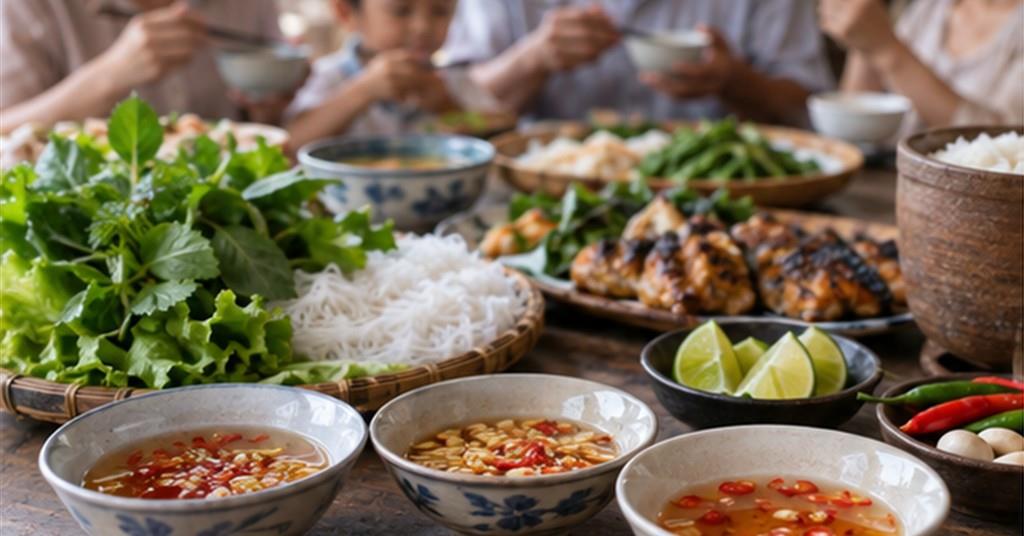 Fish sauce on the table across the three regions: from how it is mixed to what it is eaten with
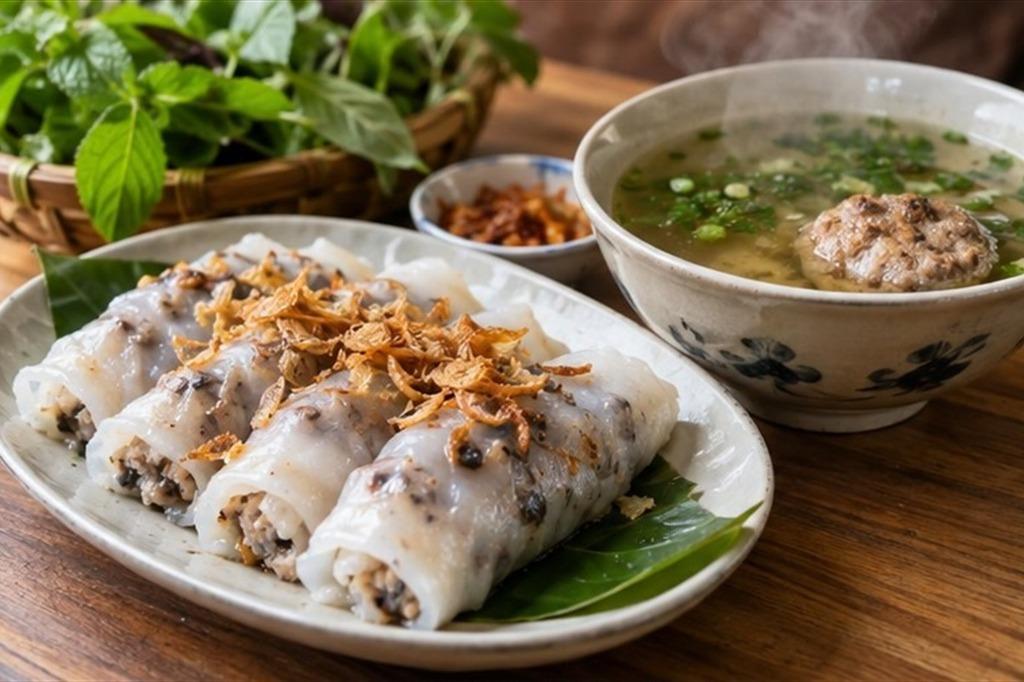 Cao Bang banh cuon: a thin rice sheet eaten with a bowl of hot broth on the frontier
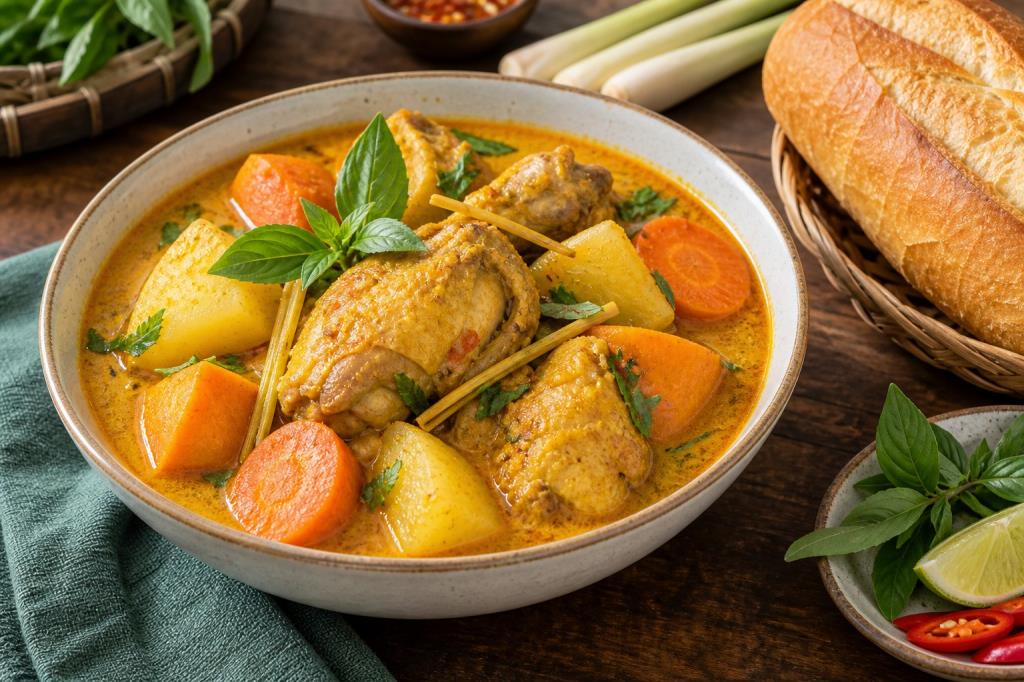 How to cook Vietnamese chicken curry: gently rich, tender meat and potatoes that hold together
 The coastal kitchen of central Vietnam: grilled fish, fermented sauce and getting through the storm season
Đăng nhập để bình luận: / Sign in to comment: