



The northern Vietnamese Tet table: from the pot of banh chung to the first family meal of the year
The northern Vietnamese Tet table is not recognised by banh chung, boiled chicken or pickled onion alone. Behind the dishes lies a schedule of preparation stretching over days, memories of gathering around the cooking pot, the way offerings are made to ancestors, and the wish for a household that wants for nothing as the new year begins.
The food in this article is seen as a living system: dishes are tied to climate, ingredients, labour, family memory and the ways people sit down together. So this is not a claim that an entire country has only one palate or one set of rituals. Every region, religion, community and household has its own versions, and each deserves respect.
Quick facts
- Settings: the family home, the clan hall and the round of new year visits.
- Common dishes: banh chung, boiled chicken, fried rolls, pork sausage, bamboo shoot soup, stir-fries and pickled onion.
- The rhythm of preparation: buying ingredients, wrapping the cakes, cooking the feast, making the offering and then eating together.
- Flavour: protein-rich dishes and sticky rice are balanced by soup, vegetables and pickles.
- Note: what goes on the table changes with the province, the family's means and its own customs.
How it came about
Tet is bound to the agricultural cycle, the moment that closes the old year and opens a new season. When work in the fields pauses, families repair the house, prepare food that will keep for days and set aside time for visits. The festive table therefore both feeds people and reorganises the relationships between the living, the ancestors and the community.
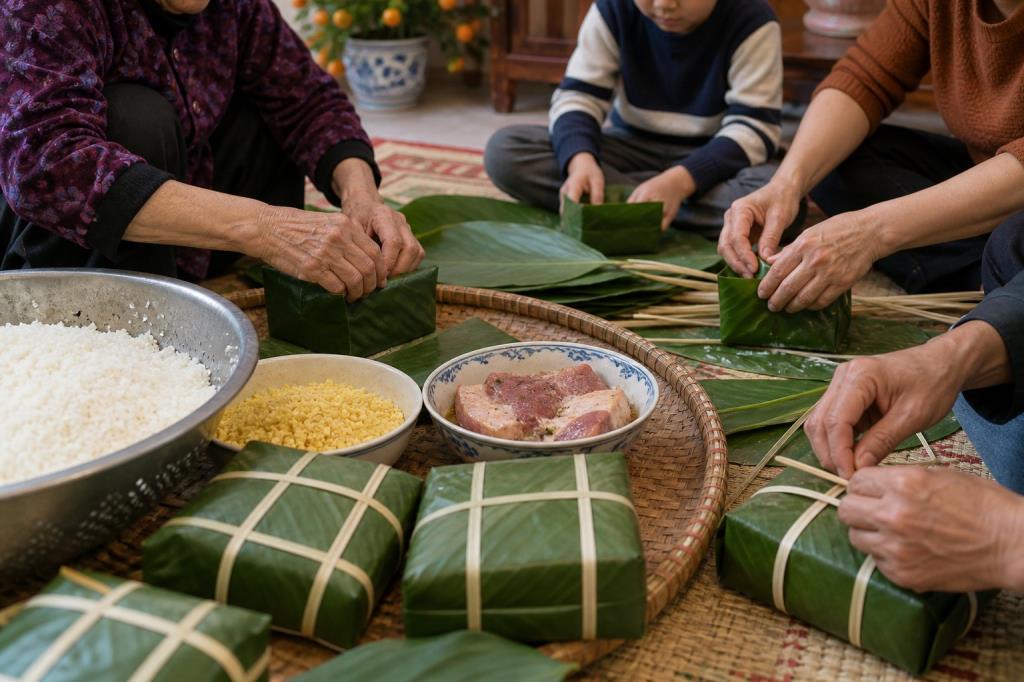
Banh chung is told through the legend of Lang Lieu, with sticky rice, mung beans, pork and dong leaves standing for the produce of a farming society. In practice, much of the cake's value also lies in collective work: washing the rice, preparing the beans, cleaning the leaves, tying the bindings and watching the pot for hours.
Not every northern household lays out the same number of bowls and plates. Four bowls with four plates, or six with six, appear often in traditional descriptions, but real life is always flexible according to region, the number of people, means and taste. What endures beyond the numbers is the idea of preparing with care and sharing.
How is a meal put together?
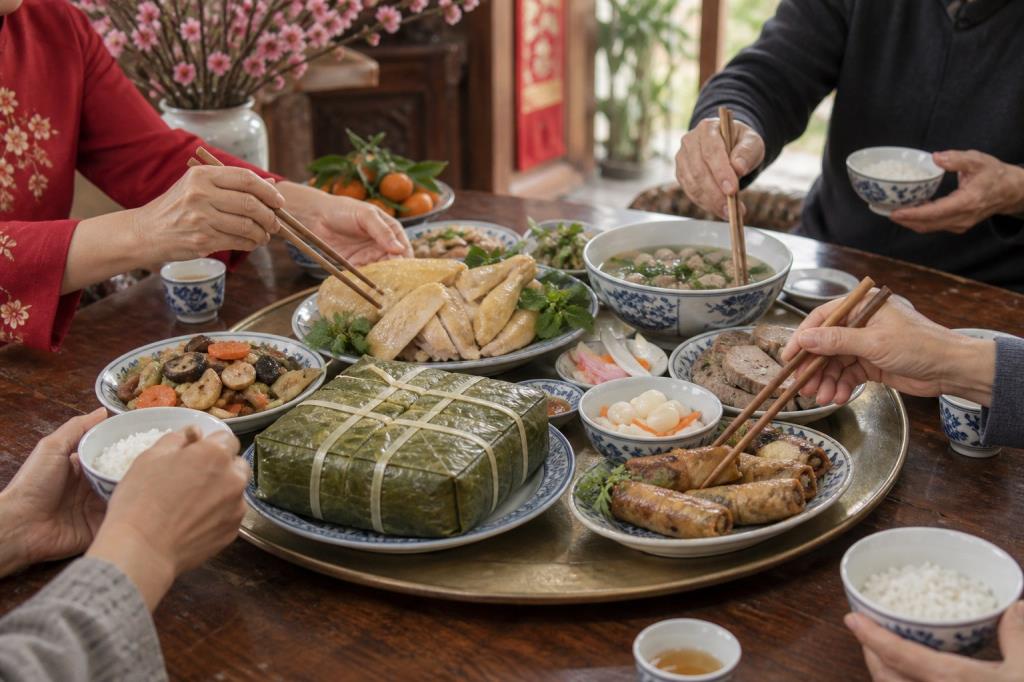
The table usually holds a group of cold or easily sliced dishes such as pork sausage and banh chung; hot dishes such as chicken, fried rolls and stir-fries; soups that balance the flavours, such as bamboo shoot, dried skin or glass noodle soup; and finally pickled onion and vegetables. The cook also thinks about colour, shape and how well each dish will hold through several rounds of guests.
Before the family eats, part of the feast may be placed on the altar according to belief and household custom. When the offering is taken down, the dishes return to the shared table. Children learn how to invite their grandparents to eat, adults serve one another, and the stories of the past year continue around the rice bowls.
The elements that make the character recognisable
- Banh chung is square, pressed firm, yet the grains of rice stay tender.
- Boiled chicken, whole or chopped onto a plate, is usually reserved for the more formal part of the feast.
- Pork sausage, plain or made from stir-fried parts, provides a cold dish that is convenient when guests arrive.
- Fried rolls bring a crisp texture and are usually made in batches.
- Bamboo shoot soup, dried skin soup or glass noodle soup provides the warm liquid element.
- Pickled onion, pickled scallion or salted vegetables cut through the richness.
The list above is a map for observing, not a formula that boxes anything in. An ordinary family meal may be far simpler, while a festival table is elaborate and full of symbolism. The cultural value lies as much in how things are chosen, prepared, divided and offered to one another as in the number of dishes.
Ingredients tell a story of geography
Winter and early spring in the north make root vegetables, dried bamboo shoots, shiitake, kohlrabi, carrots and hot dishes fit the season. Sticky rice, mung beans, dong leaves and pork connect the fields, the garden and the livestock; dried ingredients let a household stay self-sufficient while the markets are closed.
Craft villages making sausage, glass noodles, cakes and pickles supply part of the urban festive table, while many families still make the key dishes themselves. The Tet market is not only a place to buy and sell but a signal of the season: dong leaves, bamboo bindings, onions, bamboo shoots and flowers all appear at once.
The techniques that build the flavour
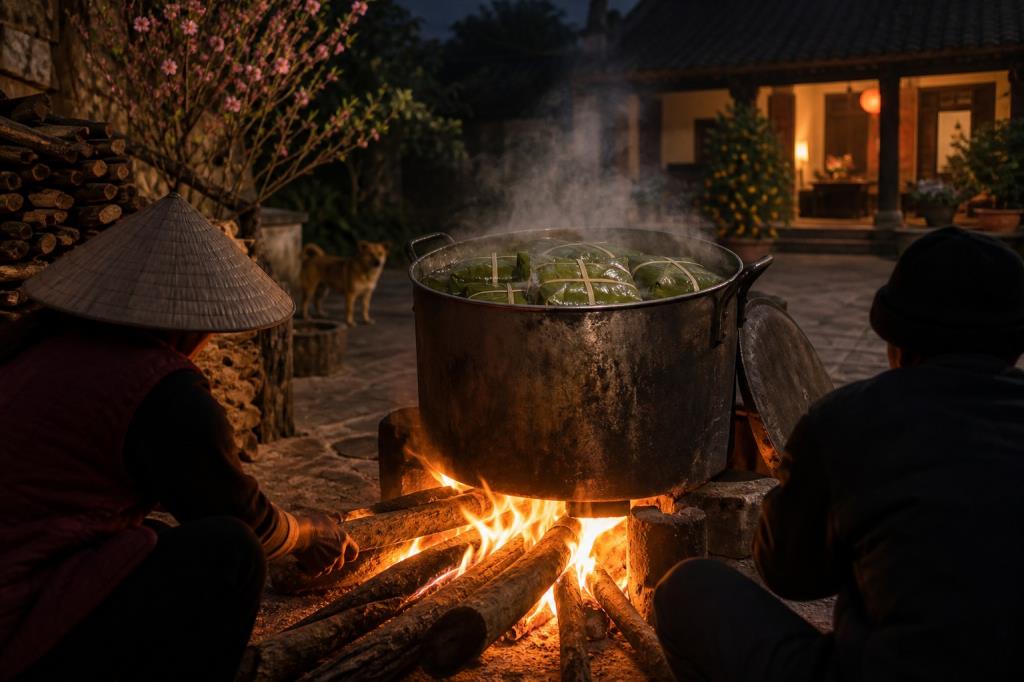
Wrapping banh chung means laying the leaves so nothing leaks, distributing rice, beans and pork evenly, and tying firmly enough for the cake to hold its shape while still swelling. The pot must always have enough water and a steady flame; once cooked, the cakes are washed and pressed so the surface is flat and the excess water drains away.
A good-looking boiled chicken depends not only on how it is shaped but on a moderate heat, so the skin does not split and the meat is safely cooked. Rolls should be wrapped evenly with a dry filling and fried in batches. Bamboo shoots need thorough preparation; the hot dishes are timed so they do not go cold or lose their texture during the offering and while guests are served.
Seen from the kitchen, a traditional technique is usually a community's answer to a very practical problem: making grain easier to eat, using up a harvest, extending how long food keeps, or building layers of aroma from a limited supply of fuel. When modern technology shortens a stage, the flavour may still be good, but the rhythm of the work, the sensory knowledge and the space in which the craft is handed on all change too.
The table, hospitality and good manners
The first feast of the year gives weight to seniority and to the act of inviting others to eat, though each family sets its own level of formality. Younger people usually invite grandparents and parents first; a guest is served the choicest pieces as a gesture of regard. Accept graciously, and say clearly if you have a restriction or an allergy.
- Ask the host before touching food that is being used as an offering.
- Wait for the elders or the host to invite you to begin.
- Use the serving chopsticks or reverse your own, according to the family's custom.
- Take a moderate amount and avoid digging through a dish for the best piece.
- Keep new year greetings and conversation cheerful, and avoid pressing anyone to eat or drink.
- If you help in the kitchen, take on one clear task such as washing leaves, watching the pot or laying out bowls.
Differences between regions and families
The Red River delta, the midlands, the coast and the big cities differ in their ingredients, their soups, their kinds of sausage and their pickles. A small household may reduce the spread; younger families add dishes that suit their health or order from a supplier they trust.
A modern Tet also includes vegetarian dishes, smaller portions and better ways of keeping food. Such changes need not cost the tradition anything, as long as the family still understands the meaning, takes part together and avoids turning the table into a contest of display.
The best approach is to use the name of the region, the community or the specific dish wherever you can. Very broad labels such as “Asian food”, “Middle Eastern cuisine” or “African dishes” are convenient in conversation but easily blur history and diversity. A dish that has crossed borders may also be kept alive by several communities at once; looking for a single “owner” is often less meaningful than understanding the branches along which it grew.
Common misconceptions
The more dishes on the table, the more traditional it is
Quantity is only one expression of it. A table that is sufficient, carefully cooked and matched to the number of people holds the spirit of reunion better than a crowded, wasteful one.
Banh chung is just something to eat
Wrapping and watching the pot create time for passing on the skill, telling stories and dividing the work between generations; that is a part of the culture you cannot see when you simply buy the finished cake.
Northern food is always bland
Many dishes aim at balance and at letting the ingredients speak, but braised dishes, fish sauce, pickles and fermented sauces still carry strong flavour. Tastes differ by region and by family.
A more respectful way to experience it while travelling
- If you are invited to a Tet meal at someone's home, arrive on time and ask in advance what gift would be appropriate.
- Do not photograph the altar or a ritual without asking first.
- Taste a dish before adding fish sauce, chilli or seasoning.
- Mention in advance any allergy to sticky rice, pulses, meat, mushrooms or fish sauce.
- Help clear up if the setting is informal and the host agrees.
- Praise a specific dish or step rather than comparing one household's table with another's.
If a host or someone serving shows you a way of eating that differs from your habits, watch first and then follow it as far as you are comfortable. You can politely ask about allergies, dietary needs or how hot something is. Ask permission before photographing people cooking, an altar, a ritual or a private space; prices and judgements about the food also belong in their local context.
Trying it at home without turning the dish into a stereotype
You can put together a small table of banh chung, boiled chicken, fried rolls, bamboo shoot soup and pickled onion. Work backwards from the serving time: pickles first, the cakes bought or wrapped early, the soup base prepared ahead, the rolls fried close to the meal. Portion it so there is enough of each dish to taste without a great deal left over.
Cooked food should be cooled and refrigerated early rather than left out on the table all day. Cut banh chung with clean bindings and wrap what remains tightly. When reheating, take only the amount you need, and do not mix fresh food with anything that has stood out for a long time.
A version cooked at home should honestly be called an adaptation when the equipment or the local ingredients are missing. Say clearly what you substituted and how it affects the aroma, the texture and the colour. If you want to go deeper, learn from the cooks, writers and communities attached to that tradition rather than relying on a short video or a commercialised version.
An observation checklist for the five senses
- At which stage does the aroma appear: toasting, grinding, fermenting, steaming or simmering?
- Is the dominant texture crisp, airy, chewy, smooth or juicy?
- Does the depth of flavour sit in the main dish, or does it come from the side dishes and the seasonings on the table?
- What part do the utensils, the crockery and the seating arrangement play?
- Who prepares the food, how is the knowledge passed on, and on what occasion does the meal take place?
Traditional food in modern life
Electric stoves, catering services and work schedules have made the scene of watching the pot less common in cities, but many neighbourhoods and schools organise communal wrapping sessions. Such an activity is meaningful when the participants genuinely learn the steps and respect safety, rather than using it only as a photo backdrop.
The table becomes more sustainable when you buy only what is needed, make sensible use of the poaching liquid and the ingredients, and share leftovers within safe limits. Reducing dishes that repeat the same protein and adding seasonal vegetables also makes the meal lighter without making it less dignified.
Preserving heritage does not mean freezing a dish at some imagined moment in time. Young people, migrants, home cooks and restaurants all keep adjusting portions, equipment, sources of ingredients and ways of serving. What matters is recognising the core body of knowledge, acknowledging those who pass the craft on, and creating the conditions for a community to decide for itself how its heritage moves forward.
Terms worth remembering
- Co: a meal prepared formally for a special occasion.
- Banh chung: a square sticky rice cake filled with beans and pork and wrapped in dong leaves.
- Ha le: taking down what has been offered so the family can eat it.
- Gio xao: a pressed dish made from stir-fried pork parts and wood ear.
- Dua hanh: pickled onions eaten alongside rich dishes.
- Canh mang: a soup made from fresh or dried bamboo shoots, depending on the household.
Conclusion
The northern Tet table is memorable not because it has to satisfy some unchanging list, but because each dish holds part of the time a family gave to one another. From the bundle of bindings to the plate of pickled onion, the first meal of the year connects the farming season, the ancestors and the hope for a peaceful year ahead.


 How to make Hoi An chicken rice: fluffy grains, juicy chicken and a crisp onion salad
 Me xung from Hue: chewy malt, toasted sesame and the slow rhythm of tea
 The food of Hue: where the royal kitchen, everyday dishes and small street stalls meet
 Hue vegetarian food: why is something so plain still so layered in flavour?
 How to cook hu tieu Nam Vang: a clear broth, sweet from the bones, with noodles that hold
 How to cook bun rieu cua: fragrant, with the crab curd in soft clouds and a clear broth
 Fish sauce on the table across the three regions: from how it is mixed to what it is eaten with
 Cao Bang banh cuon: a thin rice sheet eaten with a bowl of hot broth on the frontier
Đăng nhập để bình luận: / Sign in to comment: