



Mi Quang and the kitchens of Quang Nam: a bowl with little broth and a great deal of memory
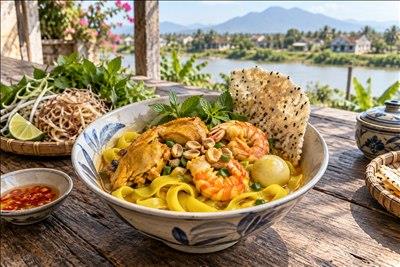
Mi Quang is easy to recognise by its wide noodles, its rich topping, the raw herbs, the peanuts and the rice cracker, but its most important characteristic is that only just enough broth is used. The bowl reflects the way people in Quang Nam concentrate flavour out of rice, the garden and whatever produce is at hand.
The food in this article is seen as a living system: dishes are tied to climate, ingredients, labour, family memory and the ways people sit down together. So this is not a claim that an entire country has only one palate or one set of rituals. Every region, religion, community and household has its own versions, and each deserves respect.
Quick facts
- Home ground: Quang Nam and the neighbouring parts of central Vietnam.
- Structure: rice noodles, a topping, a small amount of broth, herbs, peanuts and rice cracker.
- Common toppings: chicken, prawn and pork, snakehead fish, frog, or a vegetarian version depending on the place.
- The yellow colour may come from turmeric in the noodles or in the topping.
- It is both a home dish and a street dish; there is no single version.
How it came about
Quang Nam lies between mountains, plains, rivers and sea, with Hoi An once an important trading port. Rice is the foundation of both the noodles and the cracker; gardens supply the herbs and green banana; rivers, sea and livestock give rise to many kinds of topping.
There is no single origin story that everyone agrees on. What is more certain is that the dish has become a marker of local identity, appearing at memorial gatherings, family meetings, morning eateries and occasions for entertaining guests.
Using only a little broth suits the thick, wide noodles and the richly braised topping. The diner mixes so the liquid coats the strands rather than looking for a bowl full of soup. That proportion is exactly what sets the experience apart from many other noodle soups.
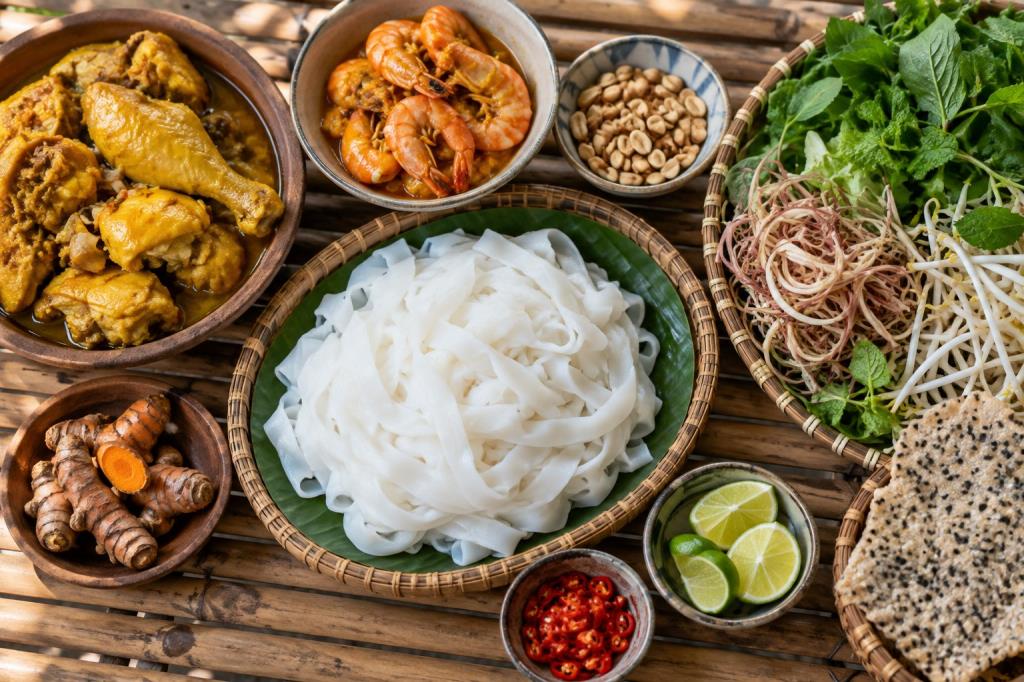
How is a meal put together?
Herbs may go in the bottom of the bowl, then the noodles, the topping and just enough broth to come partway up. On top go roasted peanuts, spring onion and herbs; the toasted sesame cracker is broken in as you eat to add crunch. Lime and chilli adjust things at the end.
A good bowl depends on the parts working together: noodles chewy enough to hold the liquid, a topping rich enough, herbs properly drained, fragrant peanuts and a cracker that is still crisp. It is still edible with one element missing, but the rhythm of soft, crisp, fresh and rich will be different.
The elements that make the character recognisable
- Wide noodles made from rice.
- Turmeric gives colour and aroma in many versions.
- The broth is rich but ladled sparingly.
- The raw herbs include many kinds of leaf according to season and locality.
- Roasted peanuts add a nutty note.
- The toasted sesame cracker adds sound and texture.
The list above is a map for observing, not a formula that boxes anything in. An ordinary family meal may be far simpler, while a festival table is elaborate and full of symbolism. The cultural value lies as much in how things are chosen, prepared, divided and offered to one another as in the number of dishes.
Ingredients tell a story of geography
The rice fields supply the grain for both noodles and crackers; the vegetable gardens around Hoi An, of which Tra Que is the best known, contribute many kinds of leaf; the hills and plains raise chickens; rivers, ponds and the sea widen the range of prawn and fish toppings.
In the rainy season the supply of herbs and the drying of crackers can change; the dry season suits cracker-making. Local markets link ingredients from the mountains down to the plains and the coast, which makes the bowl a product of a whole region rather than of one kitchen.
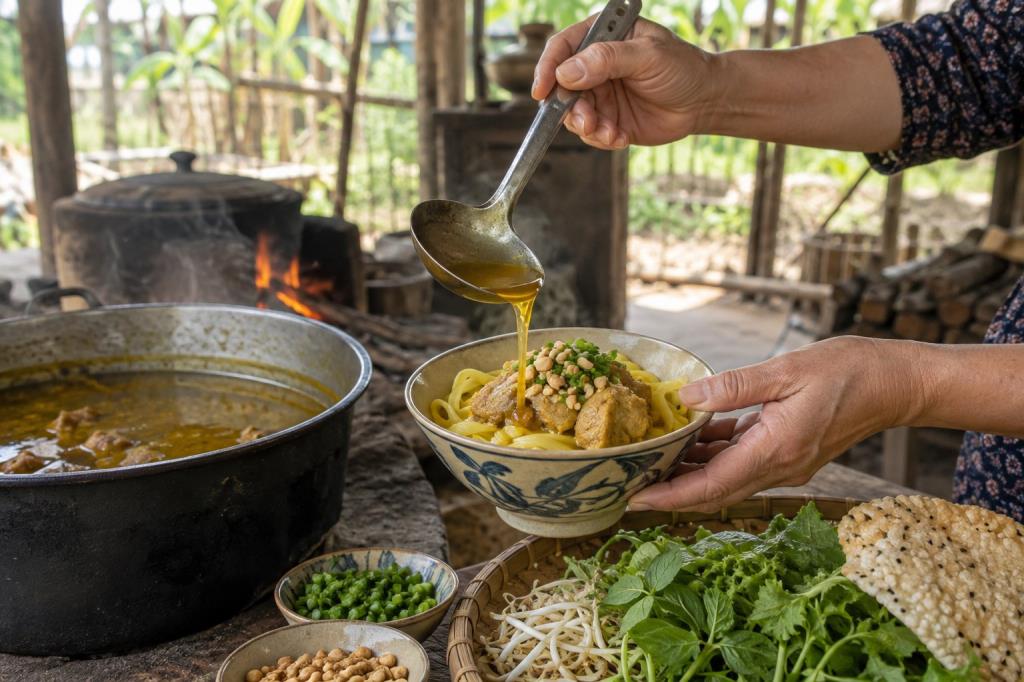
The techniques that build the flavour
The noodles need to be soft yet still have body, so they do not fall apart when mixed. The topping is braised until the seasoning clings to the meat or seafood; the broth takes its flavour from bones or from the main ingredient and is seasoned on the strong side, because so little of it is used.
The herbs are washed and thoroughly drained, then cut or left whole depending on the kind. Peanuts are roasted just to done and lightly crushed; the cracker is toasted close to serving. When the bowl is assembled, everything must be ready so the noodles do not wait long and the cracker has not drawn in moisture.
Seen from the kitchen, a traditional technique is usually a community's answer to a very practical problem: making grain easier to eat, using up a harvest, extending how long food keeps, or building layers of aroma from a limited supply of fuel. When modern technology shortens a stage, the flavour may still be good, but the rhythm of the work, the sensory knowledge and the space in which the craft is handed on all change too.
The table, hospitality and good manners
Mi Quang usually carries an informal, intimate air. The host may offer more topping, herbs or cracker; the diner mixes from the bottom up and tastes before adding seasoning. Breaking off only as much cracker as you need keeps the rest crisp for everyone else.
- Mix the bowl before judging whether there is too little or too much broth.
- Taste the broth before adding fish sauce.
- Break the cracker into small pieces rather than crumbling the whole basket.
- Take just enough herbs and help yourself to more later.
- Ask what the topping is if you have a prawn or peanut allergy or a particular diet.
- In a busy shop, state the size and the topping clearly to avoid confusion.
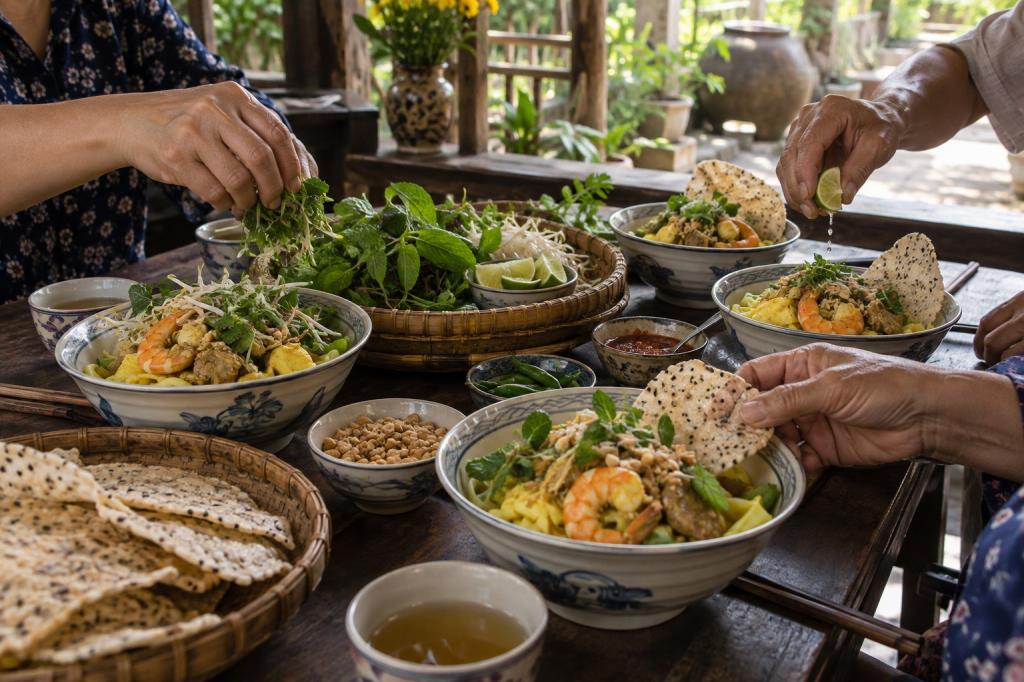
Differences between regions and families
Chicken mi from Tam Ky, prawn and pork mi, snakehead mi, frog mi and vegetarian mi all show how open the dish is. The noodles may be white or yellow, the broth differs in colour and richness, and the raw herbs change from district to district and with the season.
Away from home, mi Quang often substitutes the herbs or the cracker because of supply. An adapted version can still be good, but it is better to state what has changed than to insist every bowl must be the same.
The best approach is to use the name of the region, the community or the specific dish wherever you can. Very broad labels such as “Asian food”, “Middle Eastern cuisine” or “African dishes” are convenient in conversation but easily blur history and diversity. A dish that has crossed borders may also be kept alive by several communities at once; looking for a single “owner” is often less meaningful than understanding the branches along which it grew.
Common misconceptions
Mi Quang is a noodle soup that was short-changed on broth
The small amount of broth is a deliberate part of the structure. The rich liquid coats the noodles and links the topping to the herbs; filling the bowl would change both the proportions and the texture.
Only the prawn and pork version is the real thing
Chicken, fish, frog and vegetarian versions all have their place according to region and family. The identity lies in the whole rather than in one kind of topping.
The deeper the yellow, the better it tastes
Colour is only one signal. Quality depends on the rice, the chew of the noodles, the broth, the herbs and freshness; an overly strong colour is no substitute for flavour.
A more respectful way to experience it while travelling
- Try it in several districts or at family-run shops to see the variations.
- Do not ask for the bowl to be filled with broth before tasting it the way the shop serves it.
- Declare allergies to peanuts, prawns and fish sauce, and to gluten if the cracker contains blended flour.
- Ask which herbs are in season instead of demanding a fixed list.
- Support the local makers of noodles, crackers and herbs.
- Do not photograph the cook in a small kitchen without asking.
If a host or someone serving shows you a way of eating that differs from your habits, watch first and then follow it as far as you are comfortable. You can politely ask about allergies, dietary needs or how hot something is. Ask permission before photographing people cooking, an altar, a ritual or a private space; prices and judgements about the food also belong in their local context.
Trying it at home without turning the dish into a stereotype
Concentrate on three things: noodles at the right texture, a topping braised to the right richness, and well-drained herbs. Make the broth from the main ingredient, but ladle it on only a little at a time. Prepare the peanuts and the cracker last so they keep their aroma and crunch.
If the local herbs are unavailable, use a suitable group of herbs, lettuce, bean sprouts and green banana, and say clearly that it is an adaptation. Do not use food colouring in place of turmeric. Seafood and meat must be kept cold and cooked through safely.
A version cooked at home should honestly be called an adaptation when the equipment or the local ingredients are missing. Say clearly what you substituted and how it affects the aroma, the texture and the colour. If you want to go deeper, learn from the cooks, writers and communities attached to that tradition rather than relying on a short video or a commercialised version.
An observation checklist for the five senses
- At which stage does the aroma appear: toasting, grinding, fermenting, steaming or simmering?
- Is the dominant texture crisp, airy, chewy, smooth or juicy?
- Does the depth of flavour sit in the main dish, or does it come from the side dishes and the seasonings on the table?
- What part do the utensils, the crockery and the seating arrangement play?
- Who prepares the food, how is the knowledge passed on, and on what occasion does the meal take place?
Traditional food in modern life
Packaged dried noodles and restaurants in many provinces have carried the dish far. The challenge is to keep its characteristic proportions under the pressure of fast service, while still being able to tell where the herbs, the rice and the crackers come from.
Food tourism can support craft villages if the value chain returns to the growers and the makers. Sensible portions, ordering crackers in rounds and cutting down on single-use plastic are practical steps.
Preserving heritage does not mean freezing a dish at some imagined moment in time. Young people, migrants, home cooks and restaurants all keep adjusting portions, equipment, sources of ingredients and ways of serving. What matters is recognising the core body of knowledge, acknowledging those who pass the craft on, and creating the conditions for a community to decide for itself how its heritage moves forward.
Terms worth remembering
- Mi Quang: a rice noodle dish with a rich topping and little broth.
- Nuoc nhan: the liquid cooked with the topping and ladled over.
- Banh trang me: a rice cracker with sesame, toasted crisp.
- Rau song: an assortment of leaves, bean sprouts and green banana according to the season.
- Cu nen: an allium seasoning used in central Vietnam.
- Xu Quang: a name for the cultural region of Quang Nam and its historical connections.
Conclusion
A bowl of mi Quang tells its story through proportion: little broth but no shortage of flavour, thick noodles alongside fresh herbs, a rich topping cut through by lime and a crisp cracker. To understand the dish is to understand how people in Quang Nam bring local ingredients together in a bowl that is at once plain and tightly composed.


 Mi Quang and the kitchens of Quang Nam: a bowl with little broth and a great deal of memory
 Bo Dau banh chung: the green square cake at the crossroads into Thai Nguyen
 How to cook ca loc nuong trui: evenly done, juicy flesh and no taste of ash
 How to make Hoi An chicken rice: fluffy grains, juicy chicken and a crisp onion salad
 Me xung from Hue: chewy malt, toasted sesame and the slow rhythm of tea
 The food of Hue: where the royal kitchen, everyday dishes and small street stalls meet
 Hue vegetarian food: why is something so plain still so layered in flavour?
 How to cook hu tieu Nam Vang: a clear broth, sweet from the bones, with noodles that hold
Đăng nhập để bình luận: / Sign in to comment: