



The Voynich Manuscript: A 600-year-old book no one can read
More than a century after Wilfrid Voynich brought the book to the antiquarian book market, the writing system in the manuscript remains undeciphered by any method accepted by experts.
Beinecke MS 408 is currently housed at Yale University's Beinecke Library. Material analysis dates the vellum to the early 15th century; the illustrations are generally divided into botanical, astronomical, balneological, pharmaceutical, and formula-like sections.

Verifiable facts
1. The pages use a character system with repetitive patterns and a distribution similar to language, but it does not match any known alphabet with certainty.
This fact helps narrow the scope of speculation: a solution is only credible when it fits the entire artifact, its dating, the order of symbols, and the archaeological or archival context. Finding a few words that seem to make sense is not enough to prove the entire system.
2. The ink, pigments, and bookbinding structure are consistent with a historical artifact; this weakens the theory of a simple modern hoax.
This fact helps narrow the scope of speculation: a solution is only credible when it fits the entire artifact, its dating, the order of symbols, and the archaeological or archival context. Finding a few words that seem to make sense is not enough to prove the entire system.
3. Some pages are missing and the order of the folios may have been altered, making it harder to reconstruct the original structure.
This fact helps narrow the scope of speculation: a solution is only credible when it fits the entire artifact, its dating, the order of symbols, and the archaeological or archival context. Finding a few words that seem to make sense is not enough to prove the entire system.
4. The plant illustrations have familiar details but are generally not sufficient to identify the species, so the drawings cannot be used as a reliable "dictionary."
This fact helps narrow the scope of speculation: a solution is only credible when it fits the entire artifact, its dating, the order of symbols, and the archaeological or archival context. Finding a few words that seem to make sense is not enough to prove the entire system.
5. Many claims of having cracked the code have only produced a few sentences and failed when applied consistently to the entire manuscript.
This fact helps narrow the scope of speculation: a solution is only credible when it fits the entire artifact, its dating, the order of symbols, and the archaeological or archival context. Finding a few words that seem to make sense is not enough to prove the entire system.
Why is it still unsolved?
- There is no bilingual equivalent like the Rosetta Stone to link the symbols to a known language.
- The underlying language, encryption system, or the possibility that the text is a specialized symbol system has not been determined.
- The text is long but contextual data is very scarce: there is no confirmed author, location, or draft.
In historical cryptography, a lack of data is often more dangerous than a lack of computing power. Computers can test millions of keys, but they cannot automatically choose the right language, the right reading direction, and the right rules if those premises have not been established.
Main theories
Theory 1
A natural language written in an unknown alphabet or using shorthand rules.
Theory 2
A specialized text on medicine, astrology, or health concealed by encryption.
Theory 3
A text created with rules but containing no complete linguistic content; this theory remains a subject of debate.
What is often exaggerated
The most certain thing is that the artifact is genuinely old and the character system is undeciphered. There is no credible evidence for extraterrestrials, prophecies, or a "complete translation" currently circulating online.
A cautious approach is to separate three layers: what the artifact directly shows, what researchers infer with evidence, and what is merely popular imagination. These three layers can make the story compelling, provided they are not conflated.
Conclusion
The value of the mystery does not lie in choosing the most sensational solution, but in the ability to test a hypothesis with independent data. Until a decryption key, a parallel text, or a repeatable method appears, this file should still be considered as having no unified solution.



 UVB-76: The Mysterious Buzzing Sound Broadcast for Decades on 4625 kHz
 Tunguska 1908: What Exploded in the Skies Over Siberia?
 The Wow! Signal: 72 Seconds That Kept Humanity Listening to the Cosmos for Half a Century
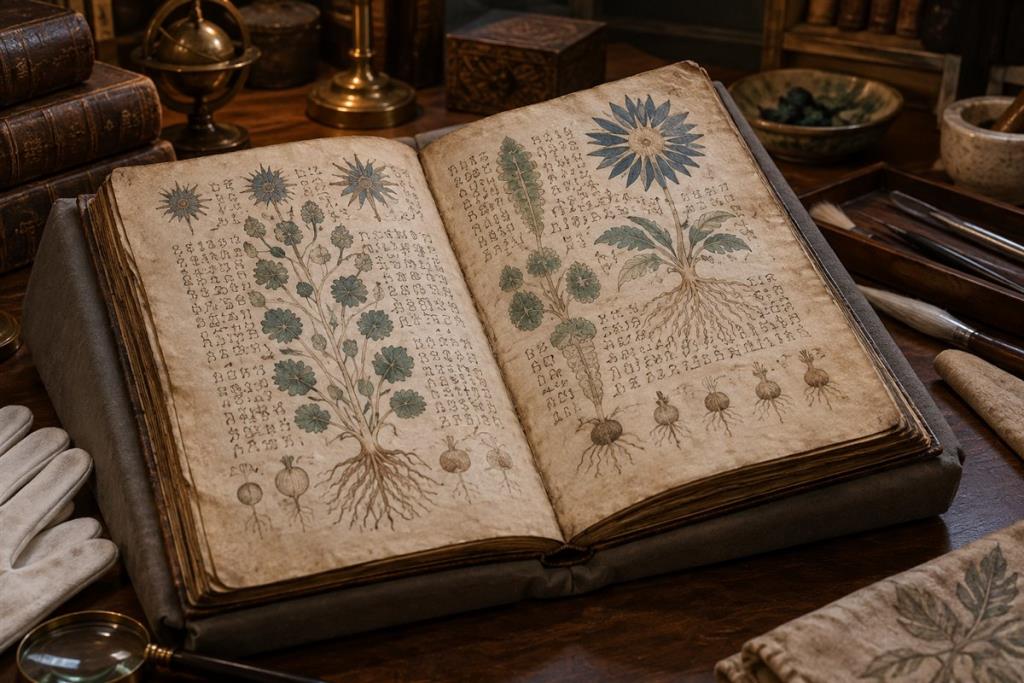 The Voynich Manuscript: A 600-year-old book no one can read
 The Phaistos Disc and the 241 Mysterious Symbols of the Minoan Civilization
 The Hessdalen Lights: Strange Orbs Continue to Appear Over a Norwegian Valley
 Bloop: The colossal sound under the Pacific and the answer from Antarctic ice
 Linear A: The Lost Script of Crete
Đăng nhập để bình luận: / Sign in to comment: