



Linear A: The Lost Script of Crete
While Linear B has been deciphered as Mycenaean Greek, its predecessor, Linear A, still keeps the language of the Minoans shrouded in secrecy.
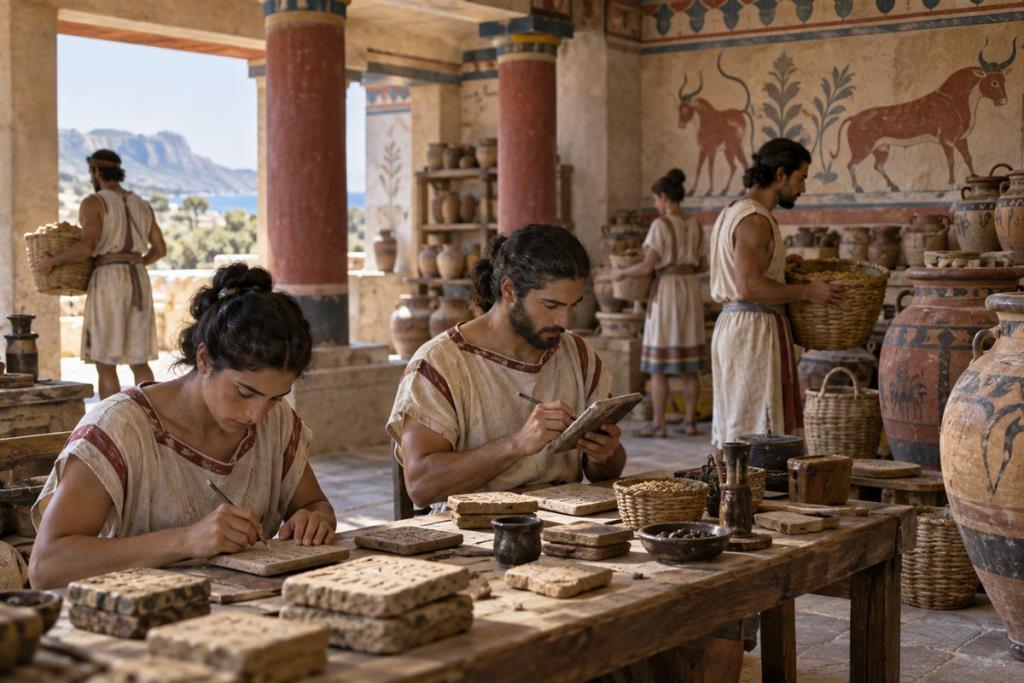
Linear A appears on clay tablets, vessels, and various artifacts across Crete and several Aegean islands, dating primarily from the second millennium BCE. While formally related to Linear B, it cannot simply be read using the phonetic values of Linear B.
Verifiable Facts
1. The corpus consists mostly of short fragments, typically ledgers, labels, or administrative records.
This evidence helps narrow down the scope of speculation: a decipherment is only credible when it aligns with all artifacts, dating, sign sequences, and archaeological or archival contexts. Finding a few seemingly meaningful words is insufficient to validate the entire system.
2. Certain signs and numbers can be identified relatively well through accounting structures and their continuation into Linear B.
This evidence helps narrow down the scope of speculation: a decipherment is only credible when it aligns with all artifacts, dating, sign sequences, and archaeological or archival contexts. Finding a few seemingly meaningful words is insufficient to validate the entire system.
3. When applying Linear B phonetic values to Linear A, researchers obtain hypothesized phonetic strings, but most do not yield meaningful Greek.
This evidence helps narrow down the scope of speculation: a decipherment is only credible when it aligns with all artifacts, dating, sign sequences, and archaeological or archival contexts. Finding a few seemingly meaningful words is insufficient to validate the entire system.
4. The distribution of findspots indicates that the script was used across multiple centers, rather than being confined to a single site.
This evidence helps narrow down the scope of speculation: a decipherment is only credible when it aligns with all artifacts, dating, sign sequences, and archaeological or archival contexts. Finding a few seemingly meaningful words is insufficient to validate the entire system.
5. The SigLA database allows for the systematic comparison of sign shapes, scribal variants, and occurrences, rather than relying on a single transcription.
This evidence helps narrow down the scope of speculation: a decipherment is only credible when it aligns with all artifacts, dating, sign sequences, and archaeological or archival contexts. Finding a few seemingly meaningful words is insufficient to validate the entire system.
Why Does It Remain Undeciphered?
- Most inscriptions are too short to reconstruct a grammar.
- The Minoan language has not been definitively linked to any known language family.
- No extensive bilingual text paired with a readable script has been found.
In historical cryptanalysis, a lack of data is often far more detrimental than a lack of computing power. Computers can test millions of keys, but they cannot independently discern the correct language, reading direction, or grammatical rules unless those premises are firmly established.
Major Hypotheses
Hypothesis 1
Linear A records an indigenous Cretan language that is non-Greek.
Hypothesis 2
The language may be connected to an Anatolian or broader Mediterranean group, but the available evidence remains insufficient to single out a candidate.
Hypothesis 3
Certain loanwords and toponyms may have survived in Greek even after the primary language disappeared.
Common Misconceptions
Researchers can partially read the numerical system and deduce administrative functions, but they cannot yet translate Linear A into complete sentences. "Pronouncing the signs" based on Linear B values does not equate to understanding the language.
A prudent approach distinguishes among three tiers: what the artifacts directly reveal, what researchers reasonably infer, and what belongs to popular imagination. All three can contribute to an engaging narrative, provided they are not conflated.
Conclusion
The true value of an enigma lies not in choosing the most sensational explanation, but in the capacity to test a hypothesis against independent data. Until a definitive key, a parallel bilingual text, or a reproducible methodology emerges, this script must be regarded as having no consensus decipherment.



 Jamaican jerk: the scent of pimento, the smoke pit and a community's living heritage
 Korean kimchi and banchan: the craft of fermentation and a table built on sharing
 Persian rice and tahdig: saffron, a crisp bottom layer and the sofreh
 Moroccan couscous and tagine: rhythm, hospitality and the flavours of North Africa
 Brazilian feijoada: a pot of black beans, a weekend lunch and a story with many roots
 The Indian thali: a balanced tray that tells a regional story and a way of eating together
 Danish smørrebrød: the open sandwich and the art of composing a lunch
 Swiss raclette: melted cheese and a shared table in the cold season
Đăng nhập để bình luận: / Sign in to comment: