



Fairy Circles in Namibia: Footprints of the Gods, Sand Termites, or a Battle for Water?
Across a long strip of the Namib Desert, millions of nearly circular barren patches lie evenly spaced across a grassy carpet. Seen from above, they resemble a grid drawn with a compass. Legend calls them the footprints of the gods; modern ecology, however, is witnessing a fierce debate between sand termites and self-organizing grasses fighting for survival.
The circles appear, grow larger, and can eventually be reclaimed by grass after several decades. They are concentrated in extremely arid sandy soils, where a brief rainfall event determines the entire growing season. Their circular shape and regular spacing suggest a feedback mechanism rather than random burn marks.
The Sand Termite Hypothesis
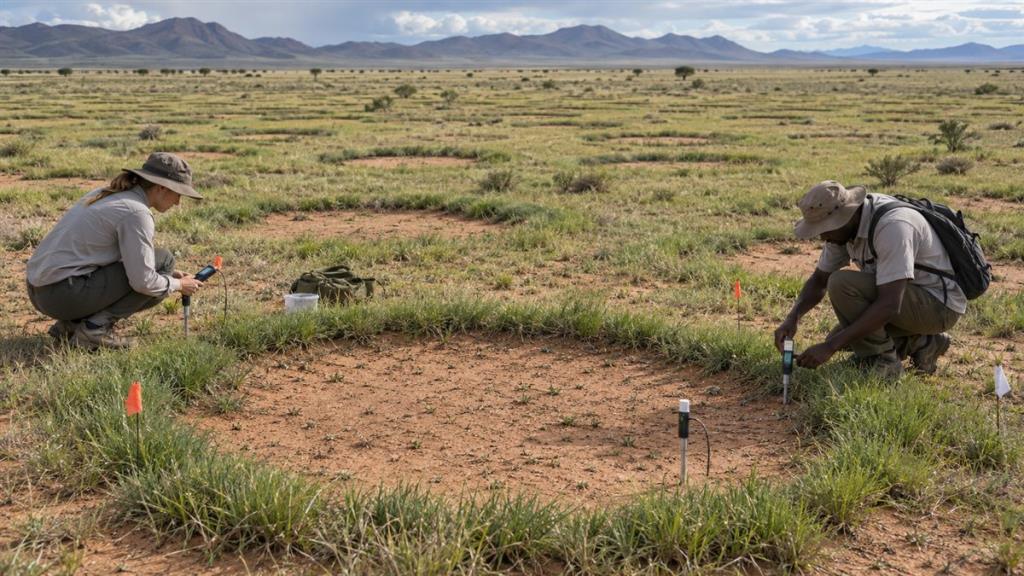
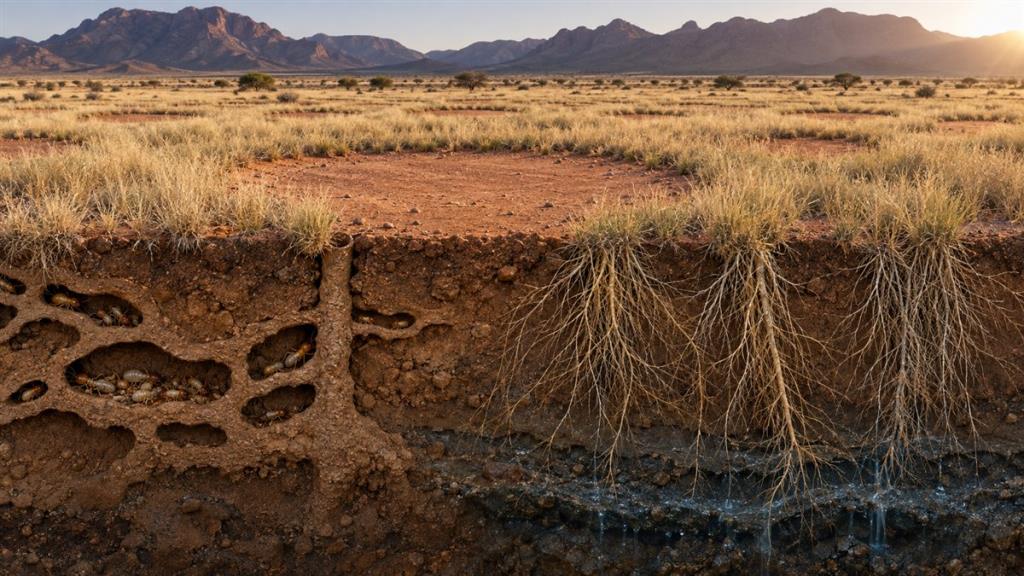
Psammotermes termites live underground, chewing on roots and maintaining a barren clearing directly above their nests. This opening reduces moisture loss through plant transpiration, allowing rainwater to penetrate deeper and sustain the colony. Many surveys have found termites beneath the circles, but critics question whether they are the primary cause or merely opportunistic arrivals after the grass has died.
The Plant Self-Organization Hypothesis
In the water competition model, mature grass roots around the perimeter draw moisture from the barren patch. At short distances, plants facilitate each other's growth, while over longer distances, they compete fiercely, producing a quasi-hexagonal pattern akin to other self-organizing systems. Measuring soil moisture post-rainfall and inspecting the condition of young roots have become crucial battlegrounds for empirical evidence.
There May Be More Than One Answer
Circles observed in Australia resemble those in Namibia, yet the soil context and Martu Indigenous knowledge point to distinct roles for termite-engineered surfaces. Identical geometries can arise from diverse ecological processes, or termites and vegetation might generate coupled feedbacks. The mystery, therefore, is not simply about "who is right," but rather which mechanism dominates in a given region and timeframe.
The Lifecycle of a Fairy Circle
Aerial photography demonstrates that new circles emerge, expand, stabilize, and eventually fade as grasses recolonize. Their lifespans vary depending on size and climatic zone. This observation contradicts the idea of permanent toxic soil patches, while simultaneously providing vital data to test models: a correct mechanism must reproduce both the birth and death of a circle.
Following rains, moisture sensors deployed at various depths and root excavations of young seedlings offer crucial clues. If roots are severed before the plant perishes, the termite hypothesis gains weight; if roots remain intact while the plant wilts due to horizontal water suction, plant self-organization is favored. The timing of sampling is decisive, as decomposing termites may only arrive after the fact.
Order Arising from Competition
In water-scarce environments, neighboring plants provide shade to conserve surface moisture, but they simultaneously compete for the same meager water reserves. Local feedbacks can spontaneously generate regular spacing without any central "commander," analogous to animal coat patterns or Turing chemical structures. However, an elegant computer model is not enough; its parameters must closely match real-world infiltration rates and spatial distribution measured in the field.
On the termite side, neighboring colonies competing for territory can likewise generate quasi-hexagonal distributions. Inter-nest distances, moisture levels within bare discs, and tunnel networks represent measurable predictions. The two mechanisms might even amplify each other.
Why Does Australia Complicate the Debate?
Gaps in the Pilbara landscape appear remarkably similar from the air, but collaborative research with the Martu people has identified many surfaces as "pavements" linked to termite construction and hardpan layers. This serves as a reminder that labels assigned purely via satellite imagery can conflate structures of entirely different origins.
Indigenous knowledge preserves names, animal tracks, and land-use histories that brief scientific expeditions lack. Combining this oral wisdom with stratigraphic excavations and remote sensing constructs a far richer picture than merely treating the terrain as an uninhabited geometric exercise.
From Mysterious Lore to Testable Records
A gripping tale often begins at a moment of sheer wonder, but a scientific investigation must reconstruct what happened before and after that pivotal instant. Researchers build timelines, locate the earliest records closest to the event, preserve raw photo files, and flag details that only surface in late recollections. A single detail echoed across hundreds of pages may still trace back to just one unverified source.
When studying natural phenomena, "failure to find" must be carefully contextualized. Failing to find meteorite fragments after decades in a swamp is entirely different from finding nothing in an undisturbed survey grid the very next morning. A northern-facing camera recording no flashes says nothing about the southern sky. The scope of the search must always qualify the conclusions drawn.
Measuring Geometry, Velocity, and Energy
Angular dimensions on an image only translate into true physical size once distance is established. Velocity similarly requires accurate distance and elapsed time, while energy is typically deduced from environmental impacts. A single miscalculation among the three can turn car headlights into a hypersonic craft or a minor chemical flare into a gargantuan power source.
Calibration is an unsung yet decisive step. Cameras must account for lens distortion; thermal sensors demand baseline references; multi-station clocks must be synchronized; and chemical samples require field blanks to screen for contamination. These granular procedures lack the drama of a striking photograph, but they delineate the boundary between mere suspicion and empirical evidence.
Good Models Must Embrace Falsification
A scientific hypothesis does not merely recount what has already been observed; it predicts what has yet to be measured. If ice sheets propel sliding stones, movement must coincide with shallow water, subfreezing nights, and sustained winds; if thermal convection forms ground rings, corresponding thermal signatures and convective currents must exist below the center. An invalid prediction forces a model to be refined or discarded outright.
Different models may each hold true under varying circumstances. Nature is under no obligation to deploy a single mechanism for every glowing orb, circular soil clearing, or peculiar cloud formation. Precise categorization often constitutes greater progress than forcing an all-encompassing answer.
The Role of Probability and Rarity
A chain of environmental conditions, none of which is extraordinary on its own, can become vanishingly rare when all must coincide simultaneously. This explains why certain phenomena leave unmistakable physical traces yet yield very few direct eyewitnesses. It also introduces observer bias: an investigator waiting for years is prone to over-interpreting events that resemble their expectations, while equipment failing at an inopportune moment leaves tantalizing gaps.
Automated sensor networks and satellite datasets reduce reliance on serendipity. Even so, detection algorithms can produce false positives; every automated alert still demands verification against raw imagery and known sources. A vast volume of data does not automatically equate to high-quality evidence.
When Can a Mystery Be Declared Solved?
A robust solution reconstructs the underlying mechanism, aligns with multiple independent lines of evidence, and leaves no critical anomalies unaccounted for. It also explains why the phenomenon is rare, localized, and seasonal. For ancient or weathered traces, science can sometimes only deliver the "most plausible explanation," as the decisive initial data have been lost to time.
Unraveling a overarching mechanism does not mean knowing every historical event in detail. We may understand that the Racetrack Playa stones move via floating ice sheets without knowing the exact calendar date each individual furrow was carved; we can confirm the red hue of Blood Falls stems from oxidized iron while still mapping its subglacial plumbing. Precise, measured language preserves the genuine wonder of the natural world.
Preserving Sites Means Preserving Data
Tire tracks on a desert playa, footsteps across fragile thin ice, soil cores gouged indiscriminately from fairy circles, or artificial lights aimed across an isolated valley can irrevocably corrupt field data. Visitors should stick strictly to permitted routes, leave all natural objects untouched, and never fabricate "evidence" for social media photos. A fabricated mark can circulate online long after the real landscape has been spoiled.
Respecting local communities is equally essential. Indigenous inhabitants are not mere background characters in a travel narrative; they hold observational histories, place names, and profound ecological understanding. Exemplary research returns its findings and conservation benefits directly to the communities where the phenomena occur.
A Checklist for Evaluating New Claims
When confronted with a sensational video or "earth-shattering" headline, one should ask six fundamental questions: Are the original, uncompressed files accessible? Can the exact time and GPS coordinates be independently verified? Are there mundane flight paths, light fixtures, or local weather anomalies that match the sighting? Was the physical size measured directly or merely guessed? Have independent specialists scrutinized the primary data? And has the claimant clearly defined what evidence would prove them wrong? Missing one criteria does not instantly invalidate a claim, but the more gaps that exist, the lower the confidence level should be.
It is equally crucial to differentiate between peer-reviewed publications, unreviewed preprints, institutional press releases, and viral anecdotes online. A single study is merely a starting point, particularly when dealing with small sample sizes or a unique field site. Scientific consensus forms only when diverse, independent methodologies converge—not when a convenient soundbite gets shared millions of times.
The Elements of Wonder Worth Keeping
Methodological rigor does not strip a story of its poetry. The breathtaking moment an entire forest flattens at once, a silent orb of light hangs suspended over a quiet valley, or an icy brinicle plunges toward the ocean floor can still send chills down the spine, even when governed by clean physical equations. The sensation of awe is why we ask questions in the first place; empirical evidence is how we ensure our answers do justice to the reality we set out to understand.
Across every frontier of inquiry, the unresolved elements should be preserved as open questions rather than papered over with sweeping declarations. Whether it concerns the exact isotopic composition of a fragment, the quantitative interplay between dual ecological drivers, a hidden geothermal vent beneath the ice, or precise meteorological trigger thresholds, these named, measurable knowledge gaps represent the true mysteries awaiting future generations to unravel.
How a Phenomenon Becomes a "Mystery"
Rare natural occurrences typically unfold rapidly, happen in remote terrain, or strike during extreme weather that cripples delicate equipment. Eyewitnesses often catch only a fleeting angle, and human memory inevitably fills in narrative blanks over repeated retellings. Once an initial photograph goes viral, disparate phenomena are easily lumped together under a single sensational umbrella. Thus, the primary scientific inquiry is not simply "what is it?" but "are we observing one single phenomenon or several distinct ones?"
A rigorous observation demands an exact timestamp, precise coordinates, azimuth heading, focal length, meteorological readings, and raw data files. An image with prominent landmarks allows for angular size estimation; dual cameras spaced apart permit trigonometric parallax calculations; light spectroscopy reveals elemental compositions and surface temperatures. Heavily compressed video clips shared online may look impressive, but they have almost always stripped away the exact metadata required for forensic verification.
Distinguishing What Is Possible from What Actually Happened
Replicating a phenomenon under laboratory conditions merely demonstrates that a theoretical mechanism is physically viable. To confirm that the identical process occurred in nature, the model must faithfully predict observed event durations, energy budgets, physical morphologies, atmospheric conditions, and the post-event physical scars. If a proposed hypothesis explains an optical color shift but fails to account for kinetic motion, the model remains fundamentally incomplete.
Conversely, the absence of an exhaustive explanation does not render all hypotheses equally plausible. A theory grounded in established physics, yielding testable predictions, and standing up to empirical scrutiny carries vastly more weight than unfalsifiable conjecture. The label "unidentified" denotes current limitations in data collection, not the signature of a supernatural event.
Common Misidentifications in the Field
Estimating physical distance in pitch darkness is notoriously treacherous. Bright stars, planets, aircraft beacons, orbital satellites, headlights distorted through atmospheric inversion layers, and insects fluttering close to the camera lens can all manifest as bizarre anomalies. Long exposures smear single point lights into apparent luminous trails; digital image stabilization creates unnatural differential motion between foreground and background; internal lens flares project ghost "orbs" that drift synchronously with camera movement.
In geomorphology and landscape ecology, circular formations naturally evoke impressions of deliberate design. Yet convective fluid motion, shockwaves, resource competition, and isotropic propagation rates inherently generate rings, discs, and repeating lattices. Geometric regularity is not, in itself, evidence of external design; what must be quantified is the dynamic mechanism sustaining the pattern across seasonal time scales.
Which Scientific Questions Are Still Worth Pursuing?
A constructive scientific question must directly yield a falsifiable field test: which specialized sensors must be deployed, which soil cores collected, and which contradictory data points would refute the working hypothesis. For ephemeral events, continuously operating autonomous sensor arrays are infinitely more valuable than brief field expeditions. For landscape patterns, decadal high-resolution satellite imagery reveals critical lifecycles and seasonal variance.
Scientific inquiry does not dilute the inherent magic of nature. A massive boulder skimming across a mudflat propelled by delicate ice sheets, a columnar vortex creating lake ice rings kilometers wide, or resilient extremophiles flourishing in pitch-black, hypersaline subglacial aquifers are far more wondrous than sensational myths. The decisive difference is that we know which facets have been verified by measurement—and which remain uncharted.
Reading New Findings with a Critical Eye
Whenever headlines proclaim that an enigma has been "completely cracked," inspect the publication date, the issuing institution, the methodology, and whether the data have undergone independent replication. Media outlets frequently inflate a "statistically consistent model" into a definitive "mystery solved." Conversely, sensational storytellers routinely discard dozens of successfully identified cases simply to showcase the few ambiguous outliers that keep suspense alive.
Trustworthy scientific conclusions are characterized by explicit boundaries: they clearly define what the findings account for, what remains unexplained, and the exact boundary conditions under which the hypothesis would break down. It is precisely these honest frontiers of knowledge that keep human curiosity vibrant without sacrificing empirical truth.
Staying Safe Around Unexplained Phenomena
Never jeopardize personal safety for the sake of a viral photograph by stepping onto fragile ice, traversing exposed terrain during electrical storms, trespassing across protected reserves, or collecting unauthorized samples in hazardous environments. Observing from a safe vantage point while rigorously recording the timestamp and viewing orientation yields far greater scientific value than a hurried, extreme close-up devoid of geographical context. Delicate geological formations must be left undisturbed so that natural traces are not corrupted by trampling footprints, tire tracks, or discarded personal gear.



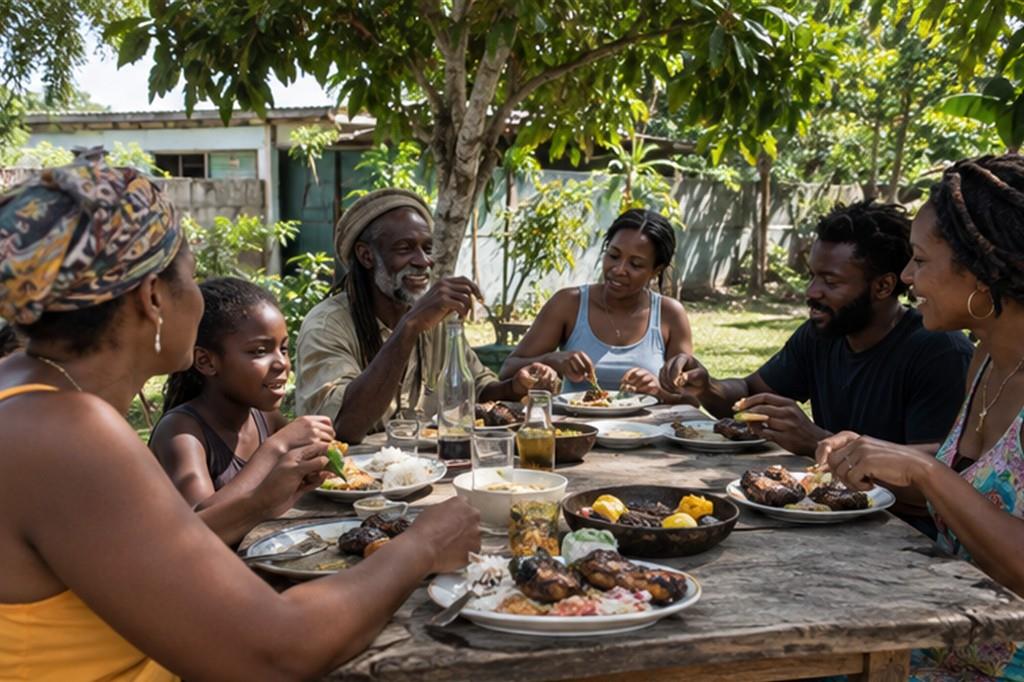 Jamaican jerk: the scent of pimento, the smoke pit and a community's living heritage
 Korean kimchi and banchan: the craft of fermentation and a table built on sharing
 Persian rice and tahdig: saffron, a crisp bottom layer and the sofreh
 Moroccan couscous and tagine: rhythm, hospitality and the flavours of North Africa
 Brazilian feijoada: a pot of black beans, a weekend lunch and a story with many roots
 The Indian thali: a balanced tray that tells a regional story and a way of eating together
 Danish smørrebrød: the open sandwich and the art of composing a lunch
 Swiss raclette: melted cheese and a shared table in the cold season
Đăng nhập để bình luận: / Sign in to comment: