



How Did the Sailing Stones of Death Valley Move?
Across the dry lake bed of Racetrack Playa in Death Valley, stones sit at the ends of long trails as if they crept through the mud when no one was looking. Some weigh hundreds of kilograms, with paths that veer abruptly or run strictly parallel. For decades, gale-force winds, magnetic fields, and elaborate hoaxes were all blamed.
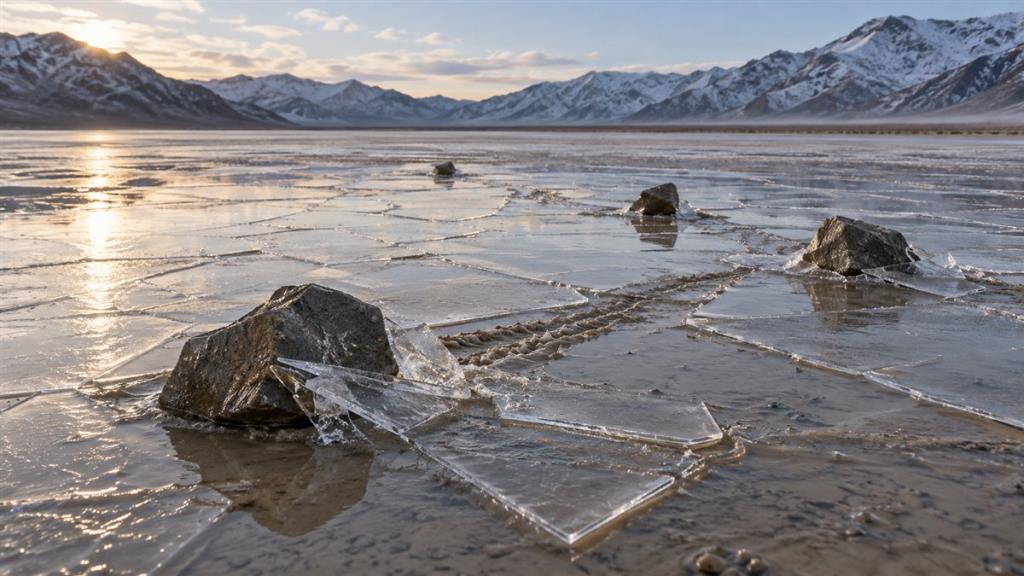
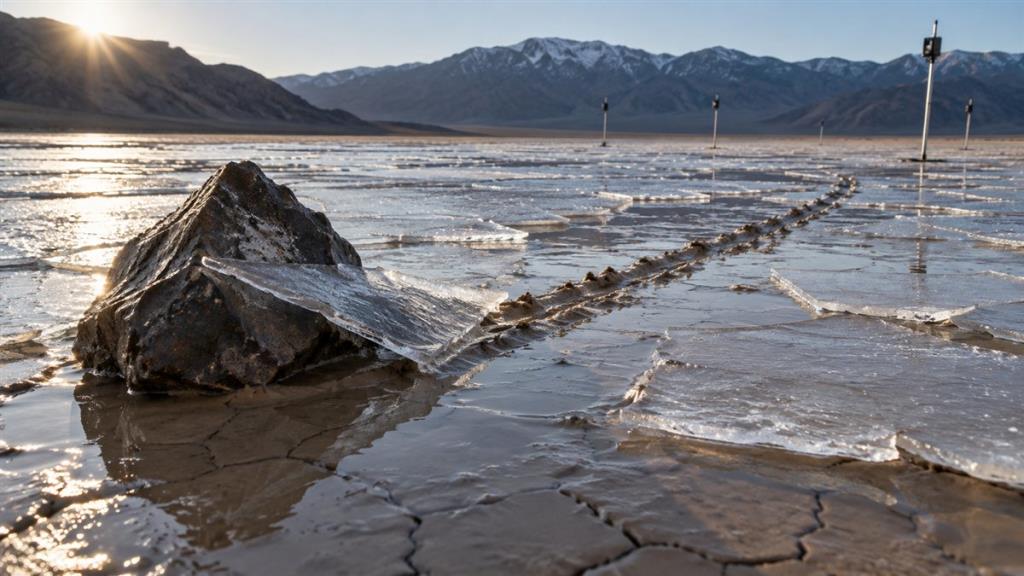
In 2013, a rare opportunity arose: the playa filled with a shallow sheet of water that froze overnight. When the sun broke the ice into thin floating panels and a light breeze blew across, the ice sheets pushed against the rocks. The research team witnessed the stones moving firsthand, while GPS instruments tracked and recorded the process.
An Almost Invisible Motion
The rocks do not race across the playa. They shift at a pace of merely a few centimeters per second over a span of several seconds to many minutes. When both the ice and the stones drift together across a vast landscape devoid of visual reference points, human eyes watching from a distance can hardly detect it. Ice sheets less than a centimeter thick offer ample surface area to catch the wind's force without needing to lift the boulders off the ground.
A Chain of Conditions That Must Align
The playa requires water deep enough to form floating ice yet shallow enough to keep the rocks exposed; the night must be sufficiently cold; the following day must warm up enough to break the ice sheet; and the wind must push in the right direction while the mud remains soft and slick. This convergence of factors is so rare that track marks can linger for years between successive movement events.
Is the Mystery Entirely Closed?
The thin-ice rafting mechanism explains direct observations and numerous synchronized tracks. However, earlier tracks were not monitored by cameras, leaving open the possibility of additional mechanisms during different eras. What has decisively changed is the evidentiary threshold: invisible forces are no longer required when we possess an observed, velocity-measured process cross-referenced with meteorological data.
Tracks as an Undated Diary
Each trail documents a heading and distance traveled, but subsequent rains, desiccated mud, and wind erase the exact chronology. Two rocks with parallel tracks may have traveled during the same event, whereas intersecting trails might be separated by years. Aerial imagery captured across seasons helps identify which tracks are fresh before scientists ever arrive on site.
Certain tracks lacking a stone at their terminal end were once cited as proof of rock theft. The 2013 observations revealed that drifting ice sheets can also gouge the mud on their own without carrying rocks, creating "ghost trails." Even so, removing stones represents actual vandalism that destroys invaluable geological records.
Why Light Winds Generate Sufficient Force
The wind's kinetic energy acts not merely against the rock's surface, but across the entire expanse of the ice sheet. Ice as thin as window glass floats atop the water, collecting wind pressure over a massive surface area and transferring that thrust to multiple rocks simultaneously. The underlying saturated mud drastically lowers friction; consequently, observed wind speeds were merely a few meters per second—far gentler than previous gale-force hypotheses had assumed.
Ice that forms too thick can lock against the rocks or the lakebed; water that is too deep allows the ice to float harmlessly over the rock tops; and without soft mud, no visible tracks would form. This extremely narrow operational window explains why researchers waited decades to witness the phenomenon firsthand.
What Instruments Have Changed
The scientific team fitted experimental stones with GPS sensors and erected automated weather stations, yet serendipity still played a crucial role: they happened to be present right when the ice sheet broke up. Direct observation synchronized wind, ice, and motion within the very same minute—far more conclusive than merely surveying tracks after the fact.
Unraveling the mechanism does not diminish the wonder of the Racetrack. That a blisteringly hot, arid playa relies on an elusive freezing night to etch long trails in the mud is an irony revealed only through persistent, patient observation.
From Enigmatic Lore to Verifiable Records
Compelling narratives often open at the moment of awe, but rigorous investigation must examine what came before and after that moment. Researchers construct timelines, seek out records closest to the event, preserve raw image files, and flag details derived solely from belated recollections. A single detail transcribed across hundreds of websites may still trace back to only one original source.
In natural phenomena, "not found" must also be carefully bounded. Failing to find meteorite fragments after decades in a marsh is fundamentally different from finding nothing in a thoroughly swept search zone the next morning. A north-facing camera capturing no luminous phenomenon says nothing about the southern sky. The scope of a search must govern the conclusions drawn from it.
Measuring Geometry, Velocity, and Energy
Angular dimensions on an image become real measurements only when distance is known. Velocity likewise requires distance and time, while energy is typically deduced from its impact on the surrounding environment. An error in any one of these three variables can turn car headlights into a hypersonic vehicle, or a minor chemical reaction into a massive energy source.
Calibration is an unsung yet decisive discipline. Cameras require optical distortion corrections; thermal sensors need baseline references; clocks at different stations must follow a synchronized standard; chemical samples demand blanks to identify contamination. These technical nuances lack the drama of a striking photograph, yet they define the boundary between mere conjecture and scientific proof.
Good Models Must Welcome Falsification
A scientific hypothesis does not merely recount what was seen; it predicts what has yet to be measured. If ice sheets propel rocks, movement episodes must coincide with shallow water, sub-freezing nights, and steady winds; if convection patterns generate circles, corresponding thermal profiles and fluid flows must exist below the center. Inaccurate predictions compel a model to be refined or discarded.
Different models can occasionally hold true in different scenarios. Nature is under no obligation to rely on a single mechanism for every glowing orb, fairy circle, or unusual cloud formation. Precise categorization often constitutes greater progress than clinging to a singular, all-encompassing explanation.
The Role of Probability and Rarity
A sequence of conditions, none of which is extraordinary on its own, can become extraordinarily rare when all must occur simultaneously. This dynamic explains why certain phenomena leave unmistakable traces yet yield few eyewitness accounts. It also introduces observational bias: those waiting years are prone to over-interpret borderline occurrences, while equipment failures at critical junctures create tantalizing data voids.
Automated sensor networks and satellite datasets reduce our reliance on luck. Nonetheless, automated detection algorithms can produce false positives; every alert still demands raw imagery and verification against known artifacts. Larger volumes of data do not automatically translate into better evidence.
When Can a Mystery Be Declared Solved?
A robust solution reconstructs the underlying mechanism, aligns with multiple independent datasets, and does not need to discard inconvenient details. It also accounts for why the phenomenon is rare, localized, and seasonal. For historical tracks, we can sometimes attain only the status of "most plausible explanation," as critical primary data has been lost to time.
Decoding the overarching mechanism does not mean knowing the backstory of every individual occurrence. We can know that Racetrack stones move via ice-rafting without knowing the exact date of every weathered track; we can attribute the hue of Blood Falls to iron while still working to map the subglacial hydrological network. Precise communication preserves authentic scientific wonder.
Preserving the Site Means Preserving the Data
Tire tracks on the playa, footsteps on delicate ice, soil removed from ring patterns, or artificial light beamed across a valley can all irreparably corrupt field data. Visitors should stay strictly on designated pathways, avoid disturbing objects, and never fabricate "evidence" for a photograph. A single fraudulent marking can outlive the real landscape online.
Respecting local communities is equally essential. They are not merely background figures in an intriguing tale; they hold generational observational history, indigenous place names, and environmental knowledge. Responsible research returns findings and conservation benefits directly to the habitats where these phenomena occur.
A Checklist for Evaluating Extraordinary Claims
When confronted with a sensational video or "groundbreaking" headline, six questions provide clarity: Are the original unedited files available? Are the timestamp and geographic coordinates verified? Does the event match mundane sources such as local lighting, flight paths, or common weather phenomena? Were dimensions measured or merely estimated? Has an independent team scrutinized the raw data? And does the author state what evidence would change their mind? Missing one item does not necessarily invalidate a claim, but each omission steadily degrades confidence.
It is equally important to differentiate between peer-reviewed papers, unreviewed preprints, press releases, and internet anecdotes. A single study is a starting point, especially when sample sizes are minimal or the field site is unique. Scientific consensus emerges when diverse methodologies converge, not when a single sound bite goes viral.
The Mysteries Worth Preserving
Scientific rigor does not require a narrative to become sterile. The sight of a flattened forest from an aerial burst, a silent luminous orb hovering over a valley, or an ice stalactite descending toward the seafloor still evokes genuine awe, even when the equations behind them are understood. Wonder is why we ask questions; evidence is how we ensure our answers honor the reality we set out to understand.
In every discipline, the genuine unknowns should be maintained as open inquiries rather than papered over with dogmatic conclusions. That might mean an object's composition, the relative contribution of competing mechanisms, a submerged heat source, or precise triggering thresholds. These well-defined, measurable gaps are the mysteries that will inspire and be unraveled by the next generation.
How a Phenomenon Becomes a "Mystery"
Rare phenomena typically unfold rapidly, in hard-to-reach locations, or under harsh weather conditions that impair scientific instruments. Eyewitnesses see only a partial angle, and memory inevitably fills in the blanks over repeated retellings. Once a pioneer photograph circulates widely, disparate anomalies are easily lumped under a single moniker. Thus, the foundational question is not "what is it?" but "are we discussing one phenomenon or several?"
A rigorous observation demands precise timing, geolocation, heading, focal length, environmental conditions, and raw metadata. Images with contextual backgrounds allow for angular calculations; dual cameras separated by a baseline provide parallax for distance; light spectra reveal elemental composition and temperature. A compressed video found on social media may look captivating, but it often lacks the exact data necessary for verification.
Distinguishing What Is Possible from What Occurred
Replicating an anomaly in a laboratory demonstrates only that a given mechanism can work. To prove that mechanism operated in nature, it must accurately predict the duration, energy budget, geometry, meteorological prerequisites, and lingering physical aftermath. If a model explains the color but fails to account for the kinematics, it remains incomplete.
Conversely, the absence of a comprehensive model does not render every speculative idea equally valid. Hypotheses that conform to physics, generate testable predictions, and withstand empirical measurement carry far more weight than unfalsifiable claims. The term "unidentified" denotes the limits of available data, not the presence of a supernatural cause.
Common Identification Pitfalls
Judging distance in the dark is notoriously unreliable. Bright stars, planets, aircraft navigation lights, satellites, distant headlights refracted through atmospheric layers, and insects fluttering close to a lens can all take on bizarre appearances. Long exposures stretch a point of light into a streak; optical image stabilization causes stationary backgrounds to drift apart from subjects; internal lens flares yield a phantom "orb" that moves in lockstep with the camera.
In landscape studies, circular geometries frequently suggest intentional design. Yet natural convection, wave interference, resource competition, and uniform radial expansion inherently produce rings or tessellated patterns. Geometric regularity alone is not evidence of conscious design; what requires measurement is the underlying dynamic that sustains the pattern over time.
Which Questions Remain Worth Pursuing?
A worthwhile question must lead directly to a measurable test: which sensor must be deployed, which sample must be retrieved, and what data could falsify the working hypothesis. For rare events, continuously operating autonomous instruments yield far more value than brief field excursions. For changing landscapes, multi-year satellite imagery reveals full life cycles and seasonal dynamics.
Science does not strip nature of its enchantment. A boulder drifting atop a wafer of ice, a water column carving rings kilometers wide, or microbes thriving in pitch-black hypersaline water beneath a glacier are vastly more extraordinary than sensationalized fiction. The difference is that we know which aspects have been measured and which still dwell in the dark.
Reading New Claims with a Critical Eye
When claims proclaim an anomaly has been "completely decoded," examine the date, the publishing institution, the underlying methodology, and whether the raw data has been peer-reviewed by independent teams. A sensational headline can effortlessly mutate "consistent model" into "case closed." Conversely, sensational storytellers may ignore dozens of identified cases just to fixate on a handful of ambiguous outliers.
Credible conclusions define their own boundaries: what they successfully explain, what questions remain open, and under what conditions their findings would be falsified. That self-imposed boundary keeps genuine curiosity alive without compromising on the truth.
Staying Safe in Pursuit of Anomalies
No photograph is worth stepping onto fragile ice, walking into a lightning storm, trespassing past conservation boundaries, or collecting uncontrolled samples in extreme environments. Observing from a safe vantage point while logging the exact time and orientation is far more valuable than capturing a dramatic close-up that sacrifices vital context. Fragile environments must also be left undisturbed so that delicate natural signatures are not ruined by footprints, vehicular tracks, or debris left behind by visitors.



 Korean kimchi and banchan: the craft of fermentation and a table built on sharing
 Persian rice and tahdig: saffron, a crisp bottom layer and the sofreh
 Moroccan couscous and tagine: rhythm, hospitality and the flavours of North Africa
 Brazilian feijoada: a pot of black beans, a weekend lunch and a story with many roots
 The Indian thali: a balanced tray that tells a regional story and a way of eating together
 Danish smørrebrød: the open sandwich and the art of composing a lunch
 Swiss raclette: melted cheese and a shared table in the cold season
 Injera in Ethiopia and Eritrea: the shared platter that binds a community
Đăng nhập để bình luận: / Sign in to comment: