



Tabby's Star: Do Its Unusual Dimmings Really Hide a Megastructure?
In Kepler data, KIC 8462852 occasionally dimmed by more than 20% in irregular curves, much deeper than a normal transiting planet. When familiar causes did not fit immediately, the idea of an "alien megastructure" emerged and captured the public imagination. But light in multiple colors told a different story: the obscuring material appears to be very fine dust.
The star is also known as Boyajian’s Star or Tabby’s Star, named after Tabetha Boyajian, who led the study announcing the unusual behavior. The initial discovery had contributions from citizen scientists of the Planet Hunters project. This is a rare example where the human eye recognized a pattern of variation that standard planet-hunting pipelines might have missed.
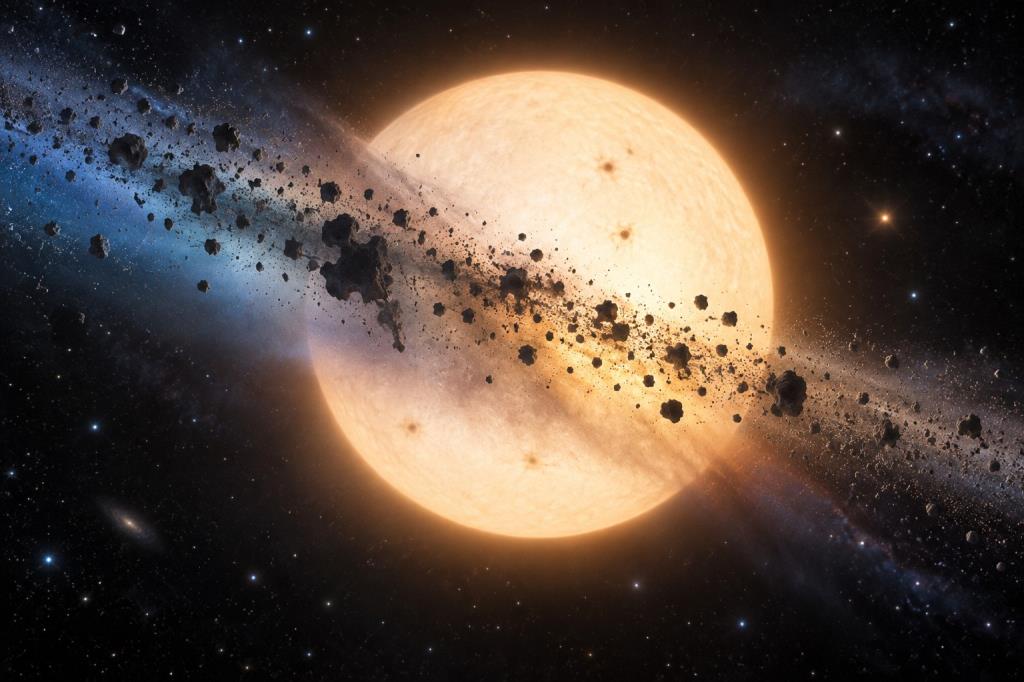
How does the light curve differ from a planet's?
When a planet in a stable orbit passes in front of a star, the brightness typically drops in a repeating rhythm and has a fairly symmetrical shape. Tabby's Star shows multiple non-periodic dimming episodes with varying depths and durations, sometimes forming complex clusters. To block more than one-fifth of the light, a single solid object would need a colossal cross-section.
No suitable companion star or large amount of infrared radiation—as expected from a dense, warm dust disk—was found. That void opened the door to comets, impact debris, interstellar dust, intrinsic stellar variations, and ultimately, artificial structures. However, an attention-grabbing idea remains just a hypothesis until it offers its own measurable signature.
The color of the dimming is the deciding test
A solid barrier, much larger than the wavelength of light, blocks all colors almost equally. Observations by Swift, Spitzer, and ground-based telescopes showed that the dimming level depends on wavelength: ultraviolet is affected more strongly than infrared. This is typical behavior for micron-sized dust grains scattering light.
This result makes the "giant solar panel" or solid screen model very difficult to fit. It also sets limits on grain size: dust that is too small in the interstellar medium has a different color law, while dust around the star must be large enough not to be blown away too quickly by radiation pressure. Dust is the name of the material; it does not yet explain the origin or structure of the cloud.
Where could the dust come from?
Fragmenting comets, collisions between small bodies, tilted rings of material, or dust lying between Earth and the star have all been proposed. Each scenario must simultaneously explain the very deep short-term dimming, long-term variations, lack of strong excess infrared, and color changes. No simple model has yet gathered all the facts into a single history.
Fine dust does not last long around a bright star without being replenished. Thus, the question shifts from "what is blocking the light?" to "what process is continuously creating or feeding dust into the line of sight?". Eccentric orbits of debris can create clumps, but the mass, collision frequency, and dust temperature must be just right.
The power of a community observation campaign
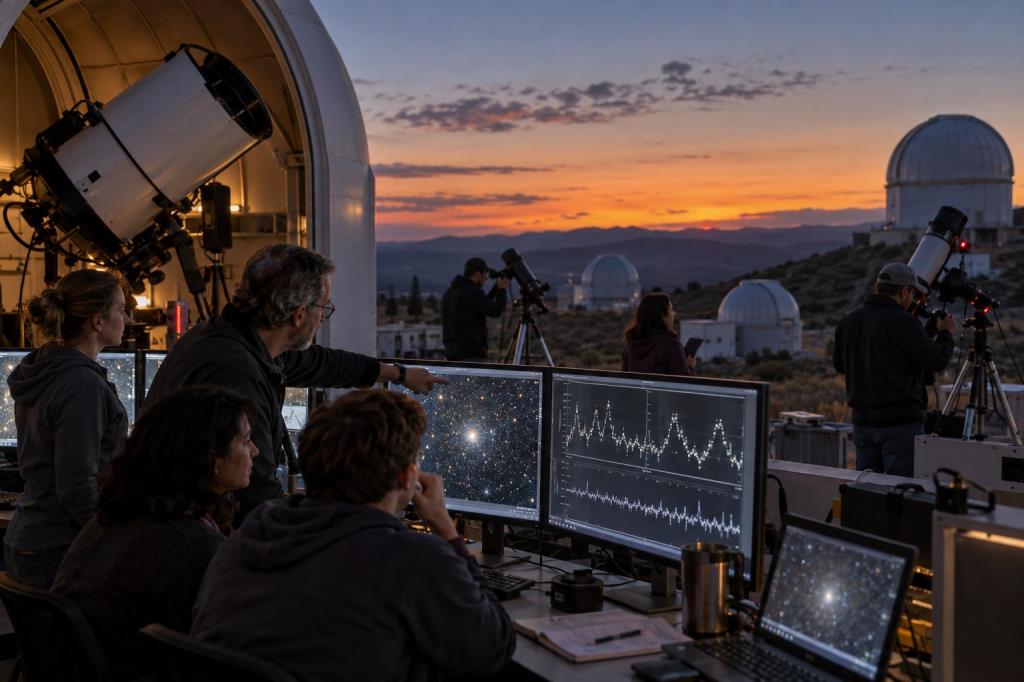
Unannounced dimming episodes make professional telescope time difficult to schedule. A steadily monitoring amateur telescope network can sound the alarm, allowing larger observatories to quickly measure spectra and multiple colors. Data from multiple locations also rule out clouds, camera glitches, and local atmospheric variations.
As a result, the mystery no longer depends on a single, now-concluded Kepler dataset. Each new episode is an opportunity to see how colors change, and whether gas absorption lines or polarization are present. A good solution must predict these signatures before the dimming occurs, rather than adjusting the story after each observation.
Where does the megastructure stand now?
Science does not forbid considering extraterrestrial technology, but that hypothesis must be held to the same standards as any other. The color-dependent phenomenon supports dust and argues against solid barriers; radio signal searches have provided no supporting evidence. Therefore, a megastructure is not the explanation favored by the data.
The plausible mystery remains large enough: what dust, where, created by what process, and why does the geometry yield such extreme dimming episodes? Tabby's Star reminds us that "knowing the material" is not synonymous with "knowing the story." The gap between the two is where astronomy continues to work.
How to read a "mystery signal" without losing the wonder
An unusual discovery typically passes through four layers: raw data, processed signals, physical interpretations, and the popular narrative. Each layer can clarify details but can also add assumptions. Speeded-up audio, surface renderings, light beams representing radio waves, or stars obscured by dust are all useful if the reader remembers they are illustrations, not direct images of the entire phenomenon.
The evidentiary value increases sharply when a phenomenon repeats, is captured simultaneously by independent instruments, and has enough raw data for other groups to analyze. A single event is not meaningless, but the number of models that can fit it is vast. A good question is not just "could this solution be right?" but also "what does it predict that other solutions do not?".
Noise, errors, and instrument limitations
Detectors do not view the world directly. Antennas have beam patterns and frequency bands; hydrophones are subject to ship noise and water structures; optical telescopes are subject to the atmosphere, pixels, and observation schedules. A signal passes through a chain of amplification, filtering, digitization, and calibration before becoming a chart. An error at any link can create a convincing shape.
Therefore, investigation teams look for control signals, instrument logs, weather, satellites, human activity, and data from distant stations. "No error found" only means the checked errors do not explain it; it does not automatically make the source supernatural. Conversely, pointing out a possible mechanism is not enough if it cannot reproduce the intensity, duration, and location.
Three levels of conclusion to distinguish
At the first level, the phenomenon is real: multiple sensors or verification processes show it is not a simple display glitch. At the second level, the source family is known—cracking ice, dust, magnetars, or outgassing. At the third level, the detailed identity and mechanism of the exact event are reconstructed. News often lumps these three levels into "solved" or "unsolved," whereas science progresses through the steps in between.
The Bloop has a very strong mechanical explanation but not necessarily an iceberg serial number. FRBs have been linked to magnetars in at least one case, but the micro-mechanism remains open. Tabby's Star shows dust obscuring light, but the source of the dust is not yet agreed upon. Dividing levels helps preserve the genuinely unknown, rather than painting mystery over what is already documented.
Why can an appealing hypothesis live for so long?
Humans prefer agents with intent: a message is easier to remember than radio noise, a creature is easier to visualize than an icequake. Illustrations copied away from their captions can gradually be mistaken for real photos. After that, thousands of articles mentioning the same detail can seem like thousands of sources, even though they all trace back to a single initial speculation.
The way to protect oneself is to trace back to the earliest source, check dates, distinguish research papers from press releases, and look at subsequent peer reviews. The more extraordinary a claim, the more it needs data that allows others to verify it. Skepticism here does not ruin the story; it prevents the story from replacing the incredible original phenomenon.
A short checklist for new discoveries
Ask: is the raw data still available; does the signal appear on independent instruments; how precise are the coordinates and timing; what processing has been applied; what familiar sources have been ruled out; what does the hypothesis predict; and what would make the authors change their minds. Not every file will answer all of these, but the missing ones indicate where certainty should pause.
It is also necessary to observe the language. "Consistent with," "suggests," and "confirmed" are three different levels. A natural model can be preferred without being complete; an exotic idea might not be absolutely ruled out but remains highly improbable. Keeping verbs accurate is a simple way to keep content both engaging and honest.
The timeline is more important than a single moment
A beautiful chart often shows only a few seconds around the peak, whereas the cause may have left traces hours or years before. Researchers look at instrument states before and after the event, maintenance logs, past activity of the source, and environmental conditions. If we only crop the anomalous segment, we lose the chance to see a signal forming or a cyclically repeating error.
The announcement date also differs from the discovery date. The first FRB was recognized in archived data years after the telescope recorded it; Wow! was spotted on paper the next morning; Oumuamua's orbit only became clear gradually as multiple observatories added positions. Recording both milestones avoids creating the impression that the entire meaning was apparent at the very first moment.
Why do non-detections still have value?
Not seeing a tail, not recapturing a signal, or not measuring infrared radiation all place limits on models. But a negative result is only as strong as the sensitivity, frequency band, sky area, and time actually observed. Saying "there is none" when the instrument is only capable of saying "not brighter than this threshold" turns a useful limit into an overreaching conclusion.
Limits from multiple instruments can fit together like pieces of a mold. No large dust, no familiar gas at measurable levels, no continuous radio signals: the space left for hypotheses grows narrower. Progress often happens that way, slow and less dramatic, before a new measurement selects the remaining mechanism.
Independence does not just mean using a different machine
Two identical telescopes running the same software and using the same catalog can still share a bug. Evidence is stronger when different methods converge: a radio position matches an X-ray burst, optical dimming varies with wavelength, or hydroacoustic bearings lead to an ice shelf where satellite imagery records disintegration. Each method has its own bias, so their intersection is less likely to be coincidental.
Independence also lies in the analysis team and data access. If only one group holds an undescribed pipeline, the community cannot know how sensitive the results are to the filtering. Publishing error margins, processing code, and matching data allows others to find bugs, while making a conclusion that passes scrutiny much more reliable.
Low probability does not mean impossible
The sky and oceans are monitored through a colossal number of trials. In billions of data points, a very strange pattern will occasionally appear simply due to noise or coincidence. Therefore, probability must account for the number of channels, time steps, and targets searched, rather than just asking how rare a single signal peak looks on its own.
Conversely, a truly rare phenomenon might only appear once in the lifetime of an instrument. A lack of repetition keeps the certainty level low, but does not justify erasing the record. The logical approach is to archive the file, lower confidence, and design observations capable of catching the exact signature if it returns. A good mystery may have to wait for the technology of another decade.
The part of the mystery worth keeping
The world is no less strange when sea monsters turn out to be cracking icebergs, or when a fast radio burst is linked to a dead star. On the contrary, the true scale is often harder to imagine: sound traveling across oceans, fine dust causing a star to change brightness, or a rock from another stellar system gliding by before we can prepare.
Good gaps have clear shapes. They are positions not yet precise enough, mechanisms not yet distinguished, materials not yet identified, or events not yet repeated. When a gap is named, the next generation of observers knows what instrument to build and what signs to await. Mystery then is not a fog obscuring evidence, but a map leading to the next measurement.



 Korean kimchi and banchan: the craft of fermentation and a table built on sharing
 Persian rice and tahdig: saffron, a crisp bottom layer and the sofreh
 Moroccan couscous and tagine: rhythm, hospitality and the flavours of North Africa
 Brazilian feijoada: a pot of black beans, a weekend lunch and a story with many roots
 The Indian thali: a balanced tray that tells a regional story and a way of eating together
 Danish smørrebrød: the open sandwich and the art of composing a lunch
 Swiss raclette: melted cheese and a shared table in the cold season
 Injera in Ethiopia and Eritrea: the shared platter that binds a community
Đăng nhập để bình luận: / Sign in to comment: