



UVB-76: The Mysterious Buzzing Sound Broadcast for Decades on 4625 kHz
On 4625 kHz, an intermittent buzzing sound has repeated day after day since at least the early 1980s. Occasionally, the channel marker stops, a Russian voice reads out a call sign, code words, and number groups, and then the buzzing returns. Listeners call it UVB-76 or The Buzzer. The transmitter is real, the messages are real; what has never been officially announced is who is using it and for what purpose.
The name UVB-76 was originally how the listening and logging community transcribed an old call sign, not a stable label announced by the station itself. Call signs change over time, while the frequency and channel marker help stations in the network know the channel is still active. Calling it a "ghost station" is appealing, but the signal has technical footprints, human voices, and a very earthly operation process.
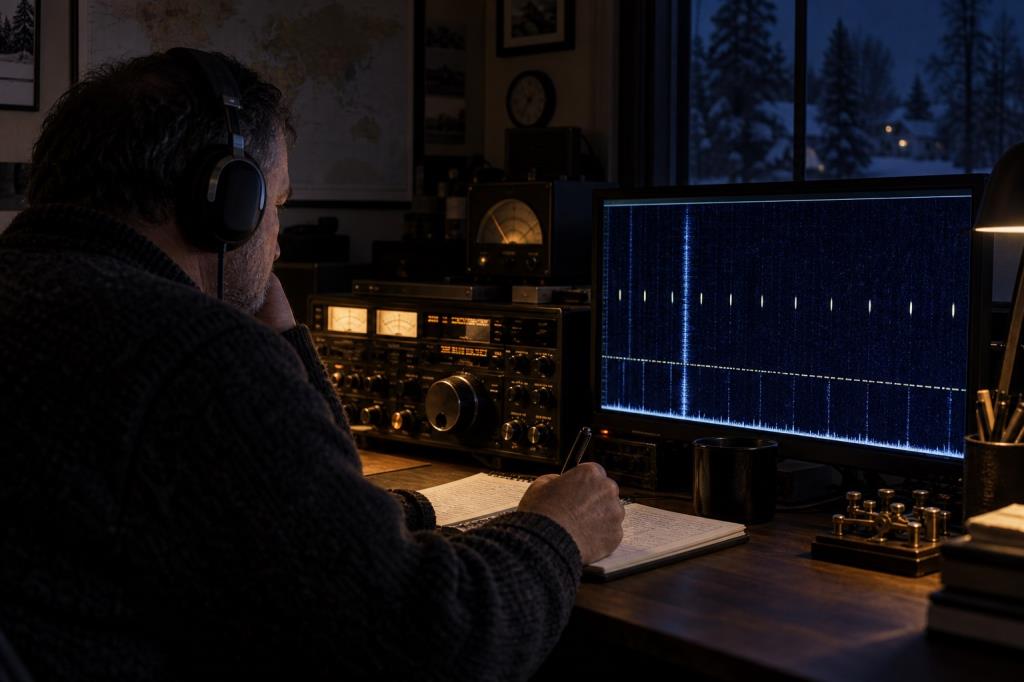
What listeners can confirm
Recordings from multiple countries show that the channel broadcasts continuously, with reception levels changing by day, night, and season like ionospheric propagation. The voice transmissions are usually short, following a repeating format with call signs and word-number groups. Sometimes the microphone seems to pick up room noise, indicating that at least part of the audio sequence is fed into the transmitter from a live audio line.
Not every strange sound on 4625 kHz comes from the station. Jammers, amateur radio operators, music rebroadcasts, and overlapping signals can interfere. Serious logging must compare multiple distant receivers: a signal present at only one point might be local interference, while simultaneous signals on multiple WebSDRs are what is noteworthy.
Numbers station or military communication network?
Classic numbers stations read code groups for agents to receive using civilian radios. UVB-76 shares some similarities, but its dense channel marker and Russian format lead many observers to lean toward a military communication network or a state agency. A channel that always has a tone helps receivers check the transmission path and recognize immediately when a command interrupts.
That remains an inference from behavior. There are no official documents confirming the recipients, code keys, or function. Stories about a "doomsday switch" lack public evidence: a nuclear deterrent system cannot be proven by a buzzing sound alone, and the station's continued broadcasting through political upheavals does not turn it into an automatic firing machine.
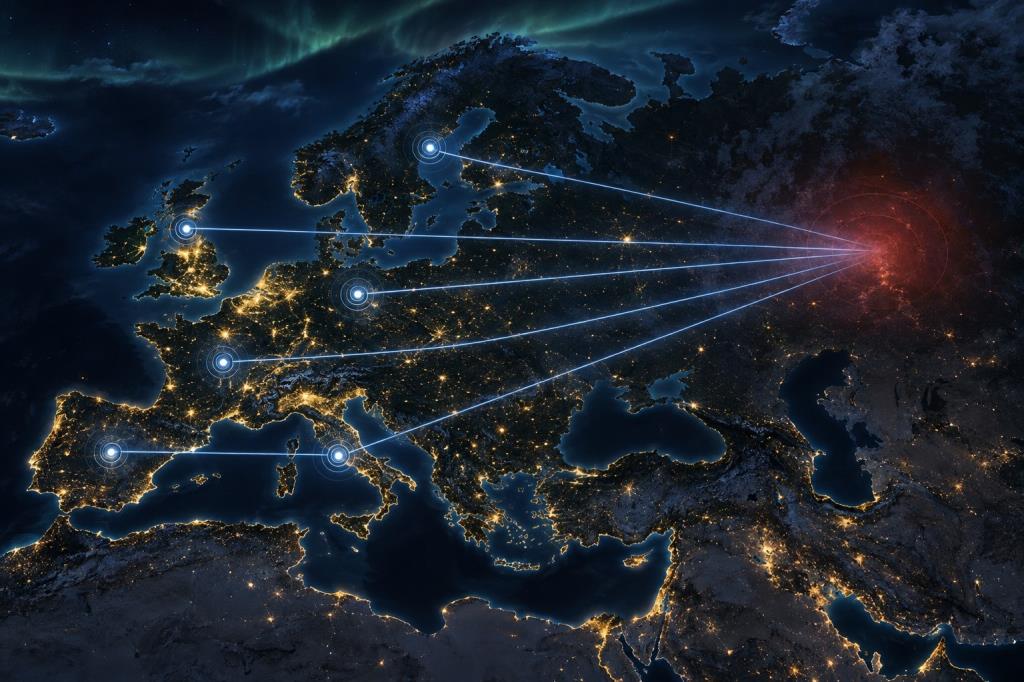
Why messages cannot be solved just by listening more
If the word and number groups use codebooks or one-time pads correctly, outsiders can record them perfectly and still not deduce the content. Word frequency does not help when each key is used only once. The timing of broadcasts sometimes coincides with military events, but with hundreds of events and many messages, post-hoc correlation is highly likely to appear by chance.
To prove a connection, rules must be set beforehand: how long of a time window, what type of events, and compared to periods with no messages. A broadcast right before a high-profile event does not say whether it was an order, a report, or completely unrelated. Without a plaintext to compare, any circulating "translation" should be viewed as guesswork.
The remaining mystery
The most pragmatic hypothesis is a state communication network with a normal purpose for the recipients but kept secret from the public. That explains the transmitter, maintenance schedule, call signs, and format. However, the unit name, network structure, and the meaning of each radiogram remain outside open records.
UVB-76 is mysterious because anyone can listen to a closed door. It is not silent like a top-secret document; it broadcasts openly but lacks the key. The gap between accessibility and comprehensibility is what has kept the buzz alive in the imagination for decades.
From narratives to verifiable records
A strong mystery does not require every detail to be unknown. First, physical evidence, contemporary documents, and measurements must be separated from illustrations, late recollections, and literary versions. A signal can be genuinely recorded but its sender unknown; a historical figure may have really existed but their famous nickname was created by later generations.
Each source answers a different type of question. Receivers give frequency and time, not intent. A stone stele gives a unit name in one place, not the fate of the entire army. Chronicles tell us the story that was passed down, but do not guarantee the author witnessed it. Reading limits correctly makes the unknown clearer.
Documentary gaps are not a blank slate
When records are missing, many stories can fit. But they are not equal: a hypothesis must fit the end dates, geography, technology, motivation, and what should have remained. A conclusion that requires fewer assumptions and explains more facts is preferred, even if it cannot be absolutely proven.
"No evidence" must also be defined in scope. Not being in the searched archives is different from never having existed; not receiving anything for a week is different from a source never repeating. Writing the scope clearly helps avoid two extremes: turning silence into evidence of a conspiracy, or treating missing records as a reason to dismiss all accounts.
The timeline is a tool against legends
Arranging sources by date shows which details appeared immediately and which were added decades later. A velvet mask becomes iron, a prime suspect becomes a theatrical monster, a technical signal becomes an apocalyptic message. Late details are not automatically wrong, but they need to explain how they came to know what early sources did not record.
We must also separate the date of the event, the date people realized it, and the date of publication. Data can sit for years before being understood; an artifact can be found and then processed according to old standards. These delays determine how much information can still be recovered using modern technology.
Independent verification takes many forms
Two receivers with the same software can share the same error; two chronicles can copy the same storyteller. Independence is stronger when different lines of evidence converge: distant receivers, satellite imagery, stratified artifacts, letters with archival chains. The less dependent on a single link, the more robust the conclusion.
Replication is also important. A microwave oven recreating Perytons under specific conditions is causal evidence; a volcanic model that is merely "capable of making sound" is not enough for Upsweep without replicating the sweep pattern and seasonal rhythm. History offers few chances to re-test, so we must cross-reference texts, archaeology, and probability.
Do not let illustrations become false evidence
There are no photographs of medieval events or direct images of many cosmic sources. Drawings in an article help visualize the context, not assert that the faces, actions, or composition happened exactly that way. Captions should describe what the image is explaining rather than calling it a photo of the scene.
Images that spread away from the article often lose their captions. Therefore, images should avoid fake text, overly certain symbols, and sensational details without sources. A mysterious atmosphere can come from lighting, empty space, and traces, without needing to plant "evidence" that history never provided.
A checklist for readers
Ask what the earliest source is; did the author witness it; is the raw data still available; has an independent group confirmed it; when did the famous details first appear; what does the hypothesis predict; and what evidence could prove it wrong. If there is no way to refute it, it is a flexible story, not yet a solution.
Finally, distinguish "cannot be ruled out" from "highly probable." Countless scenarios cannot be absolutely ruled out because data is lost, but history and science can still rank them. Speaking in probabilities does not make an article less appealing; it tells the reader where the solid ground ends.
Margin of error varies by type of evidence
An audio recording can give frequency and timing quite accurately, but it does not point to the source if the sensor network is too sparse. A text can record names of people and places, yet the author's intent, intermediate copies, and contemporary language all create margins of variance. Physical artifacts, seemingly the most objective, can still be separated from their stratigraphy, over-restored, or dated according to an object lying next to them. Therefore, we should not lump all question marks into a single word: "mystery." Each record needs its own map of errors: what was measured directly, what was inferred, what was recalled by witnesses, and what was only retold after generations.
When two pieces of evidence conflict, the rational response is not to immediately choose the more thrilling one. We need to look at the resolution, the time gap, the chain of custody, and whether the recorder had a specific agenda. A receiver placed in the right spot can be more reliable than ten people listening by ear; conversely, a clean data stream without context is also easily over-interpreted. Making the level of uncertainty public helps the story stand firm when new discoveries are made. It also distinguishes caution from avoidance: a good researcher must be able to say why they believe one possibility over another, even if they cannot make an absolute conclusion.
Names can shape the entire story
Many famous phenomena are known by an appealing nickname. Nicknames help the public remember, but at the same time, they sneak in a pre-packaged interpretation: "the trumpets," "the ghost," "the vanishing army," or "the prisoner in the iron mask" make the mind fill in extra imagery. After hundreds of retellings, the label is easily taken as the original description. The way to check is to return to the earliest wording, compare translations, and clearly state which part is a modern name. Just a small difference—iron or velvet, disappeared or reassigned, a single sound or a repeating sequence—can change the entire set of hypotheses.
The media also creates a selection effect: coincidences are kept, while hundreds of normal occurrences fade from memory. Highly visual details usually outlive dry figures, so later retellings seem more complete and frightening than the original records. This does not mean everything is imagined. It shows the need to study both the phenomenon and the history of the story about the phenomenon. When we know where a detail first appeared, we can recognize whether it is an independent fact, a new phrasing of an old fact, or an embellishment added to make the story easier to pass down.
What can move a record forward?
With audio or radio signals, progress usually comes from synchronized data across multiple stations, calibrated equipment, and accompanying environmental records. Time-of-arrival differences allow for direction finding; frequency spectra and repetition patterns help separate machinery, atmosphere, geology, or astronomy. Raw data must be saved for other groups to rerun analyses instead of just looking at processed graphs. A new reception does not necessarily solve an old mystery, but it can turn the vague question "what is that?" into specific testable questions about location, energy, cycle, and generation mechanism.
With history, progress can come more slowly: an archive is re-cataloged, private letters emerge, organic materials are dated, or isotopic signatures reveal where a person once lived. Technology is only useful when the question and the origin of the sample are clear. Testing an object with a broken chain of custody can produce a very precise number for the wrong subject. Conversely, a small administrative note placed correctly on a timeline can sometimes eliminate an entire major hypothesis. The value lies in the connection between the new measurement and the old record, not in the modern appearance of the equipment.
Why are solutions sometimes still incomplete?
There are cases with strong solutions that cannot be reconstructed minute-by-minute. We can identify a class of source, a social cause, or a high-probability identity, while personal motives and detailed sequences of actions are lost. Demanding that a solution cover every detail easily creates an impossible standard; but accepting a general label without checking exceptions is also too permissive. The way to balance this is to divide conclusions into tiers: what is almost certain, what is supported by abundant evidence, what is still contested, and what currently lacks data to judge.
That incompleteness is the honest part of research. A file can be closed regarding the mechanism but remain open regarding the people, or vice versa. When the primary origin is identified, secondary questions do not become meaningless: why did the community react that way, why did contemporary authorities remain silent, and why do alternative versions continue to spread? Mystery, therefore, is not just a hunt for a single answer. It is also a way to observe the limits of memory, equipment, and archival power—three factors that determine what of the world is kept for those who come after.
The mysterious part worth keeping
A natural explanation can be stranger than myth: a dying star acting as a clock, a kitchen microwave mimicking cosmic signals, or a signal traveling across the entire Pacific. In history, what haunts us is often deliberate silence—names erased, orders unwritten, the marginalized leaving no words of their own.
The best mysteries have clear boundaries. We know exactly what was recorded, what is merely plausible, and what measurements are still missing. At that point, the chill does not come from exaggeration, but from standing right at the edge of the record and seeing the part of the past or the universe that has slipped out of reach.



 Korean kimchi and banchan: the craft of fermentation and a table built on sharing
 Persian rice and tahdig: saffron, a crisp bottom layer and the sofreh
 Moroccan couscous and tagine: rhythm, hospitality and the flavours of North Africa
 Brazilian feijoada: a pot of black beans, a weekend lunch and a story with many roots
 The Indian thali: a balanced tray that tells a regional story and a way of eating together
 Danish smørrebrød: the open sandwich and the art of composing a lunch
 Swiss raclette: melted cheese and a shared table in the cold season
 Injera in Ethiopia and Eritrea: the shared platter that binds a community
Đăng nhập để bình luận: / Sign in to comment: