



The Wow! Signal: 72 Seconds That Kept Humanity Listening to the Cosmos for Half a Century
On the night of August 15, 1977, the Big Ear radio telescope in Ohio recorded a narrow, powerful signal near the 21 cm hydrogen line. It lasted for only a single 72-second scan, then never reappeared in a convincingly reproducible way. On the printout, volunteer astronomer Jerry Ehman circled the alphanumeric sequence "6EQUJ5" and wrote a red "Wow!" alongside it. That spontaneous notation became the name of the most persistent question in SETI history.
The intrigue does not lie in the receiver hearing a sound or reading a greeting. Big Ear measured radio energy across frequency channels; the six characters merely represent intensity rising and then falling across sampling intervals. There was no secret message hidden inside "6EQUJ5". The remarkable facts were that the signal was extremely narrowband, powerful, and displayed a profile consistent with a celestial source drifting across the beam as Earth rotated.
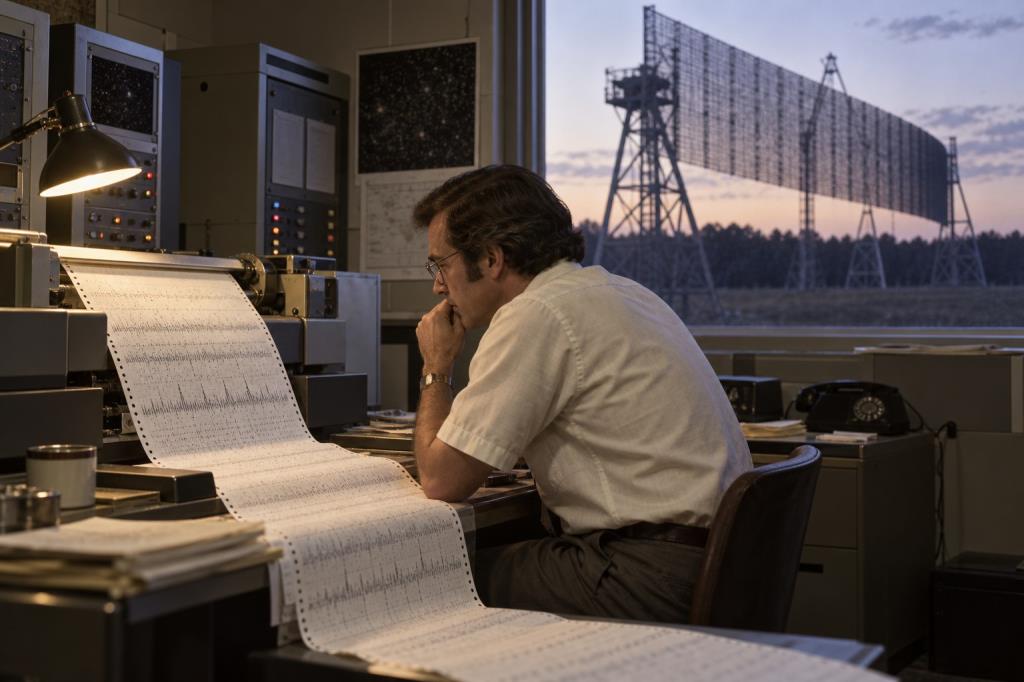
Why Was 72 Seconds Significant?
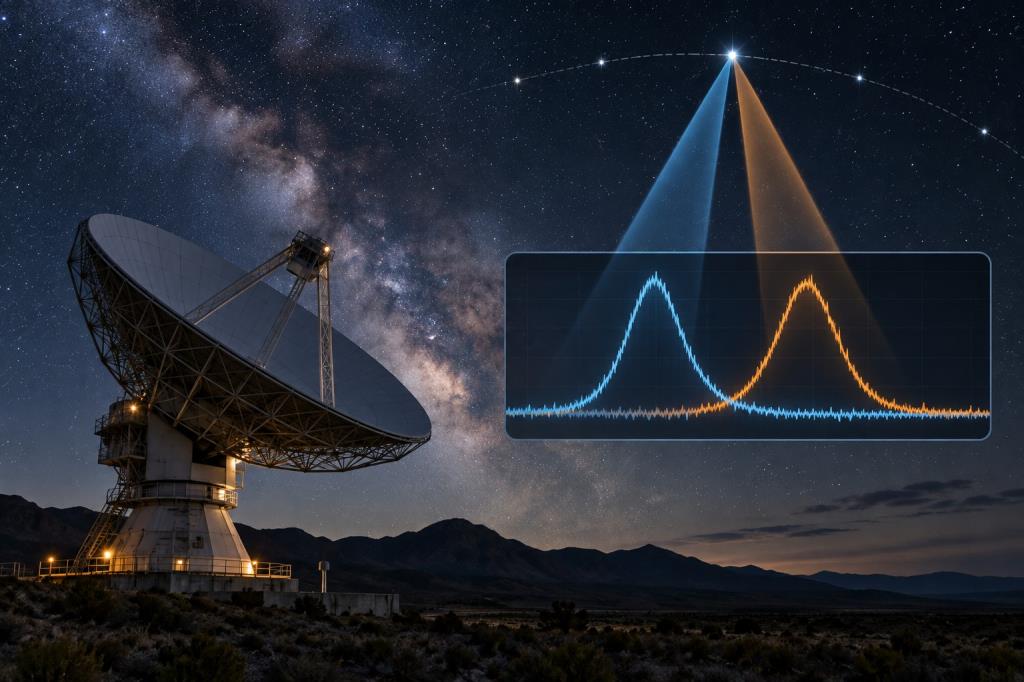
Big Ear operated as a transit telescope: it did not track targets, but rather relied on Earth's rotation to sweep patches of the sky across its two feed horns. A distant source, fixed against celestial coordinates, would brighten, peak, and fade over a duration dictated by the antenna's beam pattern. The curve of the Wow! signal closely matched that expectation, making arbitrary terrestrial interference a far less tidy explanation.
However, the telescope featured two adjacent beams, and the signal appeared in only one of them. From the printout alone, it was impossible to determine definitively which beam detected it, leaving two possible sky coordinates. Had the source been continuous, the other beam should have registered it several minutes later; its absence forced researchers to consider a brief burst, a scintillating source, or terrestrial interference that coincidentally mimicked a celestial profile.
What Does a Frequency Near the Hydrogen Line Reveal?
Neutral hydrogen radiates around 1420 MHz, a natural cosmic landmark that any civilization studying radio astronomy would likely know. Consequently, this frequency band was long considered a logical "watering hole" to search for artificial signals. Yet being "near a meaningful frequency" does not equate to "sent by intelligence": neutral hydrogen clouds, radio equipment, satellites, and receiver artifacts all had to be examined.
The historical printout offers far more limited resolution and metadata than modern digital systems. There are no raw voltage streams to re-examine polarization properties, Doppler drift, or fine-scale structure. A one-off event also prevents experimental repeatability—the gold standard required to elevate a candidate signal into a verified discovery.
Follow-Up Searches and Natural Hypotheses
Numerous campaigns returned to the target coordinates with far more sensitive instruments, yet none detected an identical signal. That rules out a continuous transmitter, but leaves open the possibility of a source with an exceptionally long period or rare transient outbursts. Hypotheses have ranged from comets and terrestrial interference to unknown astrophysical emissions; each accounts for certain aspects, but none has fully reproduced the entire event profile.
In 2025, a Puerto Rican research team published a reanalysis of archived Big Ear data and identified fainter narrowband emissions potentially linked to cold hydrogen clouds. They proposed that a rare astrophysical amplification process might have caused a sudden flare in signal intensity. While this represents a promising natural avenue of investigation, it is not yet a verified solution through re-observation. It must still successfully predict the frequency, intensity, and necessary physical conditions of such flares.
The Real Mystery That Remains
The Wow! signal did not prove extraterrestrial intelligence, yet its true identity remains unconfirmed. We know its timing, frequency, profile, and relative intensity; we lack repetitions, pinpoint sky coordinates, and rich raw data. It is precisely this asymmetry that causes any definitive claim—from "it was definitely aliens" to "it was certainly just interference"—to outpace the evidence.
A new signal only earns extraordinary status when confirmed across multiple distant observatories, displays Doppler drift consistent with celestial motion, and reoccurs. Until then, the Wow! signal should remain in its proper place: an extraordinary historical radio candidate, good enough to teach us scientific skepticism, but insufficient to answer who or what produced it.
How to Read a "Mystery Signal" Without Losing the Wonder
An unusual finding typically passes through four layers: raw data, processed signal, physical interpretation, and the public narrative. Each layer can sharpen details, but it can also introduce assumptions. Speeded-up audio conversions, artist impressions of alien surfaces, glowing lines representing radio waves, or dusty stars are all helpful—provided readers remember they are illustrations, not direct photographs of the underlying phenomenon.
The evidentiary value rises sharply when a phenomenon repeats, is simultaneously recorded by independent instruments, and provides sufficient raw data for other teams to re-evaluate. A single event is not meaningless, but the number of models that can fit it is immense. A good question is not merely "could this explanation be right?" but "what does it predict that other explanations do not?"
Interference, Errors, and Instrumental Limits
Detectors do not view the world directly. Antennas have beam patterns and bandwidths; hydrophones contend with shipping noise and acoustic layers in water; optical telescopes must deal with atmospheric seeing, pixel artifacts, and scheduling constraints. A signal travels through stages of amplification, filtering, digitization, and calibration before appearing on a chart. A flaw at any link in the chain can generate a convincing pattern.
Consequently, investigators scrutinize control signals, instrument logs, weather records, satellite passes, human activity, and data from distant stations. "No error found" simply means that the checked failure modes cannot explain it—it does not automatically render the source extraterrestrial. Conversely, suggesting a plausible mechanism is not enough unless it reproduces the observed intensity, duration, and sky position.
Three Levels of Conclusions to Distinguish
At the first level, the phenomenon is real: multiple sensors or verification procedures demonstrate that it is not a trivial display artifact. At the second level, the source family is identified—ice fracturing, cosmic dust, a magnetar, or outgassing. At the third level, the exact identity and detailed mechanism of that specific event are reconstructed. News headlines often collapse these three tiers into "solved" or "unsolved," whereas science progresses through the intermediate rungs.
The Bloop has a very strong mechanistic explanation without requiring the exact registration number of the iceberg. Fast Radio Bursts (FRBs) have been linked to magnetars in at least one instance, though the exact microscopic radiation mechanism remains open. Tabby's Star shows dips caused by dust obscuration, even if the origin of the dust remains debated. Categorizing claims into these levels preserves what is genuinely unknown without romanticizing what has already been explained.
Why Do Captivating Hypotheses Endure So Long?
Humans are drawn to intentional agents: an intentional broadcast is far more memorable than radio static, just as a sea creature is easier to imagine than an icequake. Illustrations copied without their captions can gradually be mistaken for actual photographs. Over time, thousands of articles repeating the same detail seem like thousands of independent confirmations, even though they all trace back to a single initial speculation.
The best safeguard is to trace claims back to their earliest source, verify dates, distinguish peer-reviewed papers from press releases, and examine subsequent rebuttals. The more extraordinary a claim, the more essential it is that the underlying data allows independent verification. Skepticism does not spoil the narrative; it keeps the story from eclipsing the astonishing natural phenomenon itself.
A Brief Checklist for New Discoveries
Ask: Does the raw data still exist? Did the signal appear on independent instruments? How precise are the coordinates and timing? What processing pipeline was applied? Which conventional sources were ruled out? What testable predictions does the hypothesis make? And what evidence would change the authors' minds? Not every dataset can answer all these questions, but the missing answers indicate where our confidence ought to stop.
Pay close attention to terminology as well. "Consistent with," "suggests," and "confirmed" represent three vastly different degrees of certainty. A natural model may be favored without being finalized; an exotic idea might not be entirely ruled out while still remaining highly improbable. Choosing the right verbs is a simple way to keep science communication engaging yet intellectually honest.
Timelines Matter More Than a Single Moment
A compelling graph often captures only the few seconds surrounding a peak, even though the underlying cause may have left clues hours or years prior. Researchers inspect instrument status before and after the event, maintenance logs, historical activity from the region, and ambient environmental conditions. Cropping only the anomalous slice deprives us of seeing whether a signal was gradually building up or whether it was a periodic instrumental glitch.
The announcement date also differs from the discovery date. The first FRB was identified in archival data years after the dish recorded it; the Wow! signal was spotted on paper printouts the following morning; 'Oumuamua's trajectory only became clear as multiple observatories contributed follow-up positions. Keeping these two milestones distinct avoids giving the false impression that full scientific significance was evident at the very first moment.
Why Do Non-Detections Still Matter?
Failing to see a cometary tail, not re-detecting a radio pulse, or measuring no infrared excess all place crucial constraints on theoretical models. Yet a null result is only as strong as the sensitivity, frequency range, sky coverage, and duration of the actual observation. Declaring "there is nothing there" when the detector could only say "nothing brighter than this threshold" turns a valuable upper limit into an overstatement.
Constraints from multiple instruments fit together like mold pieces. No large dust grains, no familiar outgassing species above detection limits, no continuous radio emission: the parameter space available to hypotheses shrinks steadily. Progress often happens this way—slowly and without fanfare—before a breakthrough measurement singles out the remaining viable mechanism.
Independence Means More Than Using Another Machine
Two identical telescopes running the same software and referencing the same catalog can easily share a systematic error. Evidence becomes far stronger when different methodologies converge: a radio position coinciding with an X-ray flare, optical dimming that varies across wavelengths, or a hydroacoustic bearing pointing to an ice shelf where satellite imagery subsequently confirms calving. Each technique has distinct biases, making their intersection far less likely to be an artifact of chance.
Independence also extends to research teams and data access. If a single group conceals its processing pipeline, the broader community cannot evaluate how sensitive the results are to specific filtering choices. Releasing error bars, processing code, and calibrated data allows others to test for flaws, while making any conclusion that withstands scrutiny all the more robust.
Low Probability Does Not Mean Impossibility
The sky and the oceans are monitored across an astronomical number of trials. Across billions of data points, a bizarre pattern can occasionally emerge simply through noise or random coincidence. That is why probability assessments must account for the number of channels, time bins, and targets searched, rather than asking in isolation how rare a single signal peak appears.
Conversely, a genuinely rare physical phenomenon might occur only once in an instrument's operational lifetime. A lack of repetition lowers our confidence level, but it does not justify discarding the record. The sensible response is to catalog the event, qualify our certainty, and design future observational campaigns capable of capturing the signature should it recur. A good mystery may simply have to wait for the technology of a future decade.
The Sense of Wonder Worth Keeping
The world is no less wondrous when a sea monster turns out to be a calving iceberg, or when a mysterious cosmic flash is traced to a dead star. On the contrary, the true physical reality is often grander than our imagination: sound waves reverberating across entire ocean basins, fine dust dimming the light of a distant sun, or an interstellar boulder racing past before we can fully prepare.
Good unknowns have distinct shapes. They are positional uncertainties yet to be refined, competing mechanisms yet to be disentangled, materials waiting to be identified, or transients awaiting recurrence. Once a gap is clearly defined, the next generation of observers knows exactly what instruments to build and what signatures to anticipate. Mystery is then no longer a fog obscuring evidence, but a roadmap guiding our next measurement.



 Korean kimchi and banchan: the craft of fermentation and a table built on sharing
 Persian rice and tahdig: saffron, a crisp bottom layer and the sofreh
 Moroccan couscous and tagine: rhythm, hospitality and the flavours of North Africa
 Brazilian feijoada: a pot of black beans, a weekend lunch and a story with many roots
 The Indian thali: a balanced tray that tells a regional story and a way of eating together
 Danish smørrebrød: the open sandwich and the art of composing a lunch
 Swiss raclette: melted cheese and a shared table in the cold season
 Injera in Ethiopia and Eritrea: the shared platter that binds a community
Đăng nhập để bình luận: / Sign in to comment: