



The Hessdalen Lights: Strange Orbs Continue to Appear Over a Norwegian Valley
In Norway’s cold and sparsely populated Hessdalen valley, people report white, yellow, or red lights that sometimes hover motionless and sometimes streak across the sky. A wave of sightings in the early 1980s prompted a research team to deploy cameras, radar, and sensors here. Unlike many UFO tales, Hessdalen possesses an observational dataset spanning multiple decades.
A 1984 field campaign logged dozens of sightings, yet the “Hessdalen lights” are not necessarily a single type of phenomenon. Some photographs turned out to be distant car headlights, stars, or airplanes; some signals lacked sufficient data to be categorized. The proportion of unexplained cases does not mean they all share an exotic origin.
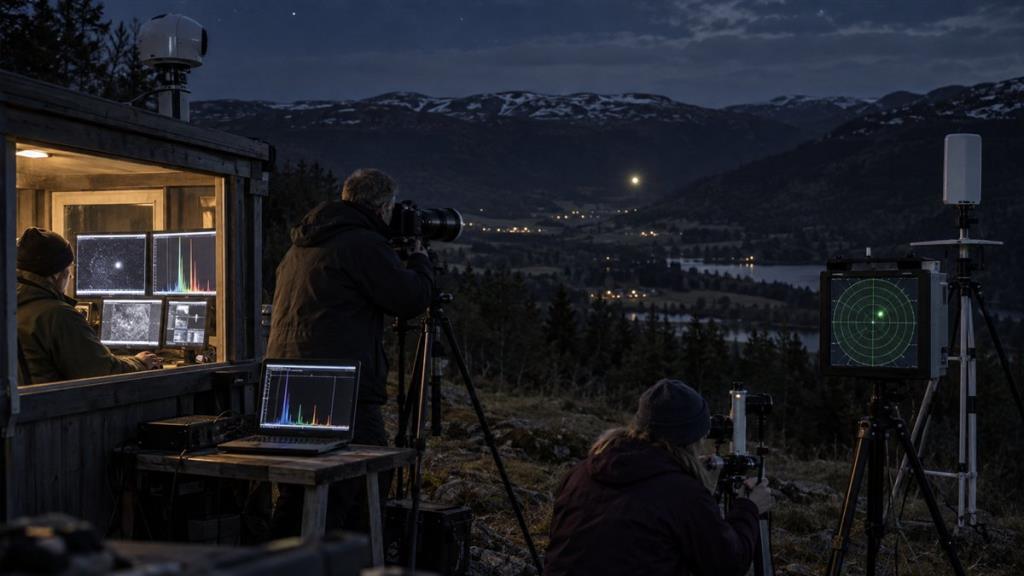
What cameras see and what human eyes infer
In a dark valley, a single point of light reveals neither size nor distance. A small object close to the camera and a large object far away can subtend the same viewing angle. Long exposures turn movement into streaks; fog and thermal inversions bend or scatter light. Measuring velocity requires at least two synchronized stations.
Natural hypotheses
Dusty plasmas, geologically driven ionization, chemical reactions in the atmosphere, and electrical charges from minerals have all been proposed. Each model accounts for certain colors or durations, yet none covers every credible recording. Labeling it plasma remains merely a hypothesis without matching optical spectra, temperatures, and electric fields.
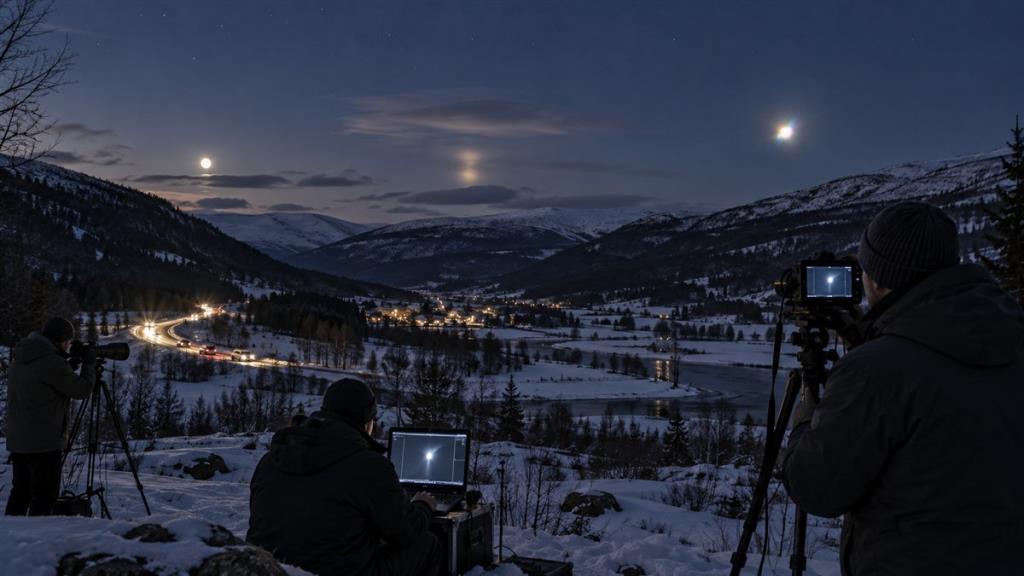
Why does the mystery remain open?
The rarity of the phenomenon means instruments are often pointed in the wrong direction or not operating simultaneously. The database also contains both robust cases and substandard photographs. Hessdalen’s real value lies in the ability to return, measure, and publish timestamps and observational conditions, rather than rushing to conclusions about alien craft.
How an observational record is built
Project Hessdalen began with resident accounts before evolving into field campaigns complete with logbooks, photographs, and scientific equipment. The automated “Blue Box” station enabled continuous monitoring even when researchers were not outdoors. However, equipment changed over the decades, leading to variations in sensitivity, field of view, and classification methods; comparing case counts across years requires accounting for these differences.
Every light must be cross-checked against flight schedules, satellites, planetary positions, roadways, and weather conditions. An obscured mountain road can cause car headlights to appear and vanish abruptly. Headlights bouncing off low cloud decks can sometimes mimic a light source suspended in midair. Eliminating mundane cases does not spell failure for the research; it makes the remaining evidence far more credible.
What can optical spectra reveal?
Spectroscopy splits light into wavelengths, revealing whether an emitter behaves like an incandescent bulb, hot gas, or a reflective surface. Yet faint sources, rapid movement, and clouds introduce noise; a photograph showing a band of color is not necessarily a calibrated spectrum. Deducing chemical composition requires subtracting background illumination, knowing the sensor’s spectral response, and repeating the observation.
Radar does not automatically confirm a solid object either. Ground clutter, weather anomalies, and false echoes can occur. The scientific value multiplies when radar, two cameras, and a spectrometer capture the same target simultaneously with synchronized clocks.
A multi-layered mystery
Some lights may indeed be rare plasma phenomena; others are man-made sources distorted by the atmosphere. Searching for a single explanation for every photograph invites false dilemmas. Categorizing sightings by color, duration, trajectory, and spectrum is far more realistic.
The greatest draw of Hessdalen is not the promise of UFOs, but an open-air natural laboratory complete with local residents, a rich history, and permanent monitoring stations. If a rare physical mechanism is at play, this is where science has the chance to wait for it to return, rather than merely dissecting a past anecdote.
From mysterious lore to verifiable records
A compelling narrative often opens at the moment of awe, but a proper investigation must reconstruct what happened before and after that moment. Researchers assemble timelines, locate records created closest to the event, preserve raw digital files, and flag details derived solely from late recollections. The same detail repeated across hundreds of websites may still trace back to a single source.
For natural phenomena, “not found” also demands clear boundaries. Failing to find meteorite fragments in a bog after decades is fundamentally different from finding none in a freshly cleared survey area the very next day. Capturing no light on a north-facing camera reveals nothing about the southern sky. The scope of the search must always qualify the conclusion.
Measuring shape, speed, and energy
Angular size in a photograph only translates to physical dimensions once the distance is established. Velocity likewise demands distance and elapsed time, while energy is usually inferred from environmental effects. A mistake in any of these three variables can turn a car headlight into a hypersonic craft or a minor reaction into a colossal energy source.
Calibration is an unsung yet decisive phase. Cameras need lens distortion profiles; thermal sensors require reference baselines; station clocks must share the same standard; chemical samples require blanks to catch contamination. These mundane details lack the drama of a striking photograph, yet they mark the line between a hint and genuine evidence.
Good models must risk being refuted
A scientific hypothesis does not merely recount what was seen; it forecasts what has yet to be measured. If ice sheets propel rocks, movement should coincide with shallow water, subfreezing nights, and steady winds; if convection drives ring formation, distinct thermal structures and circulation currents must exist beneath the core. Inaccurate predictions compel a model to be revised or discarded.
Different models can each be correct under different circumstances. Nature is under no obligation to employ a single mechanism for every glowing orb, fairy circle, or odd cloud formation. Precise taxonomy often represents greater progress than hunting for a one-size-fits-all answer.
The role of probability and rarity
A sequence of conditions, each ordinary on its own, can become exceptionally rare when all must align simultaneously. This explains why certain phenomena leave unmistakable traces yet boast few eyewitnesses. It also breeds observational bias: observers waiting for years tend to log events that resemble their expectations, while equipment failures at critical moments leave tantalizing voids.
Automated sensor networks and satellite datasets reduce reliance on sheer luck. Even so, detection algorithms can produce false positives; every automated alert still demands raw imagery and verification against mundane sources. A mountain of data does not automatically equate to a mountain of quality evidence.
When can we consider a mystery solved?
A robust explanation replicates the underlying mechanism, aligns with multiple independent datasets, and leaves no vital clues ignored. It also explains why the phenomenon is rare, localized, and seasonal. With historical traces, we sometimes must settle for the “most plausible explanation” simply because decisive data has been lost to time.
Unraveling a general mechanism does not mean knowing every individual event. We know Racetrack rocks move via thin ice sheets, yet we cannot date every single trail on the playa; we know iron gives Blood Falls its crimson hue, yet the subglacial plumbing remains partly unmapped. Rigorous precision is what preserves the genuine sense of wonder.
Preserving sites means preserving data
Tire ruts on a playa, footsteps on delicate ice, soil removed from a fairy circle, or artificial lights aimed across a valley can all ruin data. Visitors should stick to authorized routes, leave objects undisturbed, and avoid staging “evidence” for a photo. A fake artifact can linger online long after the actual site has degraded.
Respecting local communities is just as vital. They are not merely background characters in a narrative; they hold the observational history, local toponyms, and ecological knowledge. Quality research gives data and conservation benefits back to the communities where the phenomena exist.
A checklist for evaluating extraordinary claims
Faced with a sensational video or viral headline, one can ask six basic questions: Is the raw file available? Can the timestamp and coordinates be independently verified? Does an ordinary light source, flight path, or weather event match the sighting? Was the size measured or merely guessed? Have independent teams reviewed the raw data? Has the author specified what evidence would change their mind? Missing one check does not prove a claim false, but the more that are missing, the lower the certainty.
It is also essential to distinguish peer-reviewed papers from preprints, press releases, and internet anecdotes. A single study is merely a starting point, especially when sample sizes are small or the location is unique. Scientific consensus forms when diverse methodologies converge, not when a single catchy explanation gets shared the most.
The mysteries worth keeping
Rigor does not drain the wonder from a story. The sight of a forest flattened in unison, a silent orb of light suspended over a valley, or a brine icicle descending to the ocean floor still inspires awe even when governed by equations. That sense of wonder is why we ask questions; scientific evidence ensures our answers stay true to the reality we set out to explore.
In every field, genuine unknowns should be acknowledged rather than swept away beneath definitive conclusions. It may be an object’s precise composition, the relative weight of two competing mechanisms, a hidden underwater heat source, or an exact triggering threshold. These well-defined gaps, paired with viable measurement plans, are the true mysteries waiting for the next generation to solve.
How a phenomenon becomes a “mystery”
Rare phenomena usually happen fast, unfold in inaccessible locations, or occur in weather conditions that degrade equipment performance. Eyewitnesses catch only a fleeting perspective, and human memory fills in blanks over repeated retellings. Once the first photo goes viral, disparate occurrences are easily lumped under a single label. Thus, the first question should never be “what is it?” but rather “are we dealing with one phenomenon or many?”
A solid observation requires an accurate timestamp, coordinates, viewing angle, focal length, weather logs, and raw files. Contextual backgrounds help establish angular size; two spaced cameras permit triangulation; optical spectra pinpoint constituent elements and temperatures. Compressed web videos may look striking, but they almost always discard the critical data required for verification.
Distinguishing what is possible from what actually happened
Synthesizing a similar effect in a laboratory only demonstrates that a mechanism can work in theory. To claim that the exact mechanism occurred in nature, it must correctly predict duration, energy output, geometry, ambient weather conditions, and physical traces left behind. A model that explains color but fails to explain kinematics remains incomplete.
Conversely, the lack of an exhaustive model does not make all hypotheses equally valid. Hypotheses consistent with established physics that produce falsifiable predictions and withstand measurement carry vastly more weight than unfalsifiable notions. The term “unidentified” describes an observational data deficit, not a supernatural cause.
Common identification pitfalls
Judging distance in the dark is notoriously deceptive. Bright stars, planets, aircraft beacons, satellites, distant headlights refracted through atmospheric layers, and insects near the lens can all mimic anomalous behavior. A long exposure stretches a point into a line; image stabilization algorithms can cause backgrounds to drift independently of foreground lights; internal lens reflections create “orbs” that glide in sync with camera movement.
In natural landscapes, circular patterns readily evoke the impression of deliberate design. Yet Rayleigh-Bénard convection, wave dynamics, resource competition, and isotropic propagation rates naturally generate rings or regular lattices. Regular geometry alone is not proof of intelligence; what must be quantified is the mechanism that maintains the pattern over time.
Which questions remain worth pursuing?
A worthwhile question must lead to an empirical test: which sensors to deploy, which physical samples to collect, and what data would refute the working hypothesis. For rare transient events, automated monitoring stations running continuously are far more valuable than short field expeditions. For landscape patterns, multi-year satellite imagery documents life cycles and seasonal shifts.
Science does not make a story any less fascinating. A stone sailing across a playa on a paper-thin sheet of ice, a water column producing rings miles across, or microbes thriving in pitch-black subglacial brine are far stranger than sensationalized myths. The difference is that we know precisely which parts have been measured and which remain uncharted.
Reading new claims with a clear head
When encountering claims that a phenomenon has been “completely cracked,” check the publication date, the issuing institution, the methodology, and whether the data has faced independent scrutiny. A sensational headline can effortlessly mutate a “compatible model” into a “solved mystery.” Conversely, narrators may disregard dozens of identified cases to focus exclusively on a handful of ambiguous outliers.
Trustworthy conclusions always define their own limits: what they explain, what remains unexplained, and what conditions would prove them wrong. It is precisely those defined limits that keep curiosity alive without sacrificing the truth.
Staying safe around natural phenomena
No photograph is worth stepping onto fragile ice, walking into an active thunderstorm, trespassing past conservation barriers, or collecting samples unsupervised in extreme environments. Observing from a safe vantage point while recording precise times and bearings is far more valuable than close-up footage that lacks environmental context. Fragile sites must also be preserved intact so that natural signatures remain untainted by footprints, vehicle tracks, or litter left behind by onlookers.



 Korean kimchi and banchan: the craft of fermentation and a table built on sharing
 Persian rice and tahdig: saffron, a crisp bottom layer and the sofreh
 Moroccan couscous and tagine: rhythm, hospitality and the flavours of North Africa
 Brazilian feijoada: a pot of black beans, a weekend lunch and a story with many roots
 The Indian thali: a balanced tray that tells a regional story and a way of eating together
 Danish smørrebrød: the open sandwich and the art of composing a lunch
 Swiss raclette: melted cheese and a shared table in the cold season
 Injera in Ethiopia and Eritrea: the shared platter that binds a community
Đăng nhập để bình luận: / Sign in to comment: