



Tunguska 1908: What Exploded in the Skies Over Siberia?
On the morning of June 30, 1908, a streak of light tore through the Siberian sky and exploded over the taiga near the Podkamennaya Tunguska River. The shock wave flattened trees across more than 2,000 km² and was detected by distant seismographs, yet left no massive impact crater behind. It is precisely this gap between widespread devastation and the absence of a physical crater that has fueled the mystery for over a century.
Local Evenki people nearby recounted a flash of light, deafening thunder, and an intense wave of heat; these accounts were gathered years later, however, and must be weighed against the degradation of human memory. It was not until 1927 that Leonid Kulik's expedition finally reached the ground zero area. They found millions of fallen trees fanning outward in radial patterns, while certain trunks at the epicenter remained standing upright, stripped bare like telephone poles.
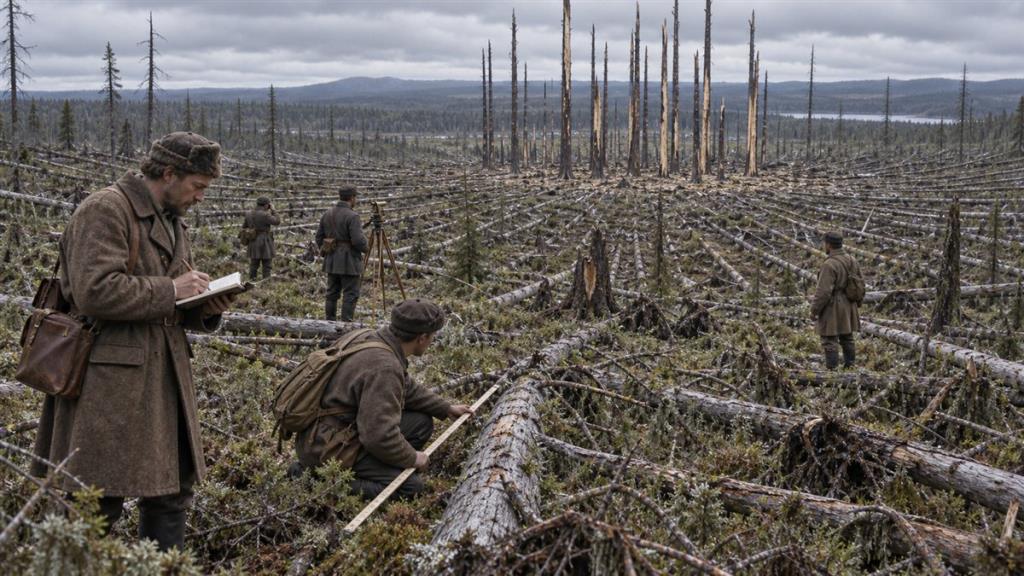
Why Was There No Crater?
An asteroid or comet fragment entering the atmosphere at extreme velocity can shatter and release its energy well before striking the ground. An airburst generates an intense shock wave that sweeps horizontally across the forest; directly below the hypocenter, the downward pressure strips away branches but does not necessarily topple vertical trunks. This tree-fall pattern is far more consistent with an aerial energy discharge than a ground-level explosion.
Asteroid or Comet?
Modern models generally lean toward a stony object several dozen meters in diameter, though its precise composition remains unresolved because the projectile was almost entirely obliterated. Microscopic spherules proposed as extraterrestrial residues are still subject to debate regarding their origin. The failure to discover substantial macroscopic fragments is not unusual for a blast of such colossal thermal and mechanical pressure.
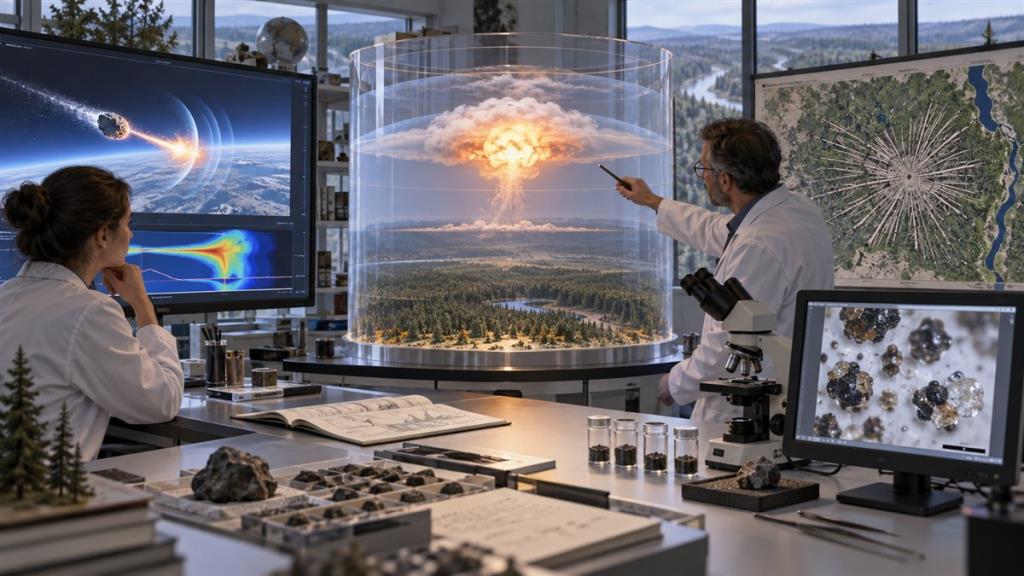
The Lingering Enigma
Trajectory, entry angle, detonation altitude, and the object's physical makeup can only be deduced by cross-referencing tree damage, eyewitness testimonies, and atmospheric models. Lake Cheko has been suggested as a potential impact crater, but its age and morphology have generated no scientific consensus. Tunguska was almost certainly a natural cosmic event; the remaining mystery lies in the precise identity of the celestial visitor that vanished into thin air.
Timeline of an Extraordinary Morning
The event occurred around 7:15 a.m. local time, when many locals were still in hunting camps and remote trading posts. Witnesses described a searing streak of light racing across the sky before intense heat and pressure waves arrived. This sequence of light, sound, and ground tremor matches a hypersonic body releasing energy into the atmosphere; varying distances caused observers to report slightly different timings and azimuths.
Barographic stations worldwide recorded pressure fluctuations traveling around the globe, while the night skies over Europe glowed with unusual brightness over the following days. High-altitude dust likely contributed to this luminescence, though attributing every distant observation to Tunguska demands caution, as the summer atmosphere naturally fosters noctilucent clouds.
What Does the Tree-Fall Map Reveal?
The forest did not collapse into a neat circle; instead, it formed a distinct butterfly-shaped swath, reflecting the oblique flight path, local topography, and detonation altitude. To estimate the total blast yield, researchers must calibrate their calculations against forest age, the passage of 19 years of natural windthrow, and the survey margins of Kulik's early maps. The upright, branchless trunks near the epicenter do not disprove an explosion; rather, they acted as vertical pillars standing directly beneath a downward vertical impulse.
Simulations compare variations in object diameter, bulk density, entry trajectory, and structural strength. Stony bodies tend to fragment catastrophically under immense dynamic pressure, whereas metallic bodies can penetrate deeper. The 2013 Chelyabinsk event provided valuable dashboard camera footage, shock-wave telemetry, and recovered meteorites, aiding the recalibration of Tunguska models despite the disparity in scale.
Once-Popular Hypotheses
Microscopic black holes, antimatter annihilations, extraterrestrial spacecraft, and catastrophic natural gas releases have all been proposed. Each of these either demands physical signatures that do not exist or fails to explain the luminous entry trajectory and tree-fall pattern as convincingly as an atmospheric airburst. A hypothesis does not gain validity merely by being difficult to disprove; it must offer distinct testable predictions that conventional models cannot provide.
Lake Cheko lies near the epicenter, but its acoustic profile, sediment cores, and age estimates remain fiercely debated. Even if Cheko proves unrelated, the high-altitude airburst model remains fundamentally intact. The question of Lake Cheko is merely one branch of investigation, not the linchpin of the entire event.
From Lore to Testable Records
A compelling narrative often opens at the moment of peak spectacle, but scientific investigation must scrutinize the before and after. Researchers build verifiable timelines, locate contemporary primary records, preserve original photographic plates, and filter out claims derived solely from late-recalled memories. A single detail repeated across hundreds of secondary sources may still trace back to an unverified singular account.
When examining natural phenomena, a "null result" must be understood within its search constraints. Failing to find meteorite fragments decades later across sprawling marshlands is vastly different from searching an immaculate test site the very next day. A camera pointing north failing to capture a flash says nothing about the southern horizon. The scope of any search must contextualize its conclusions.
Measuring Geometry, Velocity, and Energy
An angular size on a photographic plate can only be converted into physical dimensions if the precise distance is known. Velocity likewise requires verifiable distance and elapsed time, while energy yields are typically derived from environmental damage. An error in any of these parameters can transform a distant headlight into a hypersonic craft, or a localized reaction into a cataclysmic energy release.
Instrument calibration is quiet but decisive work. Cameras require lens distortion corrections; thermal sensors require reference baselines; station clocks must share common synchronization; and geochemical assays demand blank controls to guard against contamination. These technical steps lack the drama of a raw photograph, yet they mark the dividing line between an unsubstantiated anomaly and scientific evidence.
Good Models Welcome Falsification
A rigorous scientific hypothesis does not merely describe what was observed; it predicts what has yet to be measured. If moving ice sheets push sliding stones, their displacement must correlate with shallow water, subfreezing temperatures, and sustained winds; if atmospheric convection forms fairy circles, a distinct thermal profile and flow dynamics must exist beneath the center. An invalid prediction forces a model to be refined or discarded.
Competing models may hold true across different cases. Nature is under no obligation to use a single mechanism for every glowing orb, circular ground pattern, or cloud formation. Pinpointing precise taxonomies is often far more scientifically productive than searching for an all-encompassing answer.
Probability and the Illusion of Impossibility
A series of conditions—none of them individually extraordinary—can become remarkably rare when required to happen simultaneously. This explains why certain phenomena leave unmistakable physical footprints yet produce very few direct eyewitnesses. It also introduces observational bias: those waiting years for an event tend to over-interpret near-matches, while equipment failures at critical moments create tantalizing information voids.
Automated sensor networks and satellite tracking reduce reliance on serendipity. Even so, automated detection algorithms can yield false positives; every automated trigger still demands scrutiny against raw files and known baseline phenomena. More raw data does not automatically translate into stronger scientific proof.
When Can a Mystery Be Declared Solved?
A robust solution reconstructs the underlying physical mechanism, aligns with multiple independent datasets, and does not require cherry-picking or ignoring stubborn details. It also accounts for why the phenomenon is rare, why it appears in specific regions, and why it favors certain seasons. With historical events, we must sometimes settle for the "most probable explanation," simply because pivotal data have been lost to time.
Solving a general mechanism does not imply knowing every granular event. We may understand that the Racetrack Playa rocks glide via thin ice sheets without knowing the exact movement dates of ancient trails; we may understand that Blood Falls owes its hue to oxidized iron while its subglacial plumbing remains partly unmapped. Precise nuance preserves the genuine wonder of the unknown.
Preserving the Site Preserves the Data
Tire ruts on a dry playa, footprints on fragile shore ice, soil samples gouged out of anomalous rings, or artificial light pollution cast into a dark valley can permanently corrupt baseline data. Visitors should stick strictly to authorized paths, leave objects undisturbed, and refrain from manufacturing "evidence" for social media. A fabricated artifact can outlive the real physical site online.
Respecting local indigenous communities is equally vital. They are not merely colorful background figures in folklore; they are custodians of decades of environmental observation, naming conventions, and ecological memory. Ethical research returns its findings and conservation benefits to the land where the phenomenon occurs.
A Checklist for Evaluating New Claims
When confronted with a sensational video or "earth-shattering" claim, six questions should be asked: Are the original raw data files available? Can the precise timestamp and geographic coordinates be verified? Could mundane sources—such as illumination, commercial flights, or local weather—explain the signature? Were dimensions measured or merely guessed? Have independent research groups scrutinized the raw telemetry? And has the claimant specified what evidence would convince them they are mistaken? Missing one check does not automatically invalidate a claim, but missing several drastically diminishes its credibility.
It is equally crucial to differentiate between peer-reviewed literature, unreviewed preprints, press releases, and viral anecdotes. A single publication is merely a starting point, particularly when dealing with small sample sizes or unique locales. Scientific consensus emerges when diverse methodologies independently arrive at the same conclusion—not when an explanation goes viral.
The Part of the Mystery Worth Keeping
Scientific rigor does not require stripping a phenomenon of its wonder. The image of a primeval forest laid flat in an instant, a silent orb of light hovering over a twilight valley, or a brine icicle descending toward the seafloor still commands awe, even when explained by mathematical physics. Wonder is what prompts the original question; rigorous evidence ensures that our answers do not betray the truth of what we set out to understand.
In every inquiry, the genuine unknown deserves to be preserved rather than papered over with false certainty. That might mean an uncertain projectile composition, the exact ratio between competing physical mechanisms, a subaquatic heat flux, or precise atmospheric trigger thresholds. Clearly defined, measurable gaps in our knowledge are the only mysteries that future generations can meaningfully solve.
How a Phenomenon Becomes a "Mystery"
Rare events often unfold in seconds, in remote locations, or under adverse weather that degrades recording instruments. Witnesses capture only a partial vantage point, and human memory unconsciously fills in the blanks with each retelling. When an initial dramatic image spreads, fundamentally different occurrences often become conflated under a single sensational label. Therefore, the critical first question is never "What is it?", but rather "Are we analyzing one phenomenon or several different ones?"
A rigorous observation demands an exact timestamp, location, viewing azimuth, optical focal length, local meteorology, and unmodified raw capture files. Background landmarks permit angular calibration; two widely separated cameras allow trigonometric triangulation; optical spectroscopy reveals chemical elements and ionization temperatures. Highly compressed internet videos may look striking, but they usually strip away the very metadata required for scientific verification.
Distinguishing Plausibility from Actuality
Replicating a visual duplicate of an anomaly in a laboratory merely demonstrates that a theoretical mechanism is physically viable. To confirm that the mechanism occurred in the wild, it must accurately reproduce the event's duration, energy budget, morphology, environmental conditions, and physical aftermath. If a model explains the color of a phenomenon but contradicts its observed kinematics, it remains fundamentally incomplete.
Conversely, the lack of a fully unified model does not put every wild speculation on equal footing. Hypotheses that conform to known physical laws, generate falsifiable predictions, and withstand empirical testing carry vastly more weight than non-falsifiable ideas. In science, the label "unidentified" denotes the limits of available data, not the presence of the supernatural.
Common Misidentifications
Estimating distances in the dark without fixed reference points is notoriously unreliable. Bright planets, celestial stars, aircraft navigation strobes, low-orbit satellites, distant automotive headlights refracted by thermal inversions, and insects fluttering close to a camera lens can all take on uncanny appearances. Long exposures turn single points of light into moving streaks; digital image stabilization creates differential parallax between an object and its background; and internal lens reflections manifest as ghost "orbs" that mimic camera movement.
Across terrain, geometric symmetry often tempts observers to infer intelligent design. Yet natural convection cells, capillary waves, competitive resource distribution, and uniform diffusion rates inherently generate circular patterns and self-organizing tessellations. Regular geometry is not inherent evidence of intentionality; what must be studied is the physical mechanism that sustains that pattern over time.
Which Questions Remain Worth Asking?
A productive scientific question points directly toward a falsifiable test: what sensor needs to be installed, what isotope needs to be extracted, and what measurement would definitively refute the hypothesis? For rare anomalies, autonomous instruments operating continuously provide far more rigorous insight than brief, ad-hoc expeditions. For landscape dynamics, long-term multi-spectral satellite monitoring tracks life cycles and seasonal variations far better than single site visits.
Science does not diminish the wonder of the natural world. A boulder pushed across a dry lake bed by fragile rafts of ice, a giant rotating column of water carved out across kilometers of open ocean, or extremophilic microbes thriving in dark subglacial brine are far more fascinating than contrived paranormal explanations. The vital difference is that we know precisely which parts have been verified by measurement—and which parts remain waiting in the dark.
Reading New Findings with a Discerning Eye
Whenever headlines proclaim that an enigma has been "definitively solved," check the publication date, the research institution, the empirical methodology, and whether the findings have undergone independent replication. Sensational press releases regularly inflate "a plausible model" into an "absolute resolution." Conversely, sensationalist storytellers often ignore dozens of conclusively identified cases to focus exclusively on a handful of poorly documented ambiguities.
Credible conclusions are characterized by explicit boundaries: what the study explains, what remains unresolved, and what precise findings would falsify the model. These boundaries are what keep scientific curiosity vibrant without sacrificing empirical truth.
Staying Safe in the Field
No photograph or video is worth venturing out onto treacherous thin ice, exposing oneself to open lightning fields, trespassing into delicate ecological reserves, or sampling dangerous extreme environments without appropriate protocol. Observing quietly from a secure vantage point while meticulously logging timestamps, weather conditions, and viewing azimuths provides far greater scientific value than shaky close-up footage that lacks contextual data. Fragile landscapes must be left undisturbed so that delicate geological and biological baselines remain free from tire ruts, footprints, and modern debris.



 Korean kimchi and banchan: the craft of fermentation and a table built on sharing
 Persian rice and tahdig: saffron, a crisp bottom layer and the sofreh
 Moroccan couscous and tagine: rhythm, hospitality and the flavours of North Africa
 Brazilian feijoada: a pot of black beans, a weekend lunch and a story with many roots
 The Indian thali: a balanced tray that tells a regional story and a way of eating together
 Danish smørrebrød: the open sandwich and the art of composing a lunch
 Swiss raclette: melted cheese and a shared table in the cold season
 Injera in Ethiopia and Eritrea: the shared platter that binds a community
Đăng nhập để bình luận: / Sign in to comment: