



Where Do the Giant Circles Under the Ice of Lake Baikal Come From?
Every winter, Lake Baikal freezes over like a giant sheet of glass. But satellite images sometimes detect dark circles kilometers wide appearing amidst the white ice. They are too large to be recognized from the lake surface and have appeared in multiple years, at locations that are not exactly the same.
The dark circles are areas of thinner or wetter ice than the surroundings, not drawings on the surface. NASA has tracked similar structures through satellite images and photos from space shuttles. The circular geometry suggests a rising water column and a rotating convection current underneath.
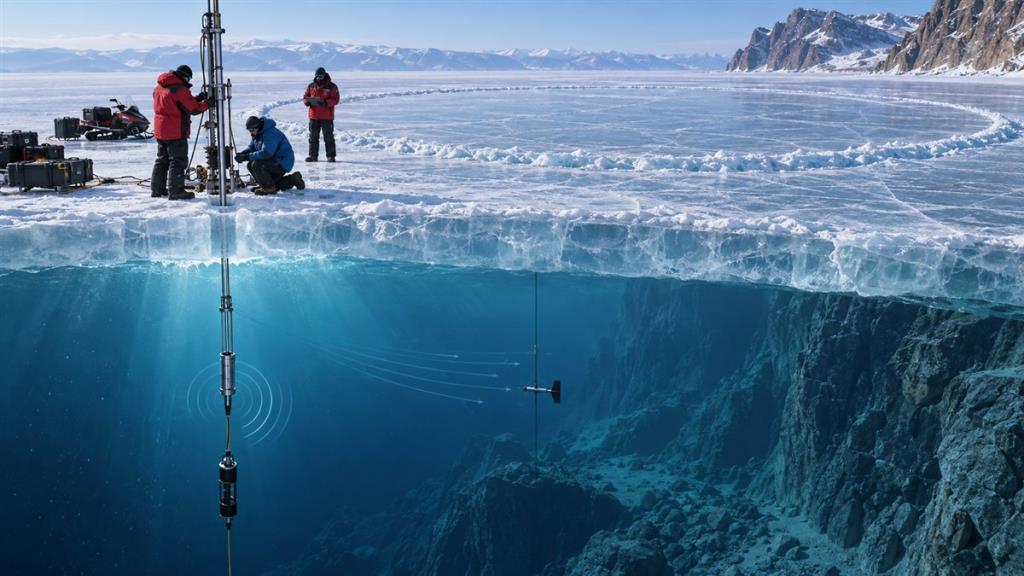
How Can Deep Water Thin the Ice?
If relatively warm water rises locally, it spreads horizontally upon hitting the ice sheet and then sinks at the edges, creating a convection cell. Heat and movement make the ice at the rim thinner; wet snow or overflowing water makes the dark circle stand out in optical images.
What Role Do Methane Gas and Hydrothermal Activity Play?
Baikal lies on a rift zone, with heat flow and gas venting in some areas. Bubbles or warm water could initiate the rising current, but each circle needs direct measurement to determine its source. The appearance of circles over very deep areas makes a simple explanation using a fixed vent insufficient.
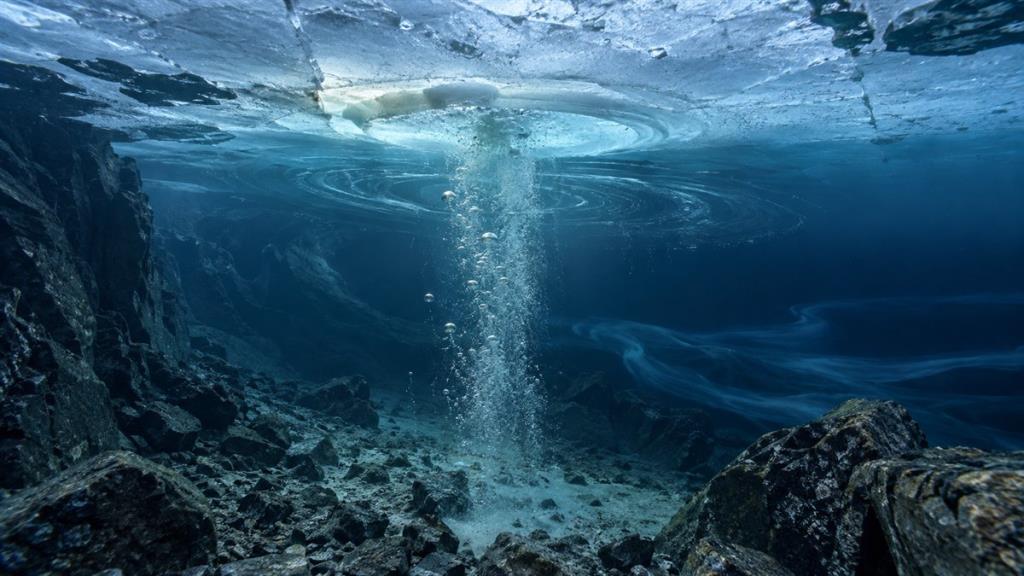
Beauty Concealing Danger
The edges of the circles can be weak ice, posing risks to vehicles and people walking on the lake. Research combining satellites, radar, thermal buoys, and ice drilling not only solves the puzzle but also serves for warnings. The open question is the trigger mechanism each year and whether changes in lake temperature alter the frequency.
Viewed from Satellites vs. Viewed on the Ice Surface
Circles kilometers wide exceed the field of view of a person standing on the lake. From the ground, it is just an area of cracks and discolored ice that is hard to recognize. Daily repeating MODIS images show the circles appearing while ice still covers the lake and then disappearing quickly during the melting season, helping to distinguish water–ice structures from fixed marks on the bottom.
Clouds, fresh snow, and the Sun's angle sometimes make the circles disappear on images even though the structure has not melted. Satellite radar can complement this because it is sensitive to roughness and water in the ice, but interpretation also requires lake surface data.
The Convection Engine Under the Glass Sheet
Freshwater reaches its maximum density near 4°C, giving the deep lake in winter a special stratification. A slightly warm or gas-rich rising source creates circular motion; the Coriolis force, bottom topography, and background currents bend it into a vortex. The moving water exchanges heat with the ice and creates a thin rim.
Methane can mark fluid flow from sediments, but bubbles do not automatically explain all the heat. Hydrothermal activity, fault lines, and lake basin shape are competing variables. Measuring one circle is not representative of all circles.
What Does the Measurement Campaign Need to Do?
The field team places chains of temperature sensors at depth, measuring current velocity, gas composition, and ice thickness from the center through the rim. Weeks of data show whether the circle forms before being seen on satellites or after a meteorological event.
Baikal is deep, wide, and has harsh winters, making measurements very difficult. The mystery does not lie in the circle as an artificial sign, but in what small energy source beneath kilometers of water can organize such a giant mark on the surface.
From Mysterious Stories to Testable Records
An engaging story often begins at a moment of awe, but investigation must go back before and after that moment. Researchers build a timeline, look for records closest to the event, keep original image files, and flag details that only come from late recollections. The same detail copied by hundreds of pages can still originate from a single source.
For natural phenomena, "not found" also needs limits. Not finding meteorite fragments after decades in a swamp is different from not finding them in a clean survey area the very next day. Failing to record light with a north-facing camera says nothing about the southern sky. The scope of the search must go hand in hand with the conclusion.
Measuring Shape, Speed, and Energy
Angular size on an image only becomes real size when the distance is known. Velocity also requires distance and time, while energy is often inferred through its impact on the environment. An error in one of the three can turn a car light into a hypersonic object or a small reaction into a giant energy source.
Calibration is a quiet but decisive step. Cameras need to know lens distortion; temperature sensors need reference points; station clocks need the same standard; chemical samples need blank samples to detect contamination. These details are less dramatic than the photo but are the boundary between signs and evidence.
A Good Model Must Accept Being Refuted
A scientific hypothesis does not just retell what has been seen but also predicts what has not been measured. If ice pushes rocks, the movement must go with shallow water, cold nights, and wind; if convection creates circles, there must be a corresponding thermal and current structure beneath the center. Incorrect predictions force the model to be modified or discarded.
Different models are sometimes correct in different cases. Nature is under no obligation to use one mechanism for every glowing orb, every dirt ring, or every similar cloud. Accurate classification can be a greater step forward than finding a single overarching answer.
The Role of Probability and Rarity
A chain of conditions, none of which is too strange, can still rarely happen at the same time. This explains why the phenomenon leaves traces but has few direct witnesses. It also causes bias: people who wait for years easily record cases close to what they expect, while equipment failing at the right time creates an attractive void.
Automated sensor networks and satellite data reduce reliance on luck. Still, detection algorithms can produce false positives; each warning still needs original images and checks of familiar sources. More data does not automatically mean more good evidence.
When Can We Say a Mystery Has Been Solved?
A strong solution reproduces the mechanism, fits multiple independent datasets, and does not ignore important details. It also explains why the phenomenon is rare, in the right place, and in the right season. With old traces, we sometimes only reach the level of "the most plausible solution" because the decisive data has been lost.
Solving the general mechanism does not mean knowing every individual event. We may know that Racetrack rocks move thanks to thin ice but not know the date of each old trail; we may know the color of Blood Falls is due to iron but still have not finished mapping the subglacial water system. Accurate phrasing preserves the truly mysterious part.
Preserving Sites Is Preserving Data
Tire tracks on a playa, footprints on thin ice, soil samples taken from a circle, or lighting equipment brought into a valley can all destroy data. Visitors should follow permitted routes, not move objects, and not create "evidence" for photos. A fake mark can live on the internet longer than the real scene.
Respecting local communities is also important. They are not just background characters in the story but hold the history of observations, names, and environmental knowledge. Good research returns data and conservation benefits to where the phenomenon exists.
A Checklist to Self-Evaluate New Claims
Faced with a "shocking" video or news, one can ask six things: is the original file still available; can the time and coordinates be confirmed; are there any common light sources, flights, or weather that match; is the size measured or just estimated; has an independent group reviewed the data; and does the author state clearly what would make them change their mind. Lacking one item does not make the claim wrong, but the more that are missing, the lower the level of certainty.
It is also necessary to distinguish peer-reviewed research papers, preprints, press releases, and online accounts. A single study is a starting point, especially when samples are few or the location is unique. Consensus forms when many different methods converge, not when an explanation is shared the most.
The Part of the Mystery Worth Keeping
Caution does not require the story to be dry. The moment a forest falls together, a glowing orb hangs silently over a valley, or an ice finger grows down to the seabed still sends shivers down the spine even when there are equations behind it. The sense of wonder is the reason to ask questions; evidence is the way to ensure the answer does not betray the very thing we want to discover.
In each topic, the unknown is kept separate instead of being covered by an absolute conclusion. It could be the composition of the object, the ratio between two mechanisms, the underwater heat source, or the exact trigger conditions. Named gaps with planned measurements are the mysteries likely to be solved by the next generation.
How a Phenomenon Becomes a "Mystery"
Rare phenomena often happen quickly, in hard-to-reach places, or in weather that makes equipment perform poorly. Witnesses only see one angle, and memory naturally fills in the gaps after multiple retellings. When the first image spreads, different cases are easily grouped under the same name. Therefore, the first question is not "what is it" but "are we talking about one or multiple phenomena."
A strong observation needs the exact hour, location, viewing direction, focal length, weather, and original data. Photos with background scenery help estimate angles; two cameras spaced apart allow distance calculations; light spectra reveal elements and temperature. Compressed videos online may look beautiful but have often lost the very data needed for verification.
Distinguishing Feasible from What Actually Happened
An experiment that creates an object similar to the phenomenon only proves that a mechanism can work. To say that mechanism actually happened in nature, it must correctly predict the duration, energy, shape, weather conditions, and traces after the event. If it only explains the color but not the movement, the model is still lacking.
Conversely, the lack of a complete model does not make all options equal. Hypotheses that fit physics, make predictions, and withstand measurements carry more weight than irrefutable ideas. The term "unidentified" describes data limitations, not the name of a supernatural cause.
Common Identification Errors
Distances in the dark are very difficult to estimate. Bright stars, planets, aircraft lights, satellites, car lights through the atmosphere, and insects near the lens can take on unusual appearances. Long exposures stretch a point into a line; image stabilization makes the background shake differently from the object; reflections in the glass create a "sphere" that moves with the camera.
In landscapes, circles also easily suggest a designing hand. But convection, waves, resource competition, and propagation speeds that are equal in all directions naturally create rings or repeating networks. Regular geometry is not in itself evidence of intelligence; what needs to be measured is the mechanism that maintains the pattern over time.
Which Questions Are Still Worth Pursuing?
A good question must lead to a test: which sensors to place, which samples to take, which data can refute the hypothesis. For rare events, automated systems running continuously are often more valuable than short survey expeditions. For landscapes, multi-year satellite images reveal lifespans and seasonal changes.
Science does not make the story less mysterious. A rock hitching a ride on a thin sheet of ice, a water column creating a circle kilometers wide, or microbes living in dark brine under a glacier are all far stranger than many sensational explanations. The difference is that we know which parts have been measured and which parts remain in the dark.
Reading New Information Mindfully
When there is a claim of "completely decoded," check the date, publishing agency, methods, and whether the data has been reviewed by another group. A press headline can turn a "fitting model" into a "solved mystery." Conversely, a storyteller might ignore dozens of identified cases just to keep a few ambiguous ones.
Reliable conclusions usually have boundaries: what is explained, what is not yet explained, and what conditions would make it wrong. It is those very boundaries that keep curiosity alive without trading away the truth.
Staying Safe When Approaching Phenomena
One should not step onto thin ice, walk into thunderstorms, cross conservation fences, or take samples in extreme environments just for a photo. Observing from a safe position, recording the time and viewing direction is often more valuable than a close-up video that loses context. Fragile sites also need to be left intact so that natural traces are not distorted by footprints, vehicles, or objects left behind by visitors.



 Korean kimchi and banchan: the craft of fermentation and a table built on sharing
 Persian rice and tahdig: saffron, a crisp bottom layer and the sofreh
 Moroccan couscous and tagine: rhythm, hospitality and the flavours of North Africa
 Brazilian feijoada: a pot of black beans, a weekend lunch and a story with many roots
 The Indian thali: a balanced tray that tells a regional story and a way of eating together
 Danish smørrebrød: the open sandwich and the art of composing a lunch
 Swiss raclette: melted cheese and a shared table in the cold season
 Injera in Ethiopia and Eritrea: the shared platter that binds a community
Đăng nhập để bình luận: / Sign in to comment: