



MV Joyita: The Unsinkable Ship and the 25 People Who Never Returned
On October 3, 1955, the MV Joyita left Apia, Samoa for Tokelau on a scheduled two-day journey. There were 25 people on board. More than a month later, the Joyita was discovered drifting north of Fiji, listing heavily but still afloat. No one on board was ever found.
The Joyita was a wooden vessel of about 70 tons, having served the US Navy and later converted for cargo. Its hull contained cork flotation material and empty fuel drums, making it very difficult to sink completely. Before departure, one engine had failed; the ship set off with the remaining engine and a radio that was not in the best condition.
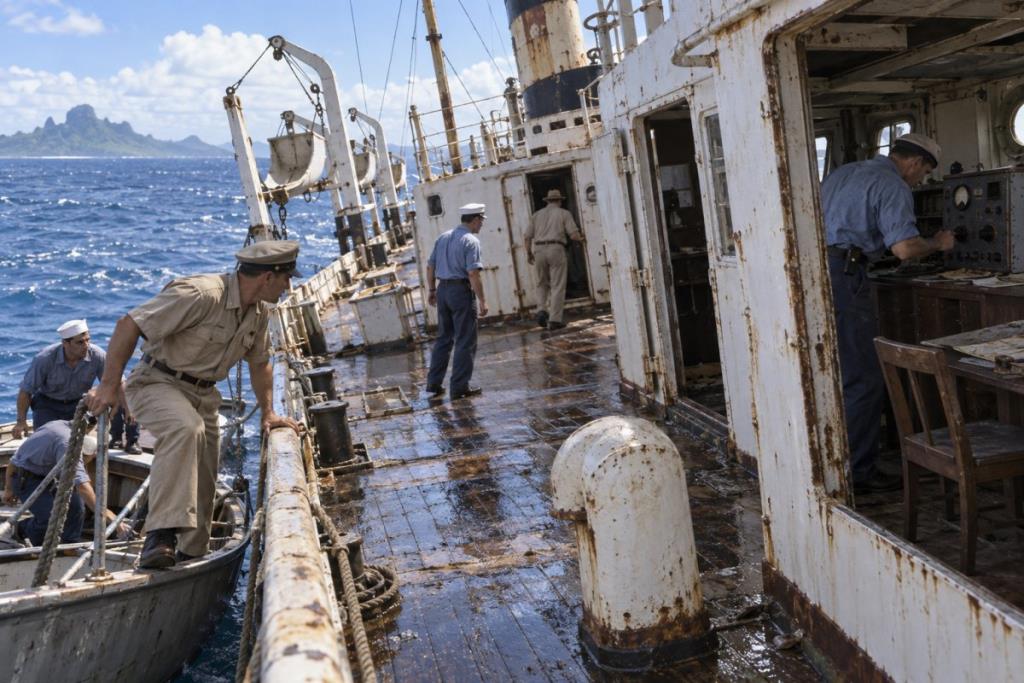
The Scene on the Ship
The Joyita was listing to port, the deck low to the water, a cooling pipe had failed, and water had entered the hold. The pumps were not working effectively. The radio was tuned to the emergency frequency, but a damaged lead meant the transmission range was very short. The logbook and navigation equipment were missing.
The small boats and life rafts were gone, suggesting the people left the ship using flotation devices. A medical bag with bloody bandages was not enough to prove a crime; there was a doctor on the trip and a patient needing treatment in Tokelau.
Why Abandon a Nearly Unsinkable Ship?
The buoyancy characteristics were not necessarily clear to everyone at night, when the ship was listing, water was spreading under the floor, one engine was lost, and the radio could not call for help. If the captain believed the ship was about to capsize, boarding the lifeboats might have seemed like the only option.
The 1956 Commission of Inquiry criticized the maintenance and linked the flooding to the broken pipe, but could not determine the exact timing and reason for abandoning the ship. That gap paved the way for stories of pirates, mutiny, and strange fishing vessels.
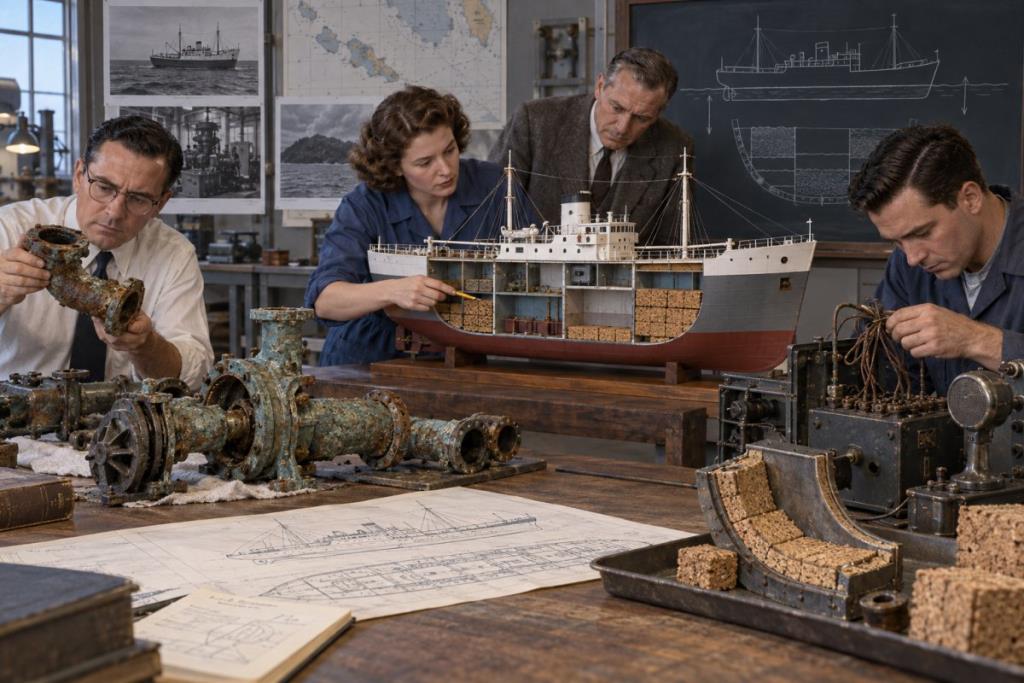
What Happened After Leaving the Ship?
If 25 people boarded small boats in rough seas, overloaded and lacking navigation, they could have been separated from the Joyita very quickly. The large ship continued to drift thanks to its buoyancy, while the low-profile boats were easily capsized or missed by aircraft. What was left behind survived better than the life-saving equipment.
Theories of violence are based on missing items and bloodstains, but cargo could have shifted during the more than a month the ship drifted. There were no bodies, weapons, or testimony to reconstruct a criminal sequence. Rumors of hiding Japanese forces reflected a post-war psyche rather than physical evidence.
Delay Changed the Scene
The Joyita drifted for over a month before being discovered. Waves, rain, corrosion, and people who accessed it later could have moved items. The ship's final position was not where the group abandoned it; currents could have carried it hundreds of kilometers. Therefore, searching for boats around the discovery point was too late and in the wrong location.
Initial search aircraft had to cover a very wide probability area. A low wooden boat, without radio transmission and colored close to the sea surface, could easily slip out of sight amidst clouds, waves, and sun glare. Not finding the boats does not prove they were taken by another ship.
Maritime Safety Lessons
The incident shows that preventive maintenance is more important than any single piece of equipment. A failed engine, poor pumps, a leaking pipe, and a short-range radio can add up to a crisis. The fact that the ship remained afloat does not make the decision at that time irrational; the sailors only knew the part of the scene they observed in the dark.
Distinguishing Facts from Speculation
A strong fact needs records close to the time of occurrence, physical evidence with a clear origin, or multiple independent measurements. Late accounts, details appearing only in popular books, and unverified images are ranked lower. "Not fully explained" does not mean all hypotheses have equal value.
The article prioritizes scenarios that explain multiple traces simultaneously with few assumptions, while keeping the unknown parts clear. If a new discovery emerges, the first question should be who confirmed it, what the identification method was, and whether the data was published for independent verification.
Conclusion
The most plausible explanation is a technical failure leading to the decision to abandon ship, after which the sea erased the traces of the lifeboats. It remains unclear who gave the order, how many boats the group used, and in which direction they went. The records explain why the Joyita stayed afloat, but not the final journey of the 25 people.



 Jamaican jerk: the scent of pimento, the smoke pit and a community's living heritage
 Korean kimchi and banchan: the craft of fermentation and a table built on sharing
 Persian rice and tahdig: saffron, a crisp bottom layer and the sofreh
 Moroccan couscous and tagine: rhythm, hospitality and the flavours of North Africa
 Brazilian feijoada: a pot of black beans, a weekend lunch and a story with many roots
 The Indian thali: a balanced tray that tells a regional story and a way of eating together
 Danish smørrebrød: the open sandwich and the art of composing a lunch
 Swiss raclette: melted cheese and a shared table in the cold season
Đăng nhập để bình luận: / Sign in to comment: