



Mary Celeste: the ship was intact but the crew vanished
On December 4, 1872, the crew of the Dei Gratia spotted the Mary Celeste sailing erratically near the Azores. Upon boarding, they found no sign of Captain Benjamin Briggs, his family, or the seven crew members. The ship was still afloat, the cargo was largely intact, but the lifeboat and the people had vanished.
The Mary Celeste had departed New York on November 7, carrying 1,701 barrels of industrial alcohol to Genoa. On board were Briggs, his wife, their two-year-old daughter, and an experienced crew. The last log entry was dated November 25 near Santa Maria Island. The nine-day gap between the entry and the discovery created a witness-free void.
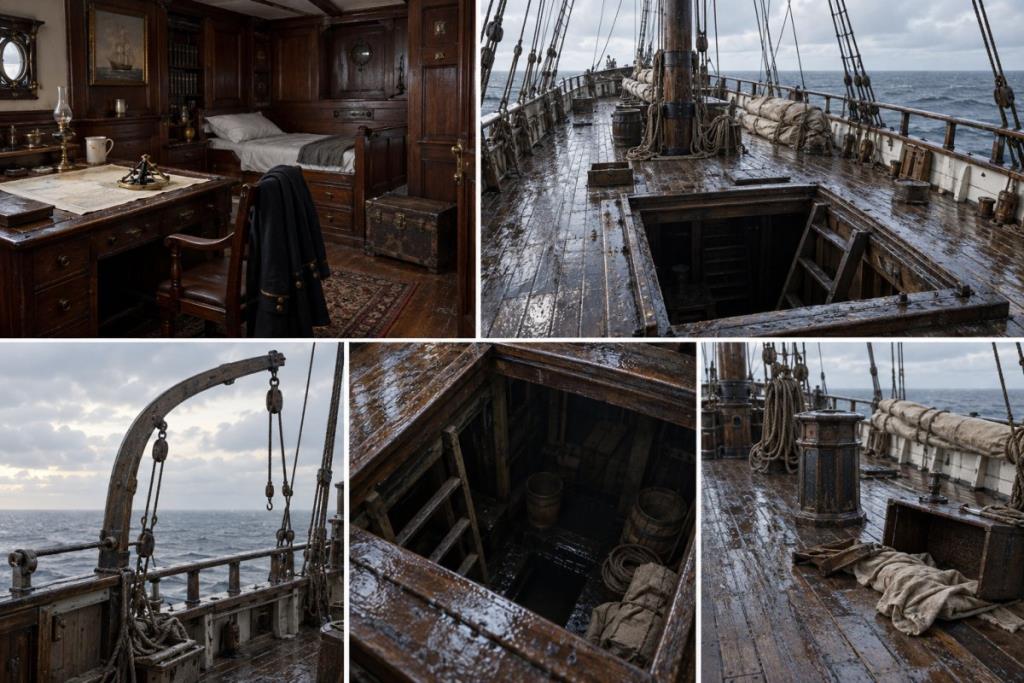
What state was the ship actually in?
Reports showed some water in the hold, some hatch covers not in perfect condition, and a faulty pump, but the Mary Celeste was not about to sink when found. Food and fresh water were still plentiful. The main papers and portable navigation equipment were gone; this is more consistent with an intentional abandonment by the captain than an instantaneous disappearance of everyone.
The small boat appeared to have been lowered, and a rope might have once connected it to the ship. If the crew believed the hull was at risk of exploding, burning, or sinking, they might have temporarily evacuated to the boat while intending to stay close. If the rope snapped in strong winds, the small boat would have been unable to catch up with the sailing ship.
Why might they have misjudged the risk?
A pragmatic theory combines several factors: rough seas, water entering the hold, coal dust making the pumps difficult to operate, and a sounding rod that may have given worrying readings. Briggs had no quick way to see all the water beneath the cargo. After days of bad weather and navigational errors, he may have believed the ship was closer to land than it actually was and ordered a temporary evacuation.
Nine barrels of alcohol were found empty. Alcohol fumes have sparked theories of an explosion or fear of an explosion, but there were no major burn marks on the ship. Pressure or noise in the hold could have alarmed those on deck without leaving a destructive explosion. This is a possible mechanism, not a proven conclusion.
What is commonly mistold?
There was no warm, steaming meal, no blood splattered on the deck, and no evidence of pirates taking everyone's lives but leaving the cargo. Many famous details come from a fictional story by Arthur Conan Doyle published in 1884; he changed names and added plot points, which gradually became mixed with the real records.
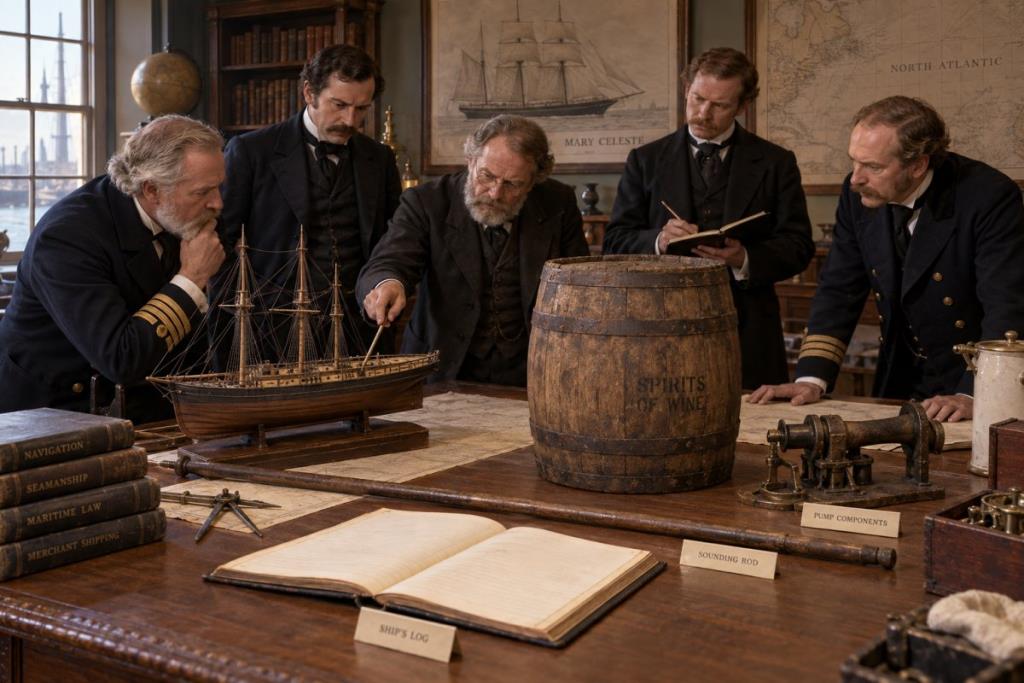
The inquiry in Gibraltar suspected salvage fraud and investigated the captain of the Dei Gratia, but failed to prove a conspiracy. The salvage award paid was lower than expected, but that does not turn suspicion into evidence of murder. The ship's name was later commercialized as a "ghost ship," overshadowing a very human maritime question: a wrong safety decision made under uncertain conditions.
What remains open?
No one knows Briggs's final order, the exact state of the pumps, or the weather at the moment of abandonment. The wreckage of the boat and the ten people have never been found. Therefore, the theory of abandonment due to fear of danger is the most plausible with the existing physical evidence, but the specific chain of causes still cannot be fully reconstructed.
How have modern experiments helped?
Tests with alcohol fumes show that the mixture can burn rapidly without leaving large soot marks, but the experiment proves a possible mechanism, not that it happened on the Mary Celeste. Similarly, analyses of the pumps and cargo load are only valuable when they match the configuration, weather, and actions of the crew in 1872.
To compare theories, one must ask how many details each scenario explains with the fewest assumptions: the missing boat, the papers taken, the ship still under sail, water in the hold, and no signs of violence. A chain of temporary abandonment followed by loss of contact explains more points simultaneously than an attack that left no trace.
How to distinguish facts from speculation
A strong fact requires records close to the time of the event, physical evidence of clear origin, or multiple independent measurements. Late accounts, details appearing only in popular books, and unverified images are ranked lower. "Not fully explained" does not mean all theories are of equal value.
This article prioritizes scenarios that explain multiple traces simultaneously with the fewest assumptions, while keeping the unknown parts clear. If a new discovery emerges, the first question should be who verified it, what the identification method was, and whether the data has been published for independent verification.
Conclusion
The Mary Celeste is mysterious not because it was completely intact, but because a ship can still survive after humans are forced to make a decision in a matter of minutes. No ghosts or pirates were needed: water in the hold, unreliable equipment, volatile cargo, an uncertain position, and a snapped rope were enough to create a tragedy.



 Jamaican jerk: the scent of pimento, the smoke pit and a community's living heritage
 Korean kimchi and banchan: the craft of fermentation and a table built on sharing
 Persian rice and tahdig: saffron, a crisp bottom layer and the sofreh
 Moroccan couscous and tagine: rhythm, hospitality and the flavours of North Africa
 Brazilian feijoada: a pot of black beans, a weekend lunch and a story with many roots
 The Indian thali: a balanced tray that tells a regional story and a way of eating together
 Danish smørrebrød: the open sandwich and the art of composing a lunch
 Swiss raclette: melted cheese and a shared table in the cold season
Đăng nhập để bình luận: / Sign in to comment: