



Helike: The Greek City That Vanished After the 373 BCE Earthquake
Helike was once so famous that ancient authors recounted that its ruins could still be seen underwater. When modern searches began, the biggest surprise was that the city was not located in the current sea but buried beneath the coastal plain.
Helike was a center of the Achaea region on the southern shore of the Gulf of Corinth. Ancient sources describe a winter earthquake in 373 BCE, followed by seawater rushing in and destroying the city. Over centuries, silt filled the lagoon and the shoreline shifted, concealing the landscape of the disaster.
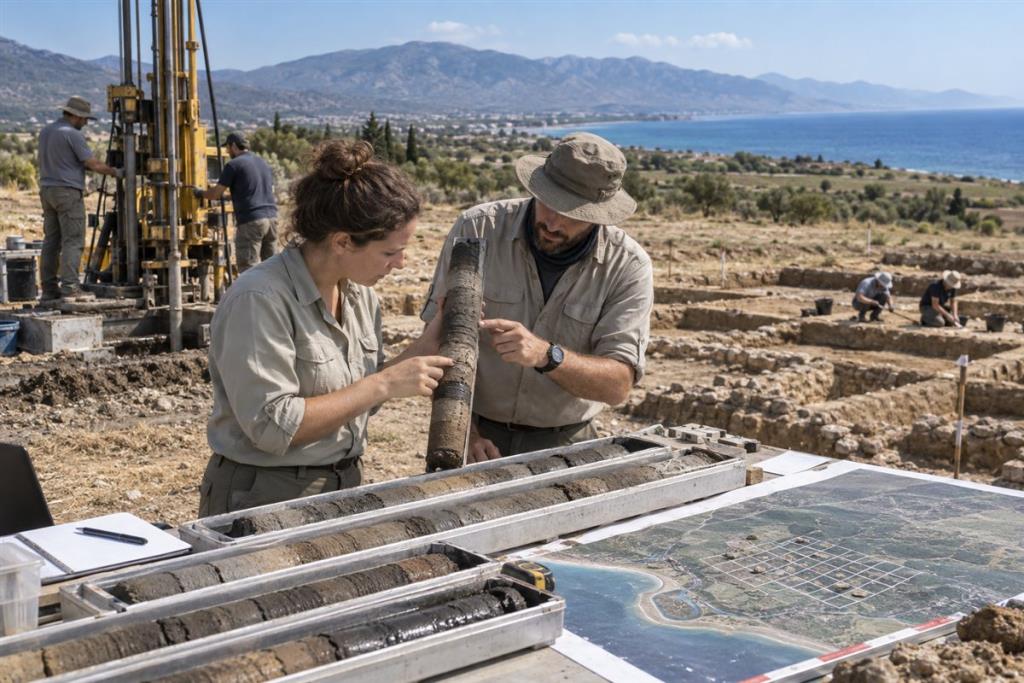
Why did the initial search look in the wrong place?
If one reads the accounts of "sinking into the sea" according to the modern shoreline, the bottom of the gulf is a logical place for sonar scanning. Surveys failed to find the city, so the Helike Project team moved to the plain. Core drilling revealed lagoon sediments and pottery shards at various depths, proving the area was once covered by water and then turned back into land by siltation.
Where archaeological and geological evidence meet
Excavations discovered house walls, roads, and destruction layers in a sedimentary environment consistent with an earthquake and marine flooding. Marine microfossils in the soil helped identify past saltwater intrusion. This is an important example of geoarchaeology: texts provide direction, geology reconstructs the landscape, and artifacts determine the timing and human activities.
There is more than just one Helike
The area also preserves an Early Bronze Age settlement buried about two millennia before the classical disaster. These occupation layers from multiple periods serve as a reminder that the name of a city does not correspond to a single ground level. Residents could return to the land after a natural disaster, building new residential areas and workshops on a transformed landscape.
Was Helike the prototype for Atlantis?
The event occurred while Plato was alive, so it is often linked to Atlantis. However, proximity in time and the shared elements of earthquake-flooding are not enough to prove a genetic relationship. Plato placed Atlantis in the distant past and used it in a political-moral story; Helike is a city with its own specific location, dating, and archaeological destruction layers.
Unresolved questions
- The extent and sequence of the tsunami, subsidence, and lagoon flooding are still being modeled.
- Matching each structure precisely to the classical city or later settlements requires further dating.
- Ancient sources were written for different purposes and therefore cannot be treated in every detail as modern geological reports.
Conclusion
Helike shows that a "sunken city" can be found by studying changes in the shoreline rather than just diving into the sea. This is a mystery that has largely been unraveled, yet it remains a valuable laboratory for earthquakes, tsunamis, and historical memory.



 Korean kimchi and banchan: the craft of fermentation and a table built on sharing
 Persian rice and tahdig: saffron, a crisp bottom layer and the sofreh
 Moroccan couscous and tagine: rhythm, hospitality and the flavours of North Africa
 Brazilian feijoada: a pot of black beans, a weekend lunch and a story with many roots
 The Indian thali: a balanced tray that tells a regional story and a way of eating together
 Danish smørrebrød: the open sandwich and the art of composing a lunch
 Swiss raclette: melted cheese and a shared table in the cold season
 Injera in Ethiopia and Eritrea: the shared platter that binds a community
Đăng nhập để bình luận: / Sign in to comment: