



Flannan Isles Lighthouse: Three Keepers Vanish in a Storm
On December 26, 1900, the relief ship Hesperus arrived at Eilean Mòr in the Flannan Isles. No signal was returned, the flag was not flying, and relief keeper Joseph Moore entered an empty lighthouse. Three keepers—James Ducat, Thomas Marshall, and Donald McArthur—had vanished.
A passing ship had noticed the light was out on the night of December 15, but the news did not reach the Northern Lighthouse Board before the relief voyage. Inside, the lamps had been prepared and the morning chores completed. Weather notes from the 15th remained on the slate waiting to be transcribed into the log, placing the time of the incident on that afternoon.
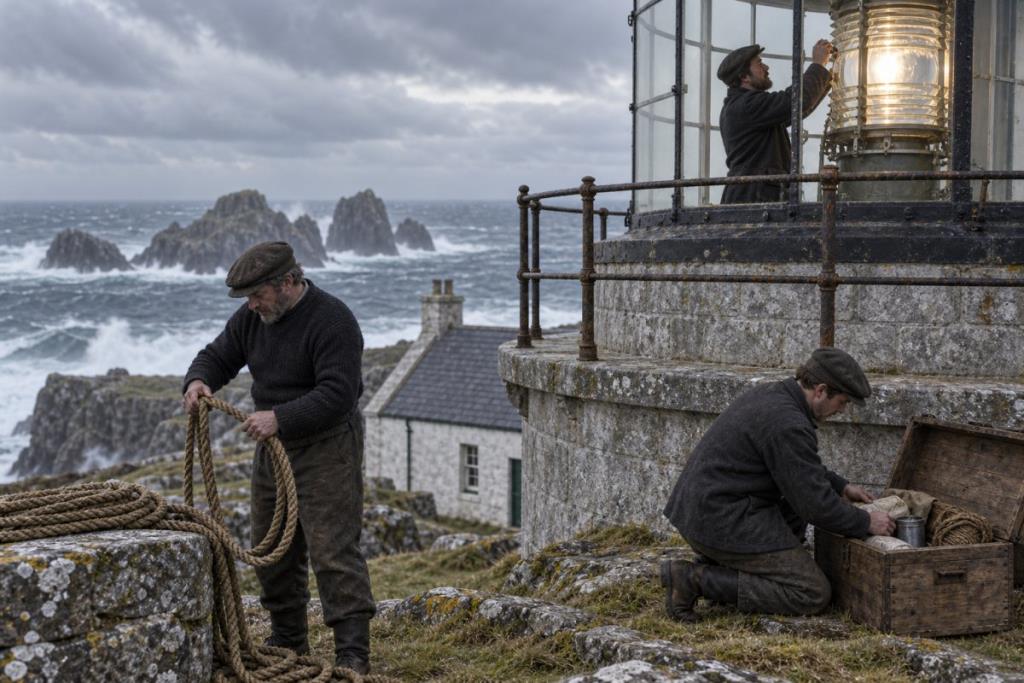
How do the records differ from the legends?
Famous versions tell of meals left warm, an overturned chair, and a logbook recording a man praying in terror. The Northern Lighthouse Board did not confirm these details. The station was generally tidy; the clocks had stopped and the stove was cold, consistent with being unattended for several days.
One set of oilskins appeared to be left behind, usually attributed to McArthur. He might have rushed out to assist his colleagues in an emergency without being fully dressed, but the distribution of clothing does not prove the order in which each man left the tower. There were no direct witnesses.
Traces at the west landing
The investigation discovered damage to railings, ropes, and equipment boxes, or that they had been displaced at an elevation higher than normal water levels. The weather had previously been very poor. Robert Muirhead, who knew all three men, concluded they likely went down to secure equipment and were swept away by a sudden rogue wave.
Regulations required that the lighthouse never be left completely unmanned, so the question of why all three went outside remains. In a rapidly developing incident, two might have gone down first and the third ran to help upon seeing danger. Procedural violations can occur when colleagues are in peril.
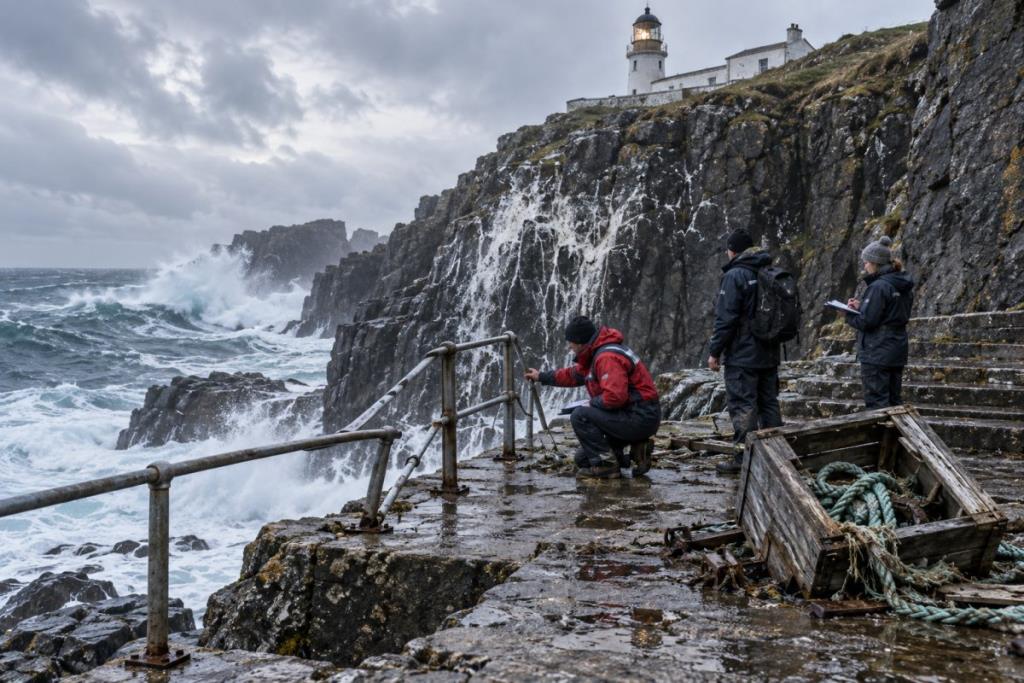
Do other theories hold up?
Conflict, murder followed by suicide, sea monsters, or abductions all lack physical evidence. There were no signs of a struggle in the station. Waves crashing onto steep rocky shores can create immense force and recede quickly; the fact that bodies were not found after eleven days in cold water does not negate a maritime accident.
What remains open
It is unknown who left the tower first, what equipment was being secured, and whether one or multiple waves caused the accident. Nearby meteorological records cannot perfectly reconstruct the conditions exactly at the western shore. The mystery lies in the precise sequence of actions, not the lack of a plausible natural mechanism.
How dangerous was lighthouse keeping?
Keepers did more than just clean glass and light lamps. They transported fuel, maintained cables, and inspected cranes and landing stages in environments of salt, wind, and slippery rock. On remote islands, minor damage to a landing could threaten the station's food supply, creating pressure to address it before the next storm arrived.
Large waves on cliffs do not need to be as tall as a wall from the open sea; the terrain can funnel water up slopes and create "run-up" waves much higher than the average level. The signs of damage at the west shore thus have physical significance. However, it only confirms the sea acted with force, not the location of each individual.
Why was the story mythologized?
An empty room, three missing men, and an eleven-day delay provided the perfect structure for a mystery story. Poetry, novels, and films added logbooks, conflicts, and omens. When fictional details are repeated without citation, they appear older than the actual records. Examining Northern Lighthouse Board documents helps return the story to the proper scope of evidence.
Distinguishing facts from speculation
A strong fact requires records close to the time of occurrence, physical evidence with a clear origin, or multiple independent measurements. Late accounts, details appearing only in popular books, and unverified images are ranked lower. "Not fully explained" does not mean all hypotheses have equal value.
This article prioritizes scenarios that explain multiple traces simultaneously with few assumptions, while keeping the unknown parts clear. If a new discovery emerges, the first questions should be who confirmed it, what the identification method was, and whether the data has been published for independent verification.
Conclusion
The 1900 solution still requires the fewest assumptions: an outdoor task in heavy seas turned into a chain-reaction accident. Respecting the record also means calling the three victims by their names and not replacing them with ghostly logbook entries that never existed.



 Jamaican jerk: the scent of pimento, the smoke pit and a community's living heritage
 Korean kimchi and banchan: the craft of fermentation and a table built on sharing
 Persian rice and tahdig: saffron, a crisp bottom layer and the sofreh
 Moroccan couscous and tagine: rhythm, hospitality and the flavours of North Africa
 Brazilian feijoada: a pot of black beans, a weekend lunch and a story with many roots
 The Indian thali: a balanced tray that tells a regional story and a way of eating together
 Danish smørrebrød: the open sandwich and the art of composing a lunch
 Swiss raclette: melted cheese and a shared table in the cold season
Đăng nhập để bình luận: / Sign in to comment: