



The Shugborough Inscription and the Eight Letters Sparking Decoders' Debates
Beneath a relief at the Shugborough Estate lies a short sequence of letters commonly transcribed as DOUOSVAVVM—tantalizingly curious, yet far too brief to prove any single solution.
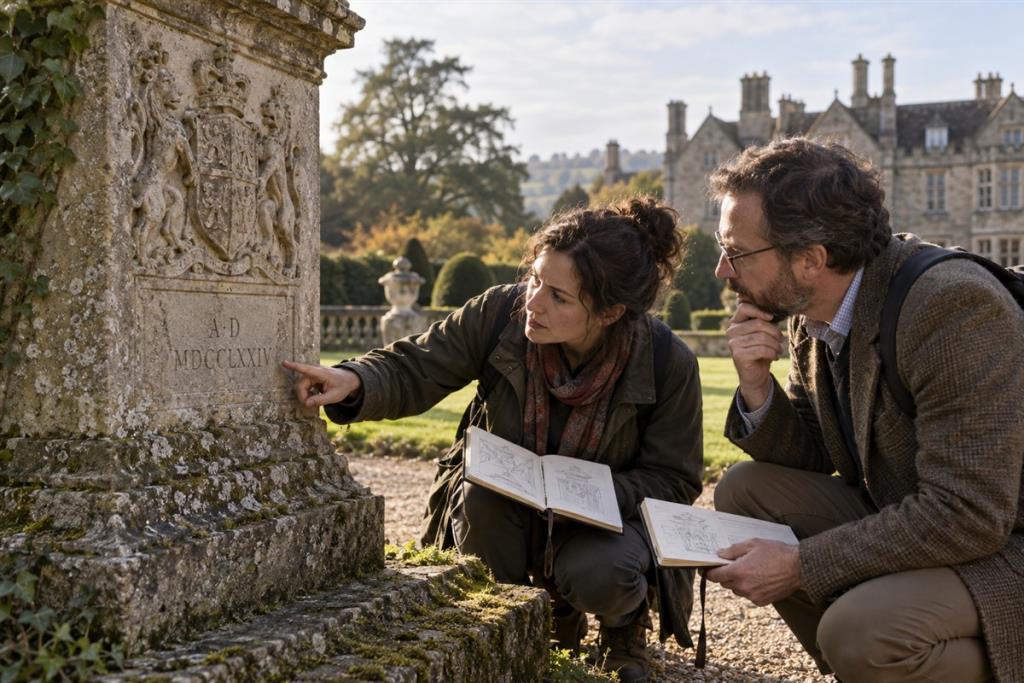
The inscription is found on the Shepherd's Monument on the Shugborough Estate in England. The relief is based on Nicolas Poussin's Et in Arcadia ego; the sequence of characters beneath it was carved in the 18th century.
Verifiable Facts
1. The two letters D and M sit on the outside, framing the eight letters O U O S V A V V in the common transcription.
This fact helps narrow the scope of speculation: a solution is credible only when it fits the entire artifact, its dating, the order of the characters, and the archaeological or archival context. Finding a few seemingly coherent words is not enough to validate a whole system.
2. The presence of the letter U led the National Trust to note that this part cannot simply be a classical Latin phrase in its original form.
This fact helps narrow the scope of speculation: a solution is credible only when it fits the entire artifact, its dating, the order of the characters, and the archaeological or archival context. Finding a few seemingly coherent words is not enough to validate a whole system.
3. No contemporary confirmed documents reveal what message the commissioner intended to convey.
This fact helps narrow the scope of speculation: a solution is credible only when it fits the entire artifact, its dating, the order of the characters, and the archaeological or archival context. Finding a few seemingly coherent words is not enough to validate a whole system.
4. The brevity of the sequence allows for countless acronyms, anagrams, and sentence expansions.
This fact helps narrow the scope of speculation: a solution is credible only when it fits the entire artifact, its dating, the order of the characters, and the archaeological or archival context. Finding a few seemingly coherent words is not enough to validate a whole system.
5. Stories linking it to the Holy Grail or secret societies appeared late and do not constitute historical evidence.
This fact helps narrow the scope of speculation: a solution is credible only when it fits the entire artifact, its dating, the order of the characters, and the archaeological or archival context. Finding a few seemingly coherent words is not enough to validate a whole system.
Why Has It Remained Unsolved?
- Ten characters are insufficient for reliable cryptographic frequency analysis.
- It is unclear whether D and M are part of the core message or framing characters.
- There is no key, no underlying language confirmed, and no parallel text.
In historical cryptology, a lack of data is often more perilous than a lack of computing power. Computers can test millions of keys, but they cannot autonomously determine the correct language, reading direction, or rules if those premises have not been established.
Primary Hypotheses
Hypothesis 1
Initials of a private memorial phrase within the Anson family.
Hypothesis 2
A Latin motto abbreviated in an unconventional manner.
Hypothesis 3
An 18th-century puzzle, decorative cipher, or an in-joke known only to an inner circle.
What Is Often Exaggerated
No solution has been validated by the National Trust or professional historians. Elaborate and compelling interpretations must be judged by their verifiability, not by fortuitous coincidences.
A prudent approach is to distinguish three layers: what the physical artifact directly shows, what researchers can reasonably infer, and what belongs merely to popular imagination. These three layers can collectively make the story fascinating, provided they are not conflated.
Conclusion
The true value of a mystery lies not in selecting the most sensational solution, but in the capacity to test a hypothesis against independent evidence. Until a deciphering key, parallel text, or reproducible method comes to light, this case must still be considered lacking any consensus solution.



 Jamaican jerk: the scent of pimento, the smoke pit and a community's living heritage
 Korean kimchi and banchan: the craft of fermentation and a table built on sharing
 Persian rice and tahdig: saffron, a crisp bottom layer and the sofreh
 Moroccan couscous and tagine: rhythm, hospitality and the flavours of North Africa
 Brazilian feijoada: a pot of black beans, a weekend lunch and a story with many roots
 The Indian thali: a balanced tray that tells a regional story and a way of eating together
 Danish smørrebrød: the open sandwich and the art of composing a lunch
 Swiss raclette: melted cheese and a shared table in the cold season
Đăng nhập để bình luận: / Sign in to comment: