



The Plain of Jars in Laos: what were more than 2,100 stone jars for?
On the Xieng Khouang plateau in Laos, thousands of large stone jars sit in clusters among the grassy hills. UNESCO records more than 2,100 tubular jars belonging to an Iron Age megalithic landscape. They are not oversized pottery but were carved from solid blocks of stone.
The sites contain jars, stone discs, quarries, grave goods and burial evidence, forming a system that spans roughly 500 BC to AD 500. Research is severely constrained by unexploded ordnance left over from the wars of the twentieth century.
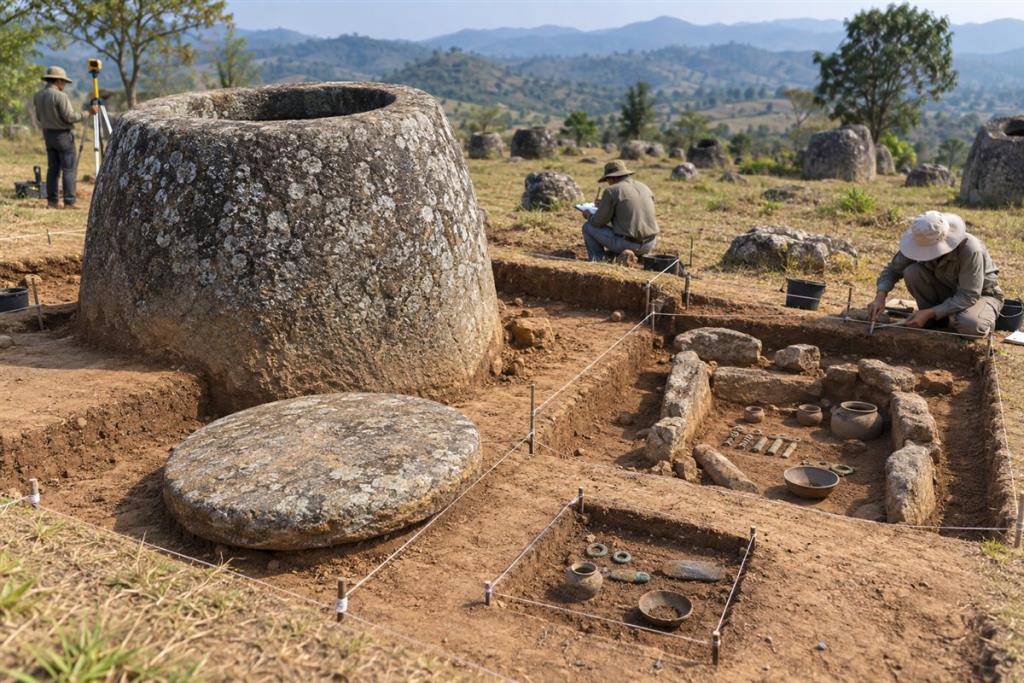
The jars are connected with funerary practice
Excavations around the jars have found primary burials, secondary burials, pits containing bones and grave goods. This strengthens the reading of a funerary landscape. Even so, it is not certain that bodies were ever placed directly inside every jar; a jar may have been involved in one stage of decomposition, held offerings, or marked a ritual area.
How was the stone transported?
Some of the stone sources lie several kilometres from where the jars now stand. Sledges, rollers, earthen tracks and human strength are all plausible; the actual terrain determines the cost. Finding abandoned blanks and quarrying marks at the source helps link the chain from selecting the stone, to roughing out the form, to finishing it on site.
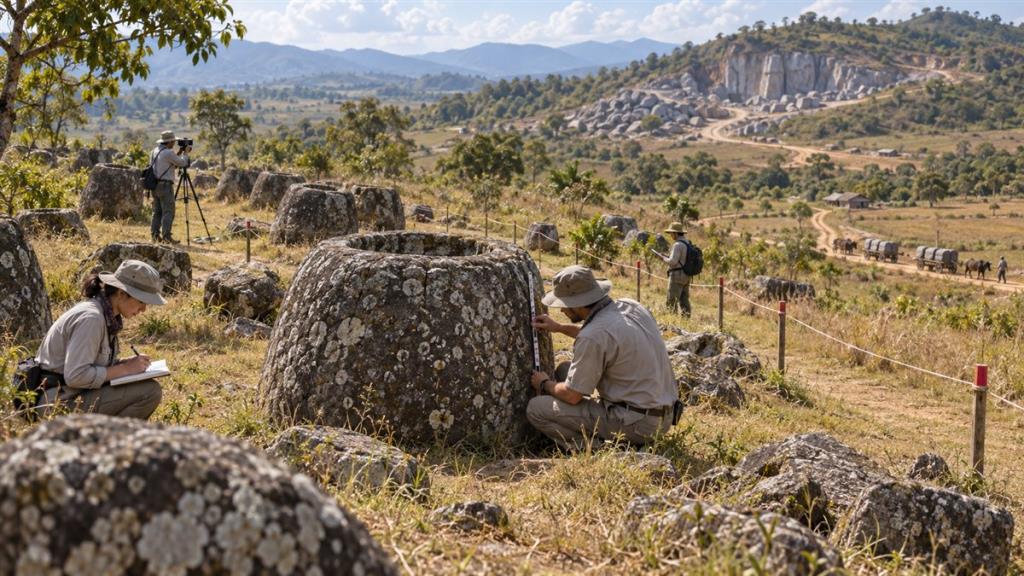
Legend and archaeology
Local stories say the jars were used to brew rice wine for a giant's victory celebration. Legend is valuable cultural heritage, but it does not by itself replace dating and biological traces. Archaeology can respect the story while testing the physical function through residues and burial context.
What remains unknown includes the identity of the communities who made the jars, how the labour was organised and how the clusters relate to one another. Isotope analysis of human remains, stone sourcing and new dating could reveal whether the dead were local people or were brought from far away to a ceremonial centre.
How should an archaeological mystery be read?
A surprising object usually raises three separate questions: how it was made, how it was used, and what it meant. An experiment can show that a technique was feasible, but it cannot by itself prove that ancient people chose that particular technique. To move from "possible" to "probable", the result has to match tool marks, materials, terrain, dating and the context of discovery.
Context is the part that cannot be replaced. An object found in a grave tells a different story from the same object in a workshop; a row of stones still in place holds information about orientation and spacing that a piece moved into a museum has lost. This is why documented excavation, conservation in situ and the publication of data matter more than quickly picking an attractive answer.
Three levels of certainty
Established means a fact confirmed by several independent measurements or records. Well founded means a model that explains many of the traces while rival options remain. Speculation means an idea that has not yet produced testable evidence. This article keeps the three layers apart so that what is unknown does not turn into an assertion.
Numbers need margins of error too. Carbon dating measures organic material, not directly the intentions of the maker; stone sourcing gives a geological origin, not the transport route; a 3D model records the present shape after centuries of weathering. A good conclusion states plainly what the data actually measures.
What could produce a breakthrough?
Tomography, 3D scanning, residue analysis, isotope measurement, mechanical simulation and experimental archaeology are opening up things that could not previously be observed. Technology, however, is only useful when the sample has a clear provenance, the procedure is published and an independent team can check the work again. A beautiful image online does not replace a scientific report.
The future answer may not be a single function. Objects and monuments live through many generations, being repaired, moved and reinterpreted. Accepting a history with several phases is usually closer to reality than forcing every trace into one secret moment.
Why is no supernatural explanation needed?
Saying that ancient people could not have built something usually reflects an underestimate of their skill, their time and their social organisation. Rope, timber, stone, metal and simple mathematics can produce enormous results when hundreds of people work together across several seasons. What deserves exploring is how knowledge was passed on and how a community persuaded itself to invest that effort.
"Not yet known" is a valid conclusion, not an empty space to be filled with any story at all. A good hypothesis produces predictions: which traces to look for, where, and what measurement could refute it. It is exactly this testability that turns a mystery into research rather than an anecdote.
The role of conservation and local communities
Artefacts are not only data for researchers; they are also the heritage of communities living today. Survey, sampling and display have to respect local law, indigenous knowledge and the limits of conservation. Visitors play a part too, by not touching, climbing, moving stones or buying objects of unclear origin. Preserving the context today is precisely what allows a later generation to test the questions that present-day technology cannot yet answer.



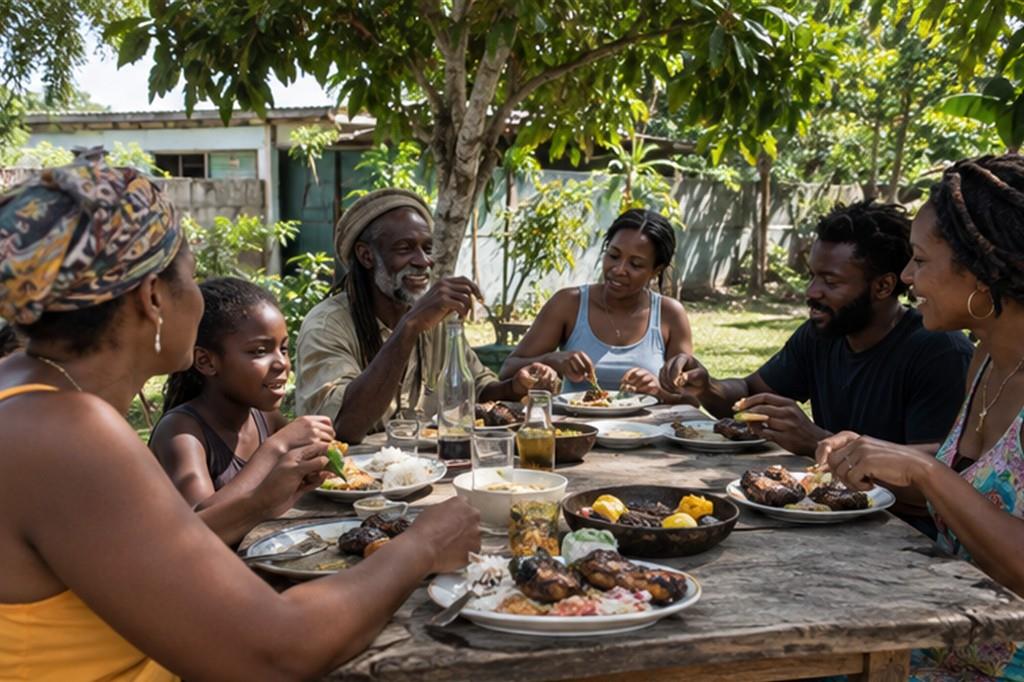 Jamaican jerk: the scent of pimento, the smoke pit and a community's living heritage
 Korean kimchi and banchan: the craft of fermentation and a table built on sharing
 Persian rice and tahdig: saffron, a crisp bottom layer and the sofreh
 Moroccan couscous and tagine: rhythm, hospitality and the flavours of North Africa
 Brazilian feijoada: a pot of black beans, a weekend lunch and a story with many roots
 The Indian thali: a balanced tray that tells a regional story and a way of eating together
 Danish smørrebrød: the open sandwich and the art of composing a lunch
 Swiss raclette: melted cheese and a shared table in the cold season
Đăng nhập để bình luận: / Sign in to comment: