



The Lost Roanoke Colony: What Does the Word CROATOAN Really Reveal?
When John White returned to Roanoke in 1590, he did not find the 117 settlers he had left behind. The houses had been dismantled, a wooden palisade had appeared, and the word ‘CROATOAN’ was carved in a prominent place. This was not a scene completely devoid of clues; the mystery lies in where those clues lead.
The settlers arrived at Roanoke Island in 1587 with the goal of establishing a permanent English colony. Food supplies were limited, relations with native communities had deteriorated from previous voyages, and the transatlantic supply line was fragile. White returned to England to seek aid, but the Anglo-Spanish War meant it took him nearly three years to return.
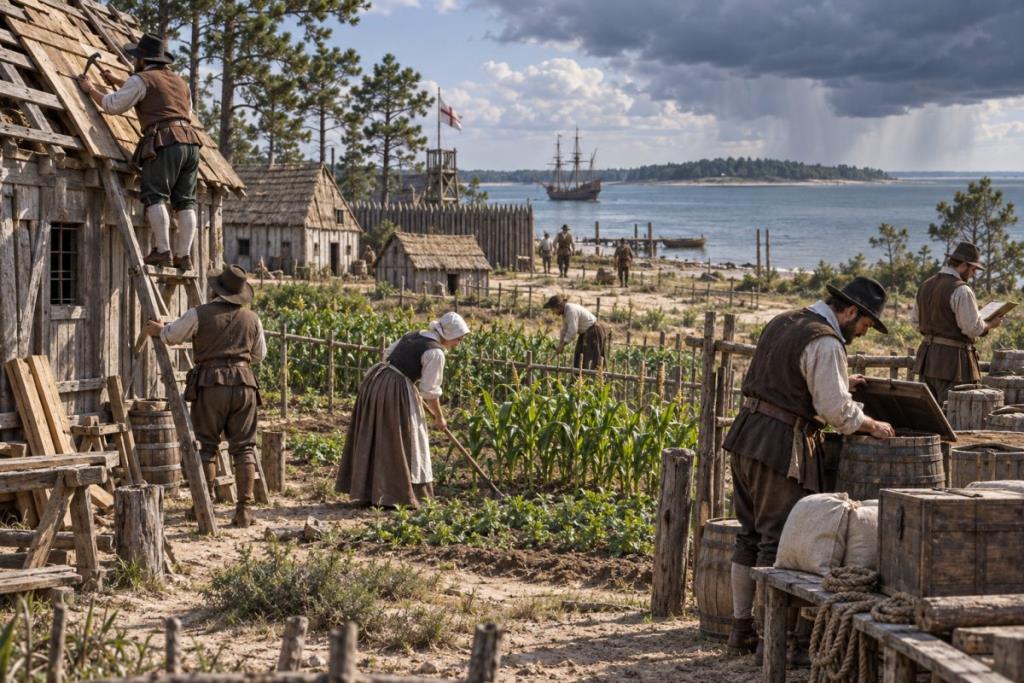
The 1590 Scene Did Not Resemble a Horror Story
According to White's account, the structures were not burned down, and he saw no obvious signs of combat. Before leaving, the group had agreed that if they were forced to relocate, they would carve the name of their destination; if they were in danger, they would add a Maltese cross. White noted that there was no cross next to the word CROATOAN. This detail makes a planned relocation more plausible than the idea of "evaporation."
Croatoan was the name of an island, now usually associated with Hatteras, and also the name of a native community that had previously had friendly relations with the English. Some of White's chests and belongings had been dug up or damaged, but the settlement overall had been cleared in an orderly fashion. A major storm prevented his crew from reaching Croatoan to check, and the most direct path was missed.
Three Main Explanations
The first theory suggests that the majority of the settlers went to live with or near the Croatoan community. The second places a group further inland, near the Albemarle Sound region, where they could find better land and avoid Spanish ships. The third is that the population dispersed into multiple groups; this explains why there is no single site containing all the traces.
Scenarios of disease, starvation, storms, or violence could still have contributed to their fate after they left Roanoke. However, there is no definitive evidence that they all died at the same time, nor is there any reliable record of a total massacre. Many popular versions have turned the documentary gap into a supernatural moment, even though the original texts do not require such an interpretation.
What Does Archaeology at Hatteras Tell Us?
Excavations have found late 16th-century European objects in the context of native artifacts. They are consistent with contact, trade, or an English presence, but a metal object or pottery shard could have passed through many hands. No graves, houses, or assemblages of artifacts have yet been universally agreed upon by researchers as the definitive settlement of the entire colony.
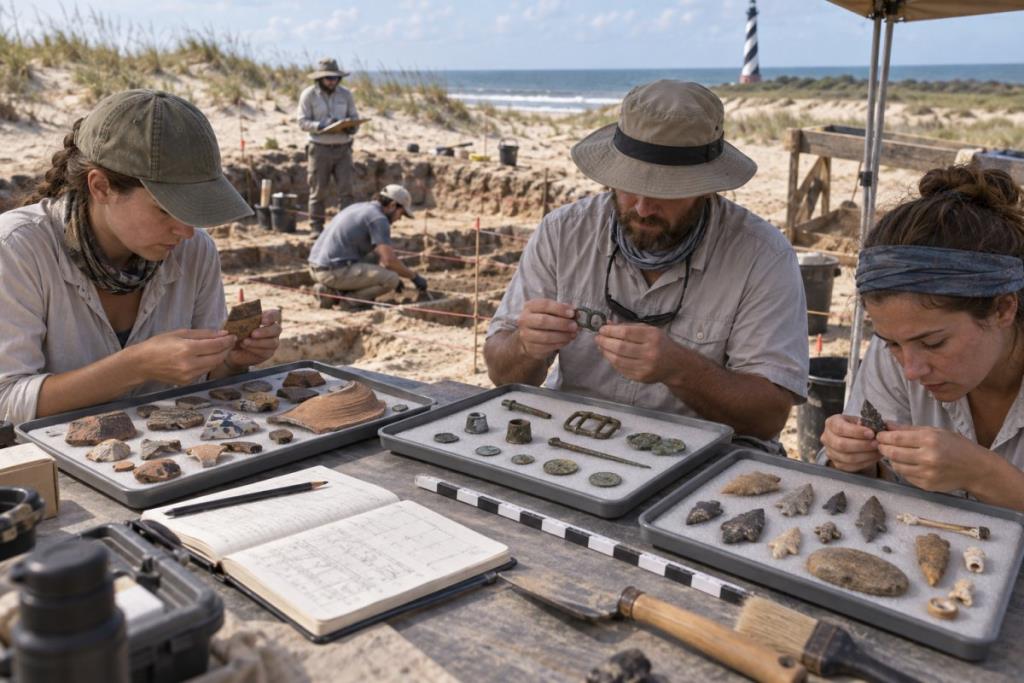
It is important not to treat the Croatoan community as an anonymous backdrop. If the Roanoke settlers integrated, the story is one of human encounter and adaptation, not of a population naturally "disappearing." Verifying this requires tight dating, clear excavation contexts, and collaboration with descendant communities.
What Is Known and What Is Missing
We know the settlers intended to signal their destination, the word CROATOAN was left without a danger sign, and White was unable to reach the island of that name. We do not know how many people left, whether they went together or split into groups, how long they survived, and whether their descendants merged into local communities.
Why Is the Case Hard to Close After More Than Four Centuries?
The Outer Banks coastline changes constantly due to storms, erosion, and accretion; part of the 1587 landscape may have been lost or lies under different sediment layers. Housing materials were primarily wood, so they decayed quickly, while metal and pottery could be traded. Therefore, archaeology must prove dating, original location, and the assemblage of objects, rather than relying on a single attractive item.
The written record is also biased toward the English and was created for funding, administrative, or defensive purposes. It records few voices of women, children, and native communities. A good future solution needs to combine landscape archaeology, material analysis, environmental history, and local traditions instead of just hunting for a "final message."
How to Distinguish Facts from Speculation
A strong fact requires records close to the time of the event, physical evidence with a clear provenance, or multiple independent measurements. Late accounts, details appearing only in popular books, and unverified images are ranked lower. "Not fully explained" does not mean all hypotheses are of equal value.
This article prioritizes scenarios that explain multiple traces simultaneously with fewer assumptions, while keeping the unknown clear. If a new discovery emerges, the first questions should be who verified it, what the identification method was, and whether the data has been published for independent review.
Conclusion
Roanoke has no final answer yet, but "CROATOAN" is a practical clue rather than a spooky code. The most cautious scenario is that the settlers actively left an unsafe place, likely dispersing and relying on native networks; the missing part is evidence strong enough to connect individual people to a location after 1587.



 Korean kimchi and banchan: the craft of fermentation and a table built on sharing
 Persian rice and tahdig: saffron, a crisp bottom layer and the sofreh
 Moroccan couscous and tagine: rhythm, hospitality and the flavours of North Africa
 Brazilian feijoada: a pot of black beans, a weekend lunch and a story with many roots
 The Indian thali: a balanced tray that tells a regional story and a way of eating together
 Danish smørrebrød: the open sandwich and the art of composing a lunch
 Swiss raclette: melted cheese and a shared table in the cold season
 Injera in Ethiopia and Eritrea: the shared platter that binds a community
Đăng nhập để bình luận: / Sign in to comment: