



Strasbourg Dancing Plague of 1518: When the Entire City Couldn't Stop Dancing
In the summer of 1518, Strasbourg records describe citizens dancing against their will, continuing to the point of exhaustion. The authorities erected stages and hired musicians because physicians believed the sick had to "dance it out," then panicked and reversed course: banning music, closing entertainment venues, and taking them to the shrine of St. Vitus. The event has a real documentary basis, but the figures of "dozens of deaths per day" told later are certainly less accurate.
The story usually begins with Frau Troffea dancing in the street and then dozens of people joining in. Specific names and dates depend on the source, with some chronicles being written late. To understand, one must separate the decisions of the city council in 1518 from the dramatic details added over generations.
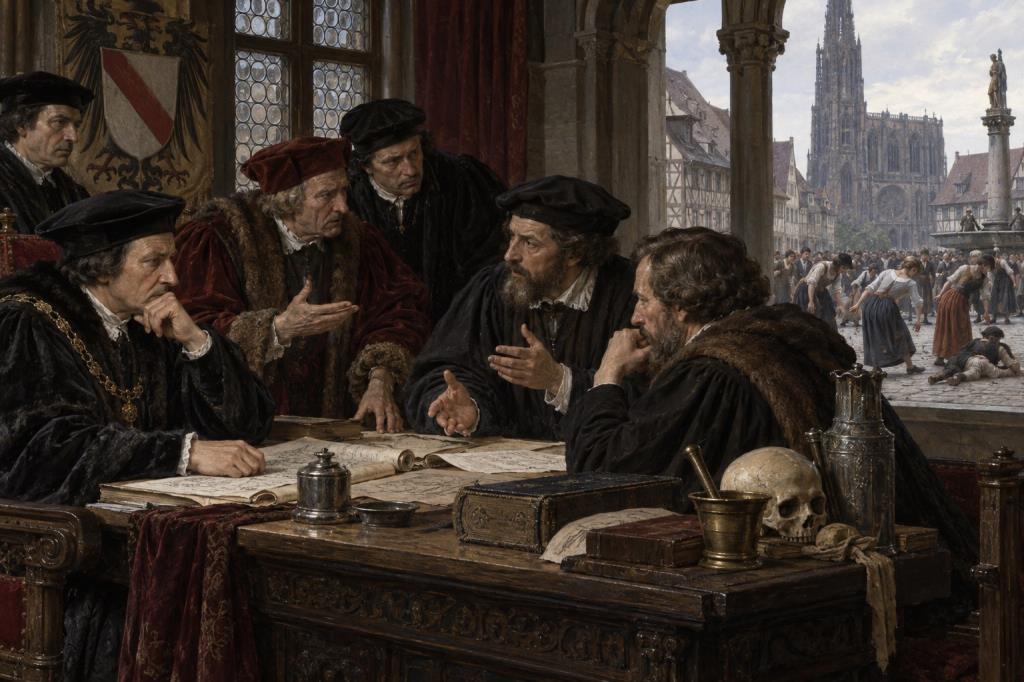
How Did Contemporaries Understand the Illness?
Strasbourg medicine believed that "hot blood" caused the seizures and that continuous movement would help rid the body of the illness. Therefore, the authorities provided space, music, and support staff. If the symptoms were influenced by social expectations, that measure might have inadvertently provided the stage and script for it to spread.
When the first method failed, the city banned public dancing and musical instruments, except for certain ceremonies. The sick were taken to a shrine of St. Vitus, wearing red shoes and performing rituals. In the worldview of that time, the saint's curse, sin, and religious healing were real parts of the experience.
Is Ergot Fungus Enough?
Ergot on rye contains alkaloids that cause convulsions, hallucinations, and limb ischemia. It is often mentioned due to famine and contaminated bread. But severe poisoning would make it difficult for patients to coordinate dancing for days; the symptoms also do not easily explain why the behavior took the cultural form of St. Vitus.
There are no food samples from 1518 to test. Ergot may have contributed to the general illness, but a single chemical explanation is inferred from possibility, not from detected toxins. Descriptions of "dancing" may have included many different movements that chronicles lumped together.
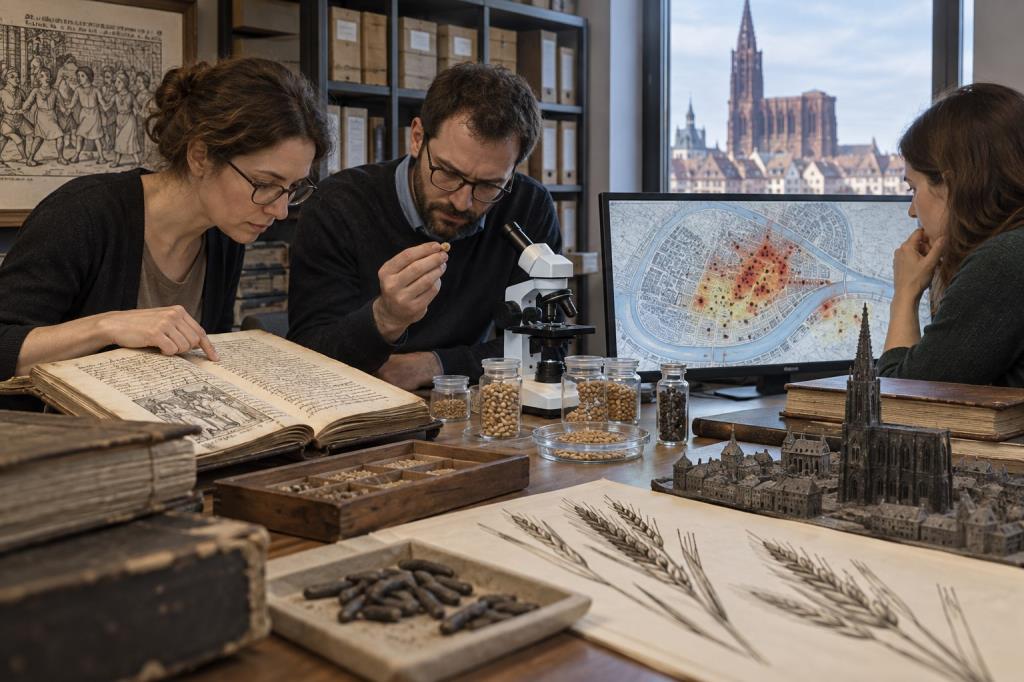
Collective Stress and Cultural Scripts
Strasbourg experienced crop failures, high food prices, disease, and religious tension. In that environment, collective psychogenic movement disorders could spread without the participants faking it. The belief that St. Vitus could compel people to dance provided a mold for the body to express distress.
The modern concept of "mass psychogenic illness" is not a definitive retrospective diagnosis. We cannot examine the patients, and the sources recorded by officials are biased. It is a model that well explains transmission through observation, the role of expectations, and ritual endings, but it does not rule out some individuals having separate neurological illnesses or poisoning.
Did Hundreds of People Really Die?
Some later sources say many died of heart attacks, strokes, or exhaustion. Research notes that contemporary city documents do not record the death toll that is often repeated. This does not mean for sure that no one died; it means the headline "15 people per day" should not be presented as verified statistics.
The Strasbourg dancing plague is a lesson in how real events are draped in layers of legend. The most certain part remains bizarre: the authorities dealt with a group of people who could not stop dancing on their own with a stage, then with bans and pilgrimages. The cause likely lies at the intersection of the body, poverty, belief, and the city's response.
From Narrative to Verifiable Records
A powerful mystery does not require every detail to be unknown. First, physical evidence, near-contemporary documents, and measurements must be separated from illustrations, late recollections, and literary versions. A signal may be truly recorded but the sender remains unknown; a character may have truly existed but their famous nickname was created by later generations.
Each source answers a different type of question. Receivers give frequency and duration, not intent. Stele stones give the name of a unit in a place, not the fate of the entire army. Chronicles tell us that a story was passed down, but do not guarantee the author witnessed it. Reading the limits correctly makes the unknown clearer.
Documentary Gaps Are Not a Blank Slate
When records are missing, many stories can fit. But they are not equal: hypotheses must fit the endpoints, geography, technology, motives, and what should have remained. A conclusion that requires fewer assumptions and explains more facts is preferred, even if it cannot be absolutely proven.
"No evidence" must also be scoped. Not present in the searched archives is different from never having existed; not captured in a week is different from a source never repeating. Writing the scope clearly helps avoid two extremes: turning silence into evidence of a conspiracy, or treating missing records as a reason to dismiss all accounts.
The Timeline Is a Tool Against Legend
Arranging sources by date shows which details appeared immediately and which were added decades later. A velvet mask becomes iron, a prime suspect becomes a theatrical monster, a technical signal becomes an apocalyptic message. Late details are not automatically wrong, but they need to explain how they came to know what early sources did not record.
One must also separate the date of the event, the date people realized it, and the date of publication. Data can sit for years before being understood; an artifact can be found and then processed according to old standards. These delays determine the level of information still recoverable with modern technology.
Independent Verification Takes Many Forms
Two machines with the same software can share a bug; two chronicles can copy the same storyteller. Independence is stronger when different lines of evidence converge: distant receivers, satellite imagery, stratified artifacts, letters with archival chains. The less dependent on a single link, the more robust the conclusion.
Recreation is also important. A microwave recreating a Peryton under specific conditions is causal evidence; a volcanic model that is merely "capable of making a sound" is not enough for the Upsweep without recreating the sweep pattern and seasonal rhythm. History has few opportunities for retesting, so it must rely on cross-referencing texts, archaeology, and probability.
Don't Let Illustrations Become Fake Evidence
There are no photographs of medieval events or direct images of many cosmic sources. Paintings in the article help visualize the context, not confirm that the faces, movements, or composition happened exactly that way. Captions need to describe what the image is explaining instead of calling it a photo of the scene.
Images that spread away from the article often lose their captions. Therefore, images should avoid fake text, overly certain symbols, and sensational details without sources. A mysterious atmosphere can come from light, empty space, and traces, without needing to plant "evidence" that history never gave.
A Checklist for Readers
Ask what the earliest source is; did the author witness it; does the original data still exist; is there an independent group confirming it; from what era did the famous details appear; what does the hypothesis predict; and what evidence could prove it wrong. If there is no way to refute it, it is a flexible story, not yet a solution.
Finally, distinguish "cannot be ruled out" from "highly probable." Countless scenarios cannot be absolutely ruled out because data is lost, but history and science can still rank them. Speaking in probabilities does not make the article less appealing; it lets the reader know where the solid ground ends.
Margin of Error Varies by Type of Evidence
An audio recording can give frequency and timing quite accurately, but may not point to the source if the sensor network is too sparse. A text can record names of people and places, but the author's intent, intermediate copies, and contemporary language all create margins of variance. Physical artifacts, seemingly the most objective, can still be separated from their stratigraphy, over-restored, or dated according to an object lying next to them. Therefore, one should not lump all question marks into a single word: "mystery." Each record needs its own map of errors: what was measured directly, what was inferred, what was recalled by witnesses, and what was only retold after generations.
When two pieces of evidence conflict, the rational response is not to immediately choose the more thrilling one. We need to look at the resolution, the time gap, the chain of custody, and whether the recorder had a personal agenda. A receiver placed in the right spot can be more reliable than ten people listening with their ears; conversely, a clean stream of data without context is also easily over-interpreted. Disclosing the level of uncertainty helps the story stand firm when new discoveries are made. It also distinguishes caution from avoidance: a good researcher must be able to say why they believe one possibility over another, even if they cannot finalize it absolutely.
Names Can Shape the Entire Story
Many famous phenomena are known by a catchy nickname. Nicknames help the public remember, but at the same time, they sneak in a pre-packaged understanding: "the trumpet," "the ghost," "the vanishing army," or "the prisoner in the iron mask" make the mind fill in extra images. After hundreds of retellings, the label is easily taken as the original description. The way to check is to return to the earliest words, compare translations, and clearly note which parts are modern names. Just a small difference—iron or velvet, vanished or reassigned, a single sound or a repeating sequence—can change the entire set of hypotheses.
The media also creates a selection effect: the coincidences are kept, while hundreds of normal occurrences vanish from memory. Visually rich details often outlive dry data, so later accounts seem more complete and terrifying than the original records. This does not mean everything is imagined. It shows the need to study both the phenomenon and the history of the story about the phenomenon. When we know where a detail first appeared, we can recognize whether it is an independent fact, a new phrasing of an old fact, or an embellishment added to make the story easier to pass down.
What Could Move the Record Forward?
With audio or radio signals, progress usually comes from synchronized data at multiple stations, calibrated equipment, and accompanying environmental records. Differences in arrival time allow for direction finding; frequency spectra and repetition patterns help separate machinery, atmosphere, geology, or astronomy. Raw data must be saved for other groups to rerun analyses instead of just looking at processed graphs. A new capture does not necessarily solve an old mystery, but it can turn the vague question "what is that?" into specific testable questions about location, energy, period, and generation mechanism.
With history, progress can come more slowly: an archive is re-cataloged, private letters emerge, organic materials are dated, or isotopic signatures reveal where a person once lived. Technology is only useful when the question and the origin of the sample are clear. Testing an object with a broken chain of custody can produce a very precise number for the wrong subject. Conversely, a small administrative note placed correctly on the timeline can sometimes eliminate an entire major hypothesis. The value lies in the connection between the new measurement and the old record, not in the modern look of the equipment.
Why Are Solutions Sometimes Still Incomplete?
There are cases with strong solutions where we cannot reconstruct every minute. We may identify a class of source, a social cause, or a high-probability identity, while personal motives and detailed sequences of actions are lost. Demanding that a solution cover every detail easily creates an impossible standard; but accepting a general label without checking exceptions is also too lax. The way to balance is to divide conclusions into tiers: what is almost certain, what is supported by much evidence, what is still contested, and what currently lacks data to judge.
That incompleteness is the honest part of research. A file may be closed regarding the mechanism but remain open regarding the people, or vice versa. When the primary origin is identified, secondary questions do not become meaningless: why did the community react that way, why did contemporary authorities remain silent, and why did other versions continue to spread? Mystery, therefore, is not just a hunt for a single answer. It is also a way to observe the limits of memory, equipment, and archival power—three factors that determine what of the world is kept for those who come after.
The Mysterious Part Worth Keeping
A natural explanation can be stranger than myth: a death making a clock, a stove in a kitchen mimicking the sound of the cosmos, or a signal traveling across the entire Pacific. In history, what haunts is often deliberate silence—names erased, orders unrecorded, the vulnerable leaving no words of their own.
The best mystery has clear boundaries. We know exactly what was recorded, what is merely plausible, and what measurements are still missing. At that point, the shiver does not come from exaggeration, but from standing right at the edge of the record and seeing the part of the past or the universe that has gone out of reach.



 Korean kimchi and banchan: the craft of fermentation and a table built on sharing
 Persian rice and tahdig: saffron, a crisp bottom layer and the sofreh
 Moroccan couscous and tagine: rhythm, hospitality and the flavours of North Africa
 Brazilian feijoada: a pot of black beans, a weekend lunch and a story with many roots
 The Indian thali: a balanced tray that tells a regional story and a way of eating together
 Danish smørrebrød: the open sandwich and the art of composing a lunch
 Swiss raclette: melted cheese and a shared table in the cold season
 Injera in Ethiopia and Eritrea: the shared platter that binds a community
Đăng nhập để bình luận: / Sign in to comment: