



Morning Glory cloud: the hundreds-of-kilometers-long white wall rolling across Australia
On certain dawns at the end of the dry season in northern Australia, a wall of cloud hundreds of kilometers long rolls low across the sky. It can travel in a single band or multiple parallel bands, heralded by shifting winds and a jump in pressure. Locals around Burketown knew of this phenomenon long before pilots called it the Morning Glory.
This is a form of roll cloud associated with an atmospheric solitary wave. The cloud appears to roll, but water vapor continuously condenses at the leading edge where air rises and evaporates at the rear where air descends.
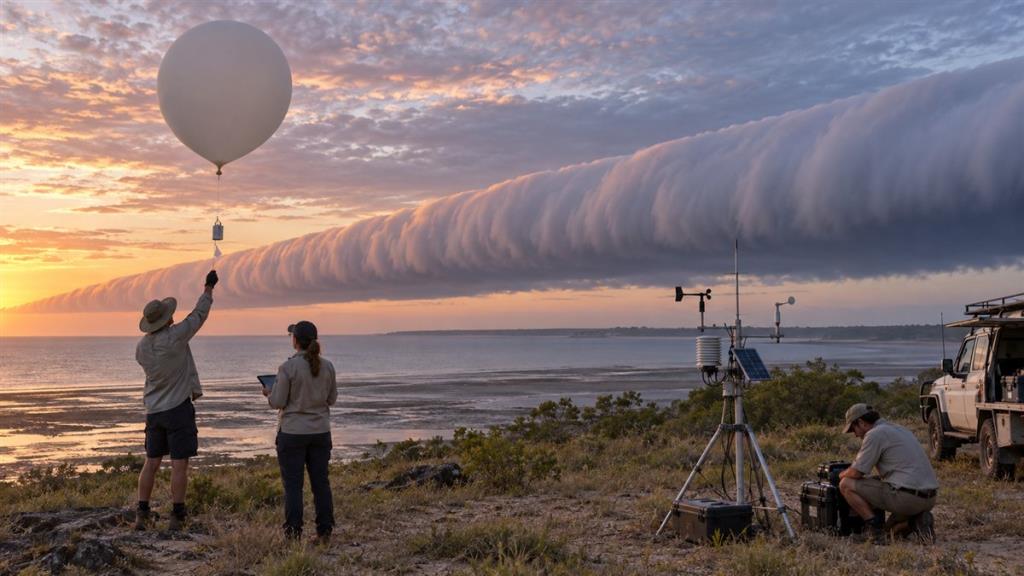
The topographic trap of the Gulf of Carpentaria
Sea breezes from both sides of the Cape York Peninsula can meet, creating disturbances that propagate toward the gulf. At night, the land cools and an inversion layer forms over the water. The cold air mass slides under the stable layer, emitting waves that travel very far with little loss of shape.
Why is this place special?
Waves and roll clouds can appear elsewhere, but the shape of the peninsula, the shallow gulf, and the monsoon cycle make the southern Gulf of Carpentaria have a relatively regular observation season from around September to November. However, precise daily forecasting remains difficult because it requires multiple atmospheric layers to align.
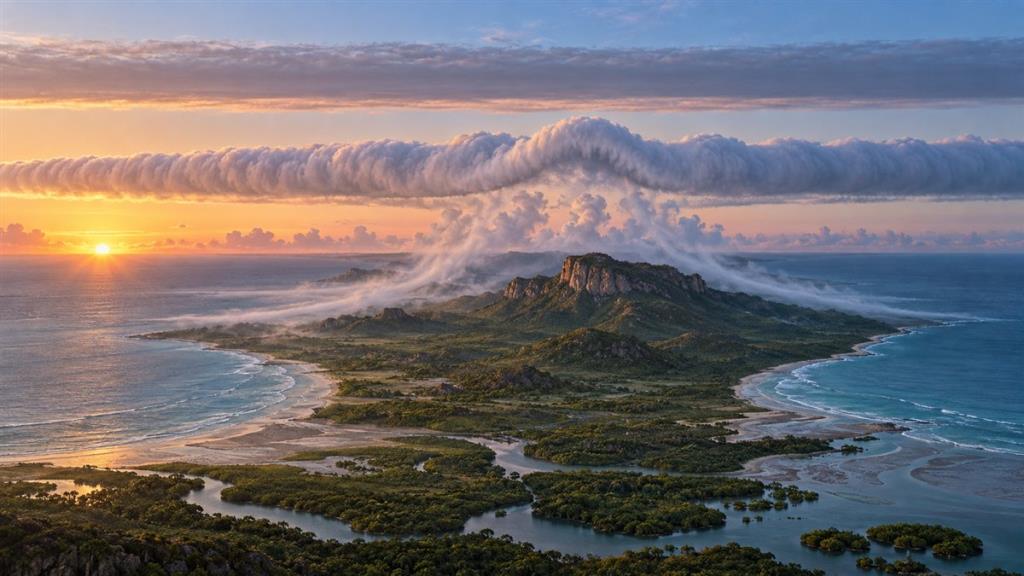
Beautiful but not entirely gentle
Glider pilots seek the lift at the front of the cloud, while small aircraft must account for turbulence, wind shear, and low cloud cover. A band of cloud does not equate to a severe thunderstorm, but its colossal appearance easily makes observers think of a tsunami in the sky. Radiosonde data shows it is a structured atmospheric wave.
The wave exists even as the cloud constantly renews
An observer sees a roll of cloud advancing, but individual cloud droplets do not travel the entire distance like a train. At the wave crest, air rises, cools, and water vapor condenses; at the rear, air descends and warms, causing droplets to evaporate. The shape propagates while the matter is constantly replaced.
This mechanism is more like a stadium wave than a physical wall. It explains why the leading edge is sharp, the trailing edge dissipates, and the band can maintain its shape over vast distances.
Two coastlines create a meeting in the night
During the day, sea breezes from the Coral Sea and the Gulf of Carpentaria penetrate Cape York. The wind fronts can collide, and after sunset, the air layer close to the ground cools and flows toward the gulf. The inversion layer above acts as a waveguide cap, preventing energy from dissipating upward.
Humidity determines whether the wave "manifests" as a cloud or merely passes through as a pressure change. Therefore, a strong wave may still fail to produce a spectacular photo if the air is too dry.
How do flyers read the Morning Glory?
Gliders can use the lift at the leading edge to fly along the cloud, but behind it lies downdrafts and turbulence. Forecasting requires satellite imagery, ground stations, radiosondes, and an understanding of local wind cycles. Inexperienced visitors should not turn the phenomenon into a spontaneous chase.
The Morning Glory has a fairly solid physical mechanism, yet the timing, number of bands, and daily durability remain hard to predict. The remaining mystery is the puzzle of forecasting a delicate coincidence in the tropical atmosphere.
From mysterious tales to verifiable records
An engaging story often begins at a moment of awe, but an investigation must look before and after that moment. Researchers build timelines, seek records closest to the event, preserve original image files, and flag details that only come from late recollections. A single detail copied across hundreds of pages may still originate from a single source.
With natural phenomena, "not found" also needs limits. Not finding meteorite fragments after decades in a swamp is different from not finding them in a clean survey area the very next day. Failing to record light with a north-facing camera says nothing about the southern sky. The scope of the search must go hand in hand with the conclusion.
Measuring shape, speed, and energy
Angular size in a photo only becomes real size when the distance is known. Velocity also requires distance and time, while energy is often inferred through its impact on the environment. An error in one of the three can turn car headlights into hypersonic objects or a small reaction into a colossal energy source.
Calibration is a quiet but decisive step. Cameras need to account for lens distortion; temperature sensors need reference points; station clocks must share the same standard; chemical samples need blanks to detect contamination. These details are less dramatic than the photo itself but represent the boundary between clues and evidence.
A good model must accept being refuted
A scientific hypothesis does not just retell what has been seen but also predicts what has not yet been measured. If ice pushes rocks, the movement must coincide with shallow water, cold nights, and wind; if convection creates rings, there must be a corresponding thermal structure and flow beneath the center. Incorrect predictions force the model to be revised or discarded.
Different models are sometimes correct in different cases. Nature is under no obligation to use a single mechanism for every glowing sphere, every dirt ring, or every similar cloud. Accurate classification can be a greater advancement than finding a single overarching answer.
The role of probability and rarity
A sequence of conditions, none of which are too unusual, can still be rare when they must occur simultaneously. This explains why a phenomenon leaves traces but few direct witnesses. It also causes bias: people who wait for years are prone to recording cases close to their expectations, while equipment failing at the exact right moment creates enticing gaps.
Automated sensor networks and satellite data reduce reliance on luck. Even so, detection algorithms can produce false positives; every alert still requires original photos and checks of familiar sources. More data does not automatically mean more good evidence.
When can we say a mystery is solved?
A strong solution reproduces the mechanism, fits multiple independent datasets, and does not ignore important details. It also explains why the phenomenon is rare, occurring in the right place and the right season. With old traces, we sometimes only reach the level of "the most plausible solution" because crucial data has been lost.
Solving the general mechanism does not mean knowing every individual event. We may know that Racetrack rocks move due to ice but not know the date of each old track; we may know the color of Blood Falls is due to iron but have not yet mapped the subglacial water system. Precise phrasing preserves the genuine mystery.
Preserving sites is preserving data
Tire tracks on a playa, footprints on thin ice, soil samples taken from a circle, or lighting equipment brought into a valley can all destroy data. Visitors should stick to permitted routes, not move objects, and not create "evidence" for photos. A fake trace can live on the internet longer than the actual site.
Respecting local communities is also important. They are not just background characters in a story but hold observation histories, names, and environmental knowledge. Good research returns data and conservation benefits to where the phenomenon exists.
A checklist for self-evaluating new claims
Faced with a "shocking" video or news piece, one can ask six things: is the original file available; can the time and coordinates be verified; is there any matching conventional light source, flight, or weather; was the size measured or just estimated; has an independent group reviewed the data; and does the author state clearly what would make them change their mind. Lacking one item does not make a claim false, but the more that are missing, the lower the certainty.
It is also necessary to distinguish between peer-reviewed papers, preprints, press releases, and online accounts. A single study is a starting point, especially when samples are few or the location is unique. Consensus forms when different methods converge, not when an explanation is shared the most.
The part of the mystery worth keeping
Caution does not require a story to be dry. The moment a forest falls together, a glowing sphere hangs silently over a valley, or an ice pipe grows down to the seabed still sends shivers down the spine even when there are equations behind it. A sense of wonder is the reason to ask questions; evidence is how we ensure the answers do not betray the very thing we want to discover.
In each topic, the unknown is kept separate rather than covered by an absolute conclusion. It could be the composition of an object, the ratio between two mechanisms, an underwater heat source, or the exact trigger conditions. Named gaps with planned measurements are the mysteries most likely to be solved by the next generation.
How a phenomenon becomes a "mystery"
Rare phenomena often occur quickly, in hard-to-reach places, or in weather that degrades equipment performance. Witnesses only see a fraction, and memory naturally fills in the gaps after multiple retellings. When the first photo goes viral, distinct cases are easily lumped under the same name. Therefore, the first question is not "what is it" but "are we talking about one or multiple phenomena."
A robust observation requires the exact hour, location, viewing direction, focal length, weather, and raw data. Photos with background scenery help estimate angles; two cameras spaced apart allow distance calculations; light spectra reveal elements and temperature. Compressed videos online may look beautiful but have often lost the very data needed for verification.
Distinguishing feasible from what actually happened
An experiment that recreates an object similar to the phenomenon only proves that a mechanism can work. To say that mechanism actually occurred in nature, it must correctly predict the duration, energy, shape, weather conditions, and post-event traces. If it only explains the color but not the movement, the model is still incomplete.
Conversely, the lack of a complete model does not make all options equal. A hypothesis that aligns with physics, makes predictions, and withstands measurement carries more weight than an irrefutable idea. The term "unidentified" describes data limitations, not the name of a supernatural cause.
Common identification errors
Distance in the dark is very difficult to estimate. Bright stars, planets, aircraft lights, satellites, car headlights through atmospheric layers, and insects close to the lens can take on unusual appearances. Long exposures stretch a point into a line; image stabilization makes the background shake differently from the object; reflections in the glass create a "sphere" that moves with the camera.
In landscapes, circles also easily suggest a designing hand. But convection, waves, resource competition, and equal propagation speeds in all directions naturally create rings or repeating networks. Regular geometry is not in itself evidence of intelligence; what needs to be measured is the mechanism maintaining the pattern over time.
Which questions are still worth pursuing?
A good question must lead to a test: which sensors to place, which samples to take, which data could refute the hypothesis. For rare events, automated systems running continuously are often more valuable than short survey expeditions. For landscapes, years of satellite imagery reveal lifecycles and seasonal changes.
Science does not make a story less mysterious. A rock traveling on a thin sheet of ice, a water column creating a kilometer-wide ring, or microorganisms living in dark brine beneath a glacier are all far stranger than many sensational solutions. The difference is we know which part has been measured and which part remains in the dark.
Reading new information with a clear mind
When there is a claim of "completely decoded," check the date, the publishing institution, the methodology, and whether the data has been reviewed by another group. A press headline can turn a "fitting model" into a "solved mystery." Conversely, a storyteller might ignore dozens of identified cases just to keep a few ambiguous ones.
A reliable conclusion usually has boundaries: what it explains, what it does not yet explain, and what conditions would make it wrong. It is those very boundaries that keep curiosity alive without trading away the truth.
Staying safe when approaching phenomena
One should not step onto thin ice, walk into lightning storms, cross conservation fences, or take samples from extreme environments just for a photo. Observing from a safe location, recording the time and viewing direction is often more valuable than a close-up video that loses context. Fragile sites also need to be left intact so that natural traces are not distorted by footprints, vehicles, or items left behind by visitors.



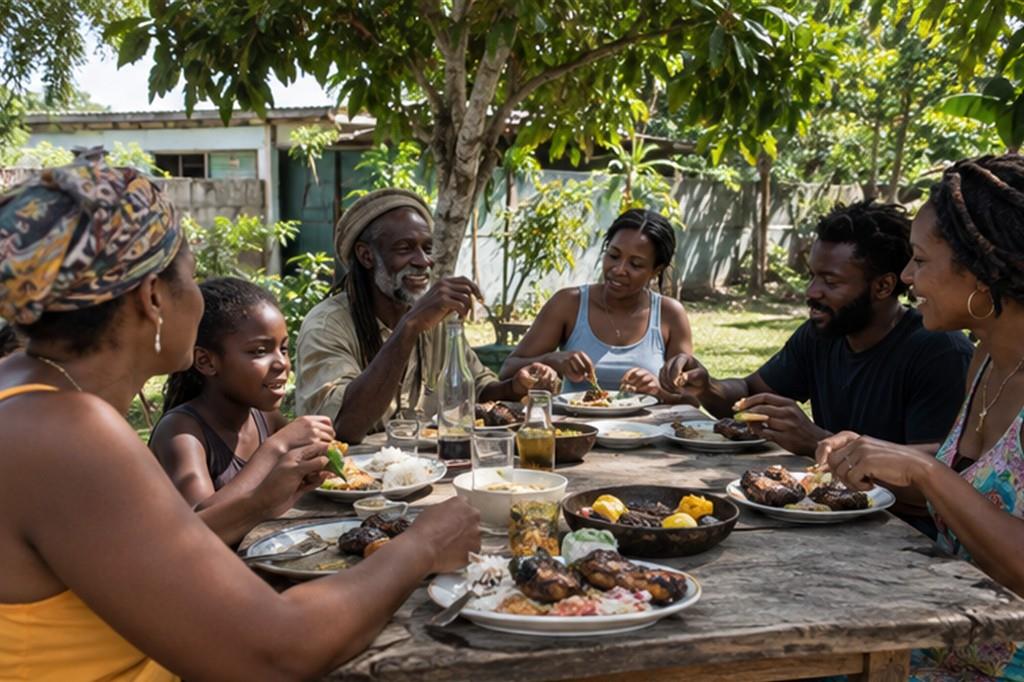 Jamaican jerk: the scent of pimento, the smoke pit and a community's living heritage
 Korean kimchi and banchan: the craft of fermentation and a table built on sharing
 Persian rice and tahdig: saffron, a crisp bottom layer and the sofreh
 Moroccan couscous and tagine: rhythm, hospitality and the flavours of North Africa
 Brazilian feijoada: a pot of black beans, a weekend lunch and a story with many roots
 The Indian thali: a balanced tray that tells a regional story and a way of eating together
 Danish smørrebrød: the open sandwich and the art of composing a lunch
 Swiss raclette: melted cheese and a shared table in the cold season
Đăng nhập để bình luận: / Sign in to comment: