



Cahokia: Why did ancient North America's largest city decline?
Around 1100, Cahokia featured a vast plaza, dozens of mounds, residential areas, and a population that may have rivaled many European cities of the same era. A few centuries later, this center grew sparse, but calling the inhabitants "vanished" is a misrepresentation of Indigenous history.
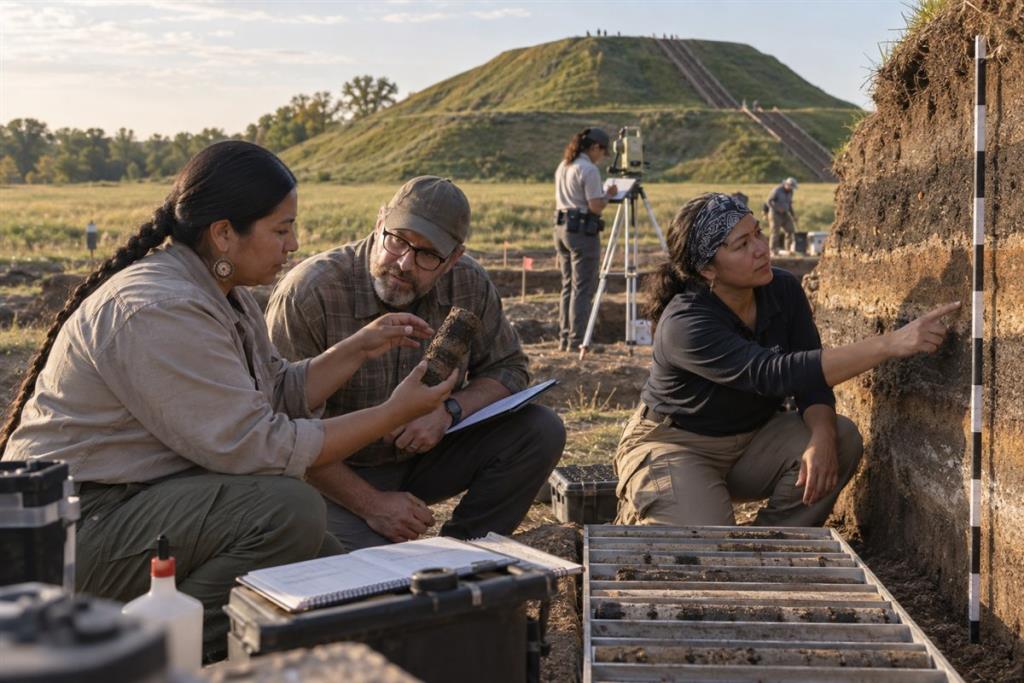
Cahokia developed near the confluence of the Mississippi, Missouri, and Illinois river systems. The central area spanned thousands of acres and once contained about 120 mounds; Monks Mound stands about 30 meters high and covers over 5 hectares. Soil was moved in baskets and piled in multiple stages, demonstrating immense planning and labor.
A city built very quickly
Archaeological data shows a sharp increase in population and construction around the year 1050, sometimes referred to as the Cahokia "Big Bang." People from various regions converged, bringing different pottery styles, foods, and customs. Plazas, platform mounds, wooden posts, and festivals helped bind the large community together, but also demanded sustainable food sources and power structures.
No single cause of decline
Flooding, drought, resource depletion, disease, conflict, and political change have all been proposed. Each factor has varying levels of evidence and may have had an impact at different times. A plausible model is usually a prolonged process: populations shifted, power networks redirected, and the center lost its role, rather than the entire city disappearing overnight.
Why the "lost mound builders" narrative is dangerous
European settlers once denied that the ancestors of Indigenous people could build such large structures and imagined a vanished race. Archaeology refutes that notion: Cahokia belongs to the Mississippian cultural world and North American Indigenous history. Descendant communities still exist, even though the ancient name of the city and the exact relationships between groups are not fully known.
Stratigraphy and environment are providing answers
Sediment cores, pollen, charcoal, flood markers, and chronological analysis help track the landscape around the city. The results sometimes revise old hypotheses, such as the timing of major floods or the extent of deforestation. This shows that the "Cahokia mystery" is not an absolute void but a multi-variable puzzle being narrowed down with data.
Unresolved questions
- The original name of the city and its specific political structure have not been preserved in writing.
- The relative weight of climate, conflict, and social choices in the population decline remains debated.
- The relationship between the inhabitants of Cahokia and modern Indigenous nations needs to be studied alongside descendant communities.
Conclusion
Cahokia declined as an urban center, but its people did not "evaporate." They moved, reorganized, and continued their history elsewhere. The correct scientific question is what pressures transformed the city, not how a mysterious people disappeared.



 Korean kimchi and banchan: the craft of fermentation and a table built on sharing
 Persian rice and tahdig: saffron, a crisp bottom layer and the sofreh
 Moroccan couscous and tagine: rhythm, hospitality and the flavours of North Africa
 Brazilian feijoada: a pot of black beans, a weekend lunch and a story with many roots
 The Indian thali: a balanced tray that tells a regional story and a way of eating together
 Danish smørrebrød: the open sandwich and the art of composing a lunch
 Swiss raclette: melted cheese and a shared table in the cold season
 Injera in Ethiopia and Eritrea: the shared platter that binds a community
Đăng nhập để bình luận: / Sign in to comment: