



Brinicle: the "icy finger" that grows down to the seabed and freezes everything in its path
Under polar sea ice, an icy tube sometimes grows straight down like an inverted stalactite. Inside it is a stream of extremely cold and dense brine. When this "finger" touches the seabed, a web of ice can spread across the sediment, trapping slow-moving creatures in its path.
A brinicle is not a living organism and does not hunt. It begins when sea ice freezes: ice crystals reject most of the salt, creating pockets of brine that have a very low temperature but remain unfrozen due to the high salt concentration.
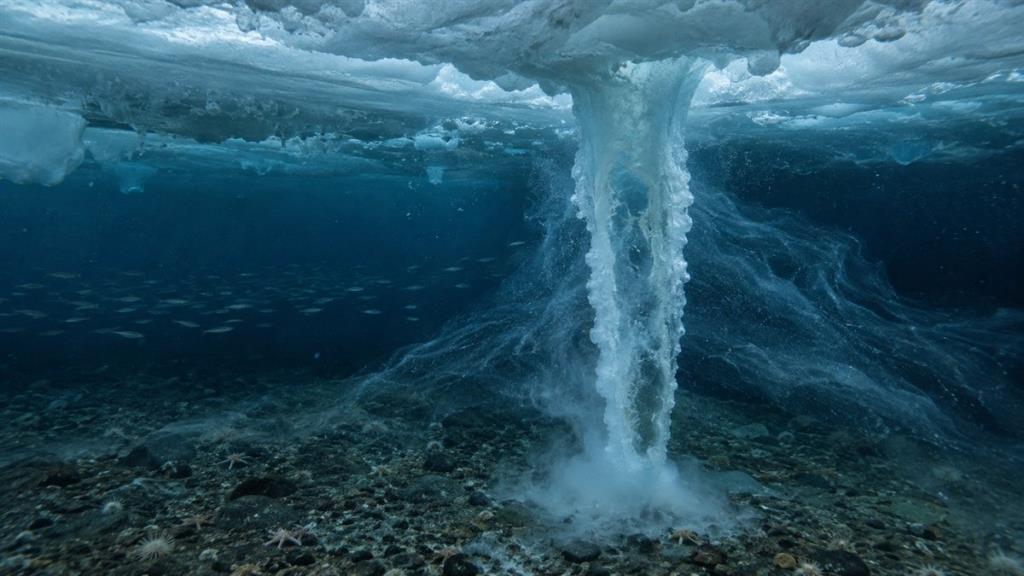
Why does the ice tube grow downward?
Dense brine is heavier than seawater, so it flows downward. The cold stream extracts heat from the surrounding water, freezing that water into the tube's walls. The newly formed ice layer provides some insulation, keeping the flow moving through the core and extending the structure toward the seabed.
An inverted "chemical garden"
Researchers compare brinicles to mineral tubes in chemical gardens: differences in concentration, heat, and boundary membranes self-organize into a tubular shape. Here, the direction of growth is downward, and the tube wall material is ice. Experiments help measure growth rates and stability conditions.
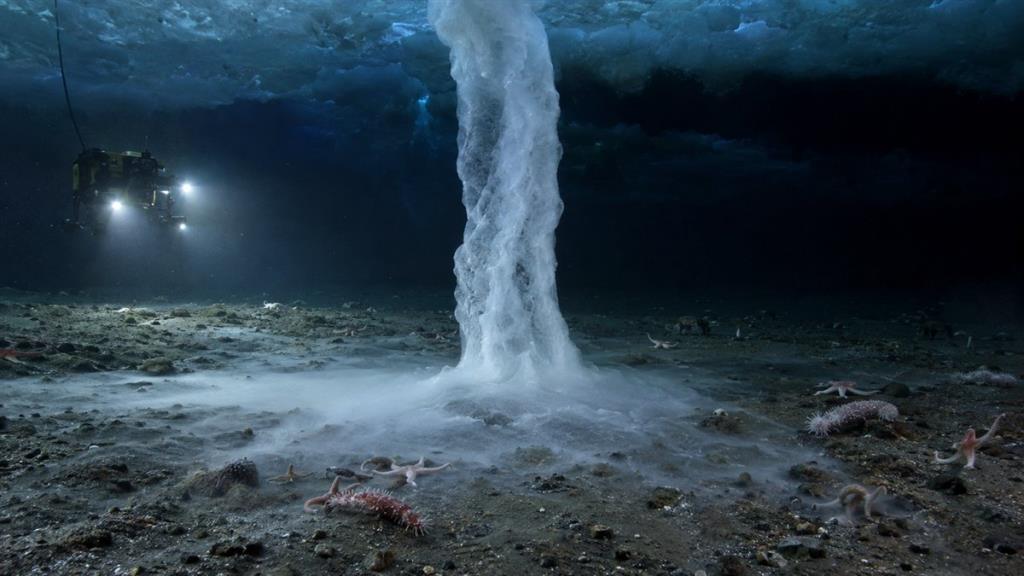
Is the danger exaggerated?
Time-lapse videos make brinicles look like they instantly freeze the entire seabed. In reality, the process has limits; many organisms can avoid it, and the flow stops when the brine source runs dry or becomes diluted. The mystery lies in a structure that self-assembles from heat and salt, not an intentional "grim reaper."
How is salt expelled from ice?
As water crystals arrange themselves, salt ions struggle to fit into the crystal lattice and are forced into brine channels. The increased salinity lowers the freezing point. This water is both colder than the surrounding seawater and heavier, creating a sinking flow through pores on the underside of the ice.
If the surrounding water is near its freezing point and relatively calm, heat transfer into the cold stream causes a layer of water to freeze around it. The tube wall grows larger while the core continues to channel brine downward—a structure built by the flow itself.
What conditions determine its shape?
A flow rate that is too strong breaks the tube; one that is too weak causes it to seal shut. Ocean currents tilt the structure, the roughness under the ice determines where it starts, and the depth determines whether it touches the seabed before the source runs dry. Therefore, fully formed, long brinicles are rarer than short tube buds.
Experiments with cold tanks controlling salinity and flow rate allow for measuring growth rates. Simulations must simultaneously solve for heat transfer, salt diffusion, buoyancy, and crystal face growth.
The moment of touching the seabed
The brine continues to spread along depressions, freezing the surrounding water into a thin layer. Slow-moving starfish or sea urchins can be encased, but the area of impact is finite. Time-lapse cameras compress hours into seconds, creating the illusion of "instant freezing to death."
Ice tubes also intrigue origin-of-life biology because the ice–brine membrane creates chemical gradients and tiny compartments. This is a direction of research, not proof that brinicles generated life.
From mysterious tales to testable records
An engaging story often begins at an awe-inspiring moment, but an investigation must look before and after that moment. Researchers build timelines, search for records closest to the event, preserve original image files, and flag details that only come from late recollections. A single detail copied across hundreds of pages may still originate from only one source.
With natural phenomena, "not found" also needs limits. Not finding meteorite fragments after decades in a swamp is different from not finding them in a clean survey area the next day. Failing to record light with a north-facing camera says nothing about the southern sky. The scope of the search must accompany the conclusion.
Measuring shape, speed, and energy
Angular size in a photo only becomes real size when the distance is known. Velocity also requires distance and time, while energy is often inferred through its impact on the environment. An error in one of the three can turn car headlights into supersonic objects or a minor reaction into a massive energy source.
Calibration is a quiet but decisive step. Cameras need to account for lens distortion; temperature sensors need reference points; station clocks must share the same standard; chemical samples need blank samples to detect contamination. These details are less dramatic than the photo itself but are the boundary between a hint and evidence.
A good model must accept being disproven
A scientific hypothesis does not just retell what has been seen but also predicts what has not yet been measured. If ice pushes rocks, the movement must coincide with shallow water, cold nights, and wind; if convection creates rings, there must be a corresponding thermal structure and flow beneath the center. Incorrect predictions force the model to be modified or discarded.
Different models are sometimes correct in different cases. Nature is under no obligation to use a single mechanism for every glowing sphere, every soil ring, or every similar cloud. Accurate classification can be a greater advancement than finding a single overarching answer.
The role of probability and rarity
A sequence of conditions, none of which are too unusual on their own, can still be rare when they must occur simultaneously. This explains why a phenomenon leaves traces but has few direct witnesses. It also creates bias: someone waiting for years is prone to recording cases close to what they expect, while equipment failing at the exact right moment creates an intriguing gap.
Automated sensor networks and satellite data reduce reliance on luck. Even so, detection algorithms can generate false positives; every alert still requires original photos and checks of familiar sources. More data does not automatically mean more good evidence.
When can we say a mystery is solved?
A strong solution reproduces the mechanism, fits multiple independent datasets, and does not ignore key details. It also explains why the phenomenon is rare, occurring in the right place and during the right season. With old traces, we sometimes only reach the level of "the most plausible solution" because crucial data has been lost.
Solving the general mechanism does not mean knowing every individual event. We may know that Racetrack rocks move thanks to ice, but not the date of each old trail; we know the color of Blood Falls is due to iron, but have yet to fully map the subglacial water system. Accurate phrasing preserves the true sense of mystery.
Preserving sites is preserving data
Tire tracks on a playa, footprints on thin ice, soil samples removed from a circle, or lighting equipment shining into a valley can all destroy data. Visitors should stick to permitted routes, avoid moving objects, and refrain from creating "evidence" for photos. A fake trace can live on the internet longer than the actual scene.
Respecting local communities is also important. They are not just background characters in a story but hold observation histories, names, and environmental knowledge. Good research returns data and conservation benefits to where the phenomenon exists.
A checklist for self-evaluating new claims
Faced with a "sensational" video or news report, one can ask six things: are the original files available; can the time and coordinates be verified; are there any matching common light sources, flights, or weather conditions; was the size measured or just estimated; has an independent group reviewed the data; and does the author state clearly what would make them change their mind. Lacking one item does not make a claim false, but the more that are missing, the lower the level of certainty.
It is also necessary to distinguish between peer-reviewed research papers, preprints, press releases, and online anecdotes. A single study is a starting point, especially when samples are small or the location is unique. Consensus forms when many different methods converge, not when an explanation is shared the most.
The part of the mystery worth keeping
Caution does not require a story to be dry. The moment a forest falls together, a silent glowing sphere hangs over a valley, or an ice tube grows down to the seabed still sends shivers down the spine, even when there are equations behind it. A sense of wonder is the reason for asking questions; evidence is how we ensure the answers do not betray the very thing we want to discover.
In every topic, the unknown is kept separate rather than covered by an absolute conclusion. It could be the composition of an object, the ratio between two mechanisms, an underwater heat source, or the exact trigger conditions. These named gaps with planned measurements are the mysteries that the next generation is likely to continue solving.
How a phenomenon becomes a "mystery"
Rare phenomena often occur quickly, in hard-to-reach places, or in weather that degrades equipment performance. Witnesses only see one angle, and memory naturally fills in the gaps after multiple retellings. When the first photo goes viral, distinct cases are easily lumped under the same name. Therefore, the first question is not "what is it" but "are we talking about one or multiple phenomena."
A strong observation requires the exact hour, location, viewing direction, focal length, weather, and raw data. Photos with background scenery help estimate angles; two cameras spaced apart allow for distance calculations; light spectra reveal elements and temperature. Compressed videos online may look beautiful but often lack the very data needed for verification.
Distinguishing between feasible and what actually happened
An experiment that creates an object resembling a phenomenon only proves that a mechanism can work. To say that the mechanism actually occurred in nature, it must correctly predict the duration, energy, shape, weather conditions, and post-event traces. If it only explains the color but not the movement, the model is still incomplete.
Conversely, the lack of a complete model does not make all options equal. A hypothesis that aligns with physics, generates predictions, and withstands measurement carries more weight than an unfalsifiable idea. The term "unidentified" describes the limits of the data, not the name of a supernatural cause.
Common identification errors
Distances in the dark are very difficult to estimate. Bright stars, planets, aircraft lights, satellites, car headlights through atmospheric layers, and insects close to the lens can take on unusual appearances. Long exposures stretch a point into a line; image stabilization makes the background shake differently from the object; reflections in the glass create a "sphere" that moves with the camera.
In landscapes, circles also easily suggest a designing hand. But convection, waves, resource competition, and equal propagation speeds in all directions naturally create rings or repeating networks. Regular geometry is not in itself evidence of intelligence; what needs to be measured is the mechanism that maintains the pattern over time.
Which questions are still worth pursuing?
A good question must lead to a test: which sensors to place, which samples to take, which data could disprove the hypothesis. For rare events, continuously operating automated systems are often more valuable than short expeditions. For landscapes, multi-year satellite imagery reveals lifecycles and seasonal changes.
Science does not make a story less mysterious. A rock hitching a ride on a thin sheet of ice, a water column creating a kilometer-wide ring, or microbes living in dark brine under a glacier are far stranger than many sensational explanations. The difference is that we know which parts have been measured and which parts remain in the dark.
Reading new information with a clear mind
When there is a claim of a "complete resolution," check the date, the publishing institution, the methodology, and whether the data has been reviewed by another group. A press headline can turn a "fitting model" into a "solved mystery." Conversely, a storyteller might ignore dozens of identified cases just to keep a few ambiguous ones.
Trustworthy conclusions usually have boundaries: what is explained, what is not yet explained, and what conditions would make it wrong. It is those very boundaries that keep curiosity alive without compromising the truth.
Staying safe when approaching phenomena
One should not step onto thin ice, walk into thunderstorms, cross conservation barriers, or take samples in extreme environments just for a photo. Observing from a safe position, recording the time, and noting the viewing direction are often more valuable than a close-up shot that loses context. Fragile sites must also be left intact so that natural traces are not distorted by footprints, vehicles, or objects left behind by visitors.



 Korean kimchi and banchan: the craft of fermentation and a table built on sharing
 Persian rice and tahdig: saffron, a crisp bottom layer and the sofreh
 Moroccan couscous and tagine: rhythm, hospitality and the flavours of North Africa
 Brazilian feijoada: a pot of black beans, a weekend lunch and a story with many roots
 The Indian thali: a balanced tray that tells a regional story and a way of eating together
 Danish smørrebrød: the open sandwich and the art of composing a lunch
 Swiss raclette: melted cheese and a shared table in the cold season
 Injera in Ethiopia and Eritrea: the shared platter that binds a community
Đăng nhập để bình luận: / Sign in to comment: