



How to cook bun rieu cua: fragrant, with the crab curd in soft clouds and a clear broth
A good bun rieu cua has a light broth with a gentle sourness from tomato, crab curd that sets into soft, airy clouds rather than crumbs, fried tofu that keeps its skin, and noodles that do not cloud the pot. This recipe for six explains in detail how to strain the crab, control the heat so the curd sets, and season with just enough shrimp paste.
Quick facts
- Serves: 6 bowls.
- Preparation: 50 minutes.
- Cooking: 60 minutes.
- Difficulty: medium.
- Yield: about 3 litres of broth.
Ingredients
- 700 g of cleaned ground freshwater crab.
- 1.2 kg of fresh rice vermicelli.
- 5 tomatoes, 400 g of fried tofu.
- 2 eggs and 150 g of minced pork, optional.
- 3 litres of water, shallots, spring onion.
- Fish sauce, shrimp paste, fermented rice vinegar or tamarind, salt and sugar.
- Split water spinach, Vietnamese balm, perilla, bean sprouts and lime.
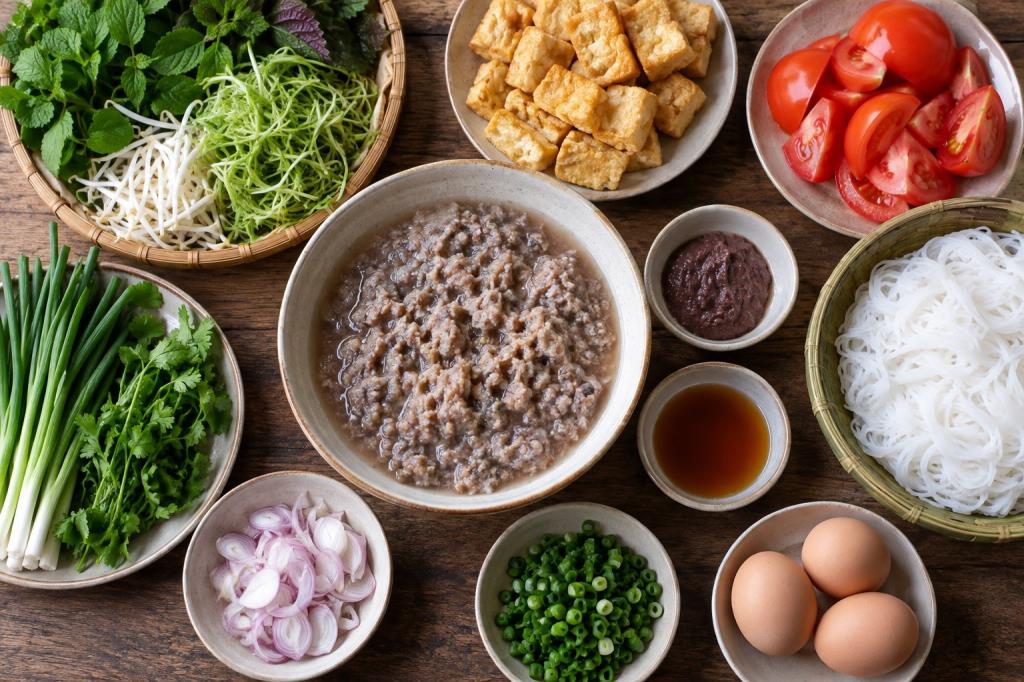
Choosing and preparing the ingredients
Fresh freshwater crab smells natural, not off; if you buy it already ground, use a source you trust and keep it cold. The tomatoes should be ripe red but still firm. The tofu should be fried a light gold with no smell of old oil. Fresh noodles should be springy and not sour.
Mix the ground crab with cool water, squeeze it gently and strain it through a sieve two or three times, discarding the hard shell fragments. Season the crab water with a little salt. Cut the tomatoes into wedges and the tofu into pieces. Wash the raw herbs well and drain them; keep the utensils used for the raw crab away from anything cooked.
Step 1: set the curd with slow heat
Put the pot of crab water on a medium-low heat and stir very gently along the bottom at first so it does not catch. When the protein starts to rise, stop stirring and lower the heat. Let the curd gather into clouds and lift it into a bowl with a slotted ladle; a rolling boil breaks it up.
Step 2: fry the tomato for colour
Fry the shallot, add two thirds of the tomato and a little salt, and cook until soft but not completely collapsed. Tip it into the crab water once you have lifted the curd out. Annatto oil can be used very sparingly; the red does not need to be deep.
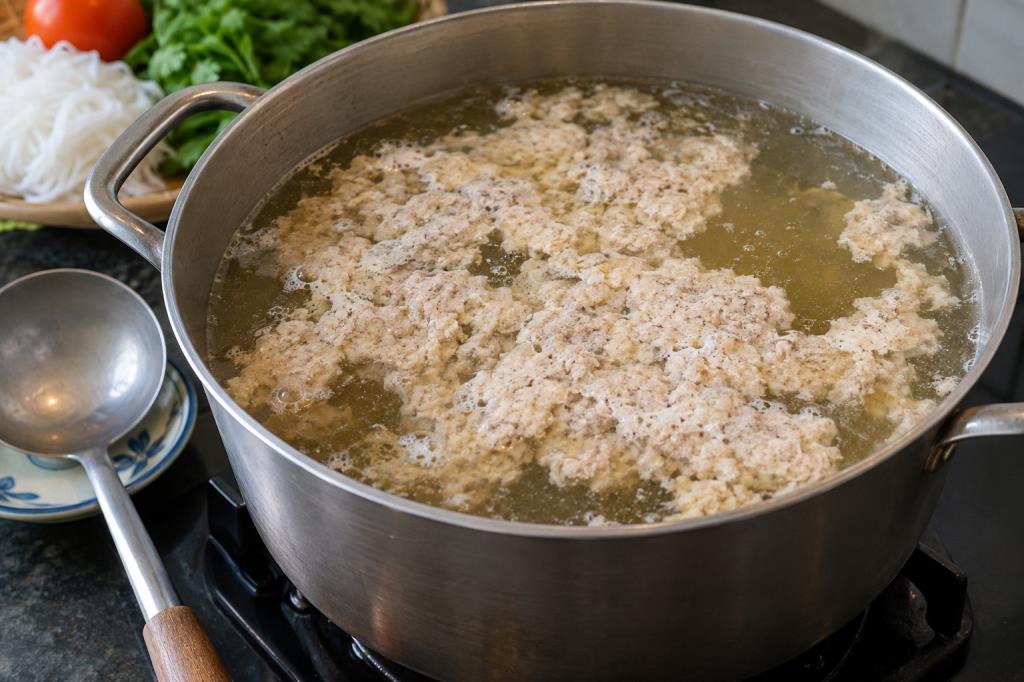
Step 3: finish the broth
Add hot water to the required volume, then the tofu and the rest of the tomato. Season with fish sauce, strained shrimp paste and fermented rice vinegar a little at a time. The broth should be lightly sour and gently salty, with the shrimp paste sitting in the finish rather than hitting you at the front.
Step 4: making the curd firmer
If you are using egg and pork, mix them with the curd you lifted out, steam or set it until cooked and cut it into pieces. Anything with minced pork must reach 71C. Do not pour the raw mixture straight into a pot at a hard boil.
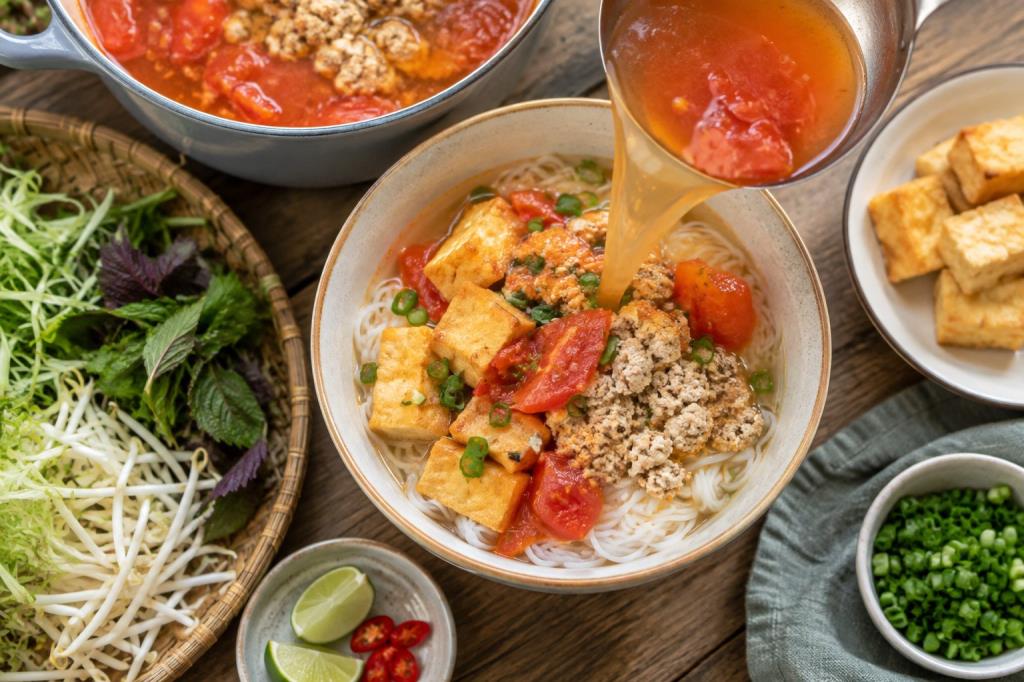
Step 5: blanch the noodles and build the bowl
Blanch the noodles in a separate pot and shake them dry. Layer the noodles, tofu, curd, tomato and spring onion, then ladle on the boiling broth. Keep the raw herbs, lime, chilli and shrimp paste on the side.
Ten small tips
- Strain the crab several times through a sieve.
- Bring the heat up gradually.
- Stop stirring once the curd rises.
- Lift the curd out before adding the acidity.
- Fry the tomato in two parts.
- Strain the shrimp paste.
- Add the acidity a little at a time.
- Blanch the noodles separately.
- Keep the herbs thoroughly dry.
- Ladle the broth while it is boiling.
Common mistakes and what to do
The curd has broken up
Stop stirring, lower the heat and lift out what has gathered with a slotted ladle; you can set the rest separately with egg to make pieces.
The broth is cloudy
It boiled too hard, or the noodles were blanched in the pot. Let it settle, ladle the top into a clean pot and keep it at a gentle simmer.
The shrimp paste is overpowering
Dilute it with hot water, strain it and add it a spoonful at a time; add more fried tomato to round it out rather than masking it with sugar.
The broth is too sour
Add hot stock, a little salt and sugar and taste again; do not simply increase the sugar.
Scaling the recipe up or down
For 12 people, set the curd in two medium pots so you can control the heat, and only then combine the liquid. Portion the noodles and herbs bowl by bowl rather than putting them into the communal pot.
When you double the recipe, choose wider equipment rather than stacking the ingredients in layers. Start strong seasonings at about 1.7 times and taste again, because the surface area for evaporation does not scale linearly. When you halve the recipe, switch to a smaller pot or pan to keep the depth of liquid and the rate of heat transfer appropriate.
Organising the work so the dish is ready on time
Read the recipe through, weigh the ingredients and sort them into raw food, the parts to be cooked, vegetables that are eaten as they are, and the finishing touches. Have a separate clean tray for cooked food. A knife, board or pair of tongs that has touched raw food must be washed before it is used again. Do the steps that can be kept cold in advance, and leave the herbs, the frying or grilling and the assembly until close to the meal.
If you are cooking for a crowd, note down when each stage started and check the dish by temperature, tenderness and colour together, not by the clock alone. Taste a spoonful that has cooled for a few seconds, because food that is too hot makes salt and sweetness hard to judge accurately. Adjust the seasoning only in small amounts.
Serving and presentation
Each bowl has noodles, tofu, tomato and clear pieces of crab curd, with spring onion scattered on top. Serve the split water spinach, Vietnamese balm, perilla, bean sprouts, lime and chilli separately.
Preparing ahead and storing
Store the broth, the curd, the noodles and the herbs separately. Chill the broth and the curd within 2 hours and reheat to 74C. The noodles and herbs are at their best on the day.
Cooked food should not be left at room temperature for more than 2 hours. Divide leftovers into shallow containers, chill them and use them within 3-4 days; when reheating, bring the whole portion to 74C. Only reheat what you are going to eat, and throw away anything with an odd smell, sliminess or other unusual sign rather than tasting it.
Allergy and safety notes
The dish contains crab, fish in the fish sauce, shrimp in the shrimp paste, and egg if you use it. Someone allergic to crustaceans cannot simply have the curd lifted out, because the protein has gone into the broth.
Pregnant women, young children, older people and anyone with a weakened immune system should eat food that is cooked right through and avoid cross-contamination. Read the label on packaged seasonings, as fish, shrimp, soy, wheat, egg, milk or peanut can appear in ready-made products.
Checking the finished dish
Before serving, check the safe temperature, the tenderness, the colour, the smell and the amount of liquid. Move the dish to clean bowls or plates and add the garnish close to serving time. If it has to wait, keep it hot properly but avoid carrying on with a strong heat, which dries the meat, softens the vegetables or thickens the liquid. Note down how much liquid and seasoning you actually used, so it is easier to repeat next time.
Controlling the heat and the equipment
The equipment should suit the quantity: too wide a pot boils the liquid away quickly, while too small a pot spreads the heat badly and leaves the food piled up. Heat it gradually and watch the size of the bubbles, the sound of the sizzle and the rate of evaporation, rather than just holding one setting on the dial. When you need to top up, use hot water so the cooking is not interrupted.
A food thermometer is a checking tool, not a substitute for looking at the texture. Measure at the thickest point, keeping away from bone and the bottom of the pot, and clean the probe before and after each use. With a dish of several components, check the largest piece or the part sitting in the cooler area of the pan.
A systematic way to taste and adjust
Before tasting, stir or ladle out a representative amount of the liquid and let it cool for a few seconds. Work out whether the dish is short on salt, sweetness, acidity, richness or aroma, and change only one element at a time. Strong seasonings such as fish sauce, shrimp paste, sugar or acid should go in a small spoonful at a time, and you should wait until they have dissolved completely before judging again.
If a dish is too salty, the thing that actually lowers the concentration is adding suitable unsalted ingredients or liquid, not adding sugar to mask it. If it is too sweet, increase the liquid and the salt a little before adding acidity. If the spices are harsh, take the bag or the solids out and let the dish rest; carrying on cooking usually makes the smell stronger.
A checklist before it goes to the table
- The raw ingredients have been cooked to a safe temperature.
- The vegetables eaten raw have been washed and drained.
- The serving utensils have not touched raw food.
- Hot dishes are hot enough and cold dishes are kept cold.
- The seasonings, dipping sauces and allergens have been clearly announced.
- The effect of the waiting time on crispness, chewiness or thickness has been allowed for.



 How to cook bun rieu cua: fragrant, with the crab curd in soft clouds and a clear broth
 Fish sauce on the table across the three regions: from how it is mixed to what it is eaten with
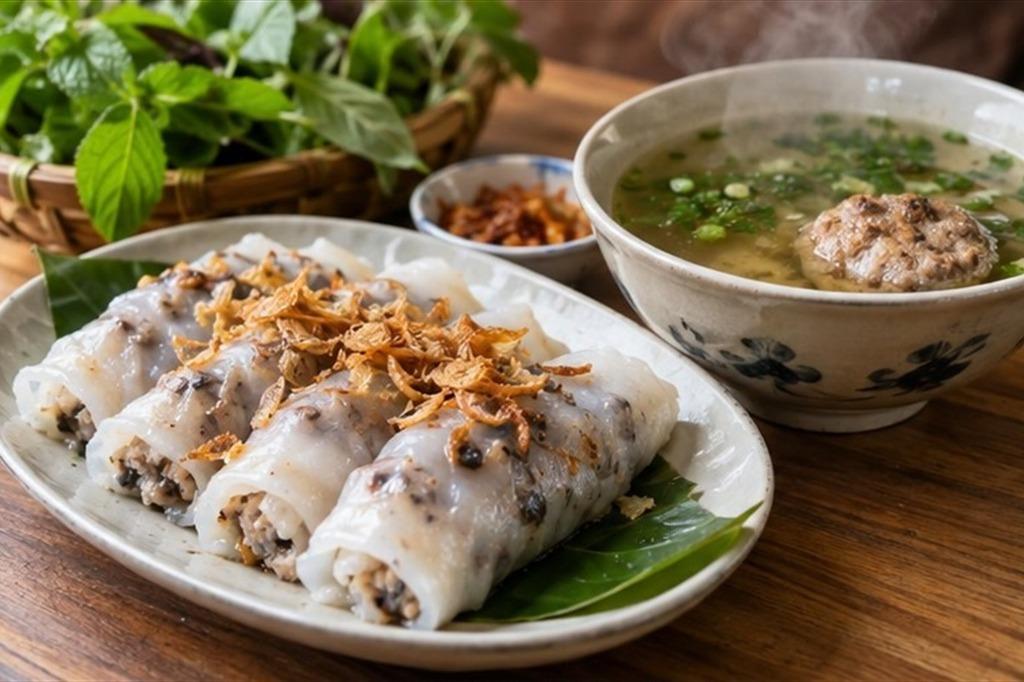 Cao Bang banh cuon: a thin rice sheet eaten with a bowl of hot broth on the frontier
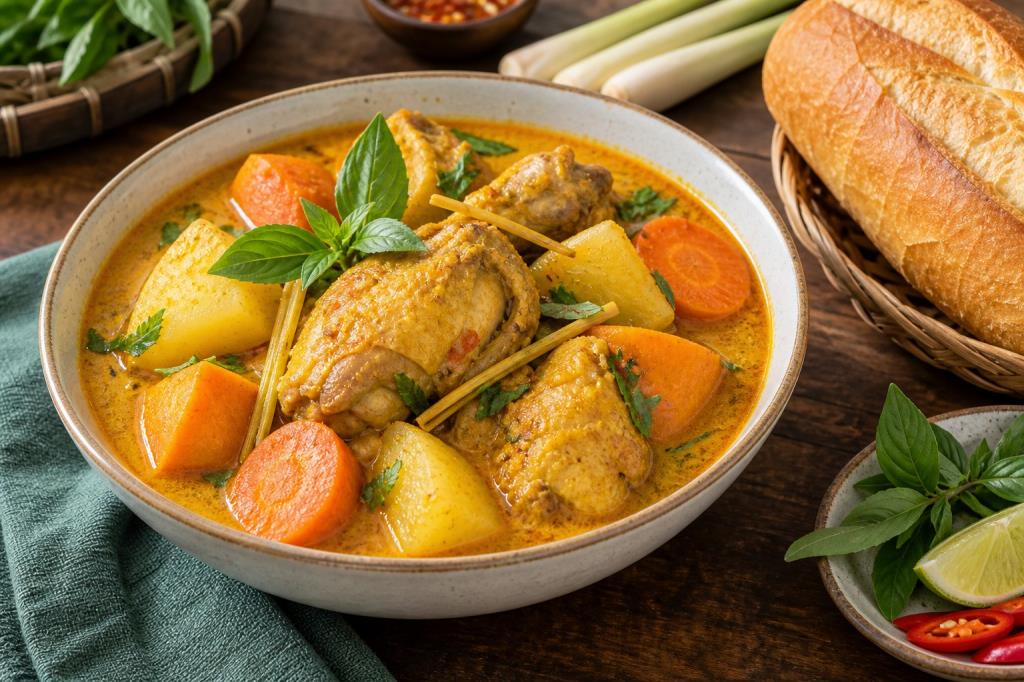 How to cook Vietnamese chicken curry: gently rich, tender meat and potatoes that hold together
 The coastal kitchen of central Vietnam: grilled fish, fermented sauce and getting through the storm season
 Bánh cuốn across the three regions: the same thin sheet, a different way of eating it
 How to make cha gio that stays crisp, with an evenly cooked filling and no split wrappers
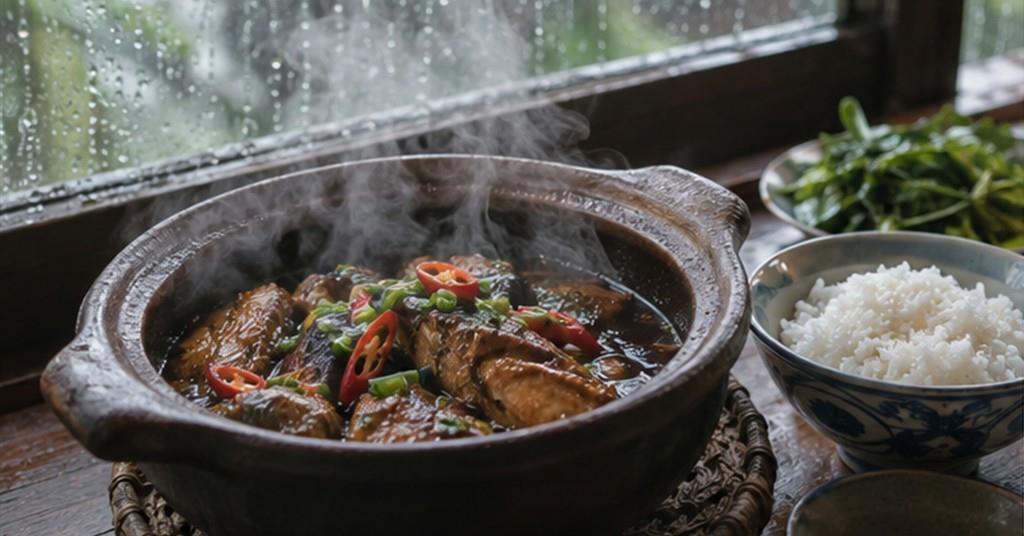 What is it about a Vietnamese rainy-season meal that people far from home never forget?
Đăng nhập để bình luận: / Sign in to comment: