



How to cook hu tieu Nam Vang: a clear broth, sweet from the bones, with noodles that hold
A good hu tieu Nam Vang has a clear broth, sweet from the bones and the daikon, chewy noodles, and every topping cooked to its own point. This recipe for six bowls keeps the broth, the pork, the prawns, the minced pork and the blanching of the noodles clearly separate, so you do not end up with a single pot that is cloudy, pungent or too sweet.
Quick facts
- Serves: 6 bowls.
- Preparation: 50 minutes.
- Simmering: 2.5-3 hours.
- Difficulty: medium.
- Suitable pot: 8 litres.
Ingredients
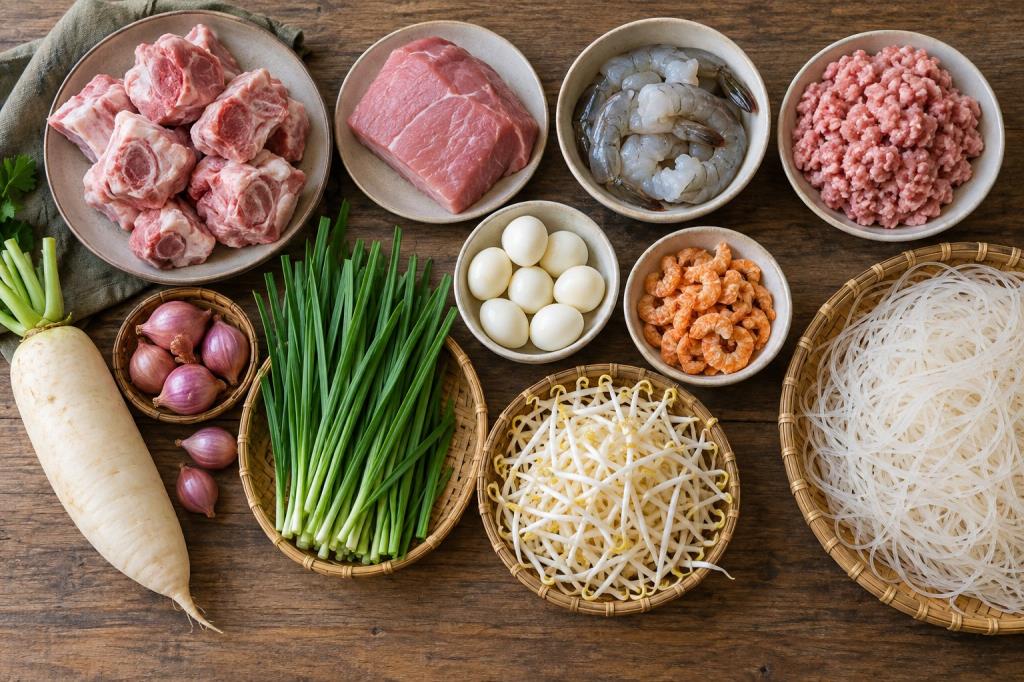
- 1.5 kg of pork bones, 500 g of pork shoulder.
- 300 g of prawns, 250 g of minced pork.
- 18 quail eggs.
- 600 g of dried hu tieu noodles.
- 1 daikon, 1 onion, dried shrimp.
- Fish sauce, salt, rock sugar, pepper.
- Garlic chives, spring onion, bean sprouts, Chinese celery, fried garlic and lime.
Choosing and preparing the ingredients
Fresh bones have no sour smell; a whole piece of shoulder slices neatly. Prawns should have glossy shells and springy flesh. The dried noodles should be unbroken and free of damp or mould. The daikon should be firm and naturally sweet; do not use too much, or the broth turns cloyingly sweet.
Soak the bones in cold water, blanch them for 5 minutes, then rinse each piece and the pot. Wash the dried shrimp, soak them separately and strain the liquid. Boil the quail eggs and peel them. Wash the vegetables and drain them; use a separate board for the raw prawns and pork.
Step 1: simmer a clear broth
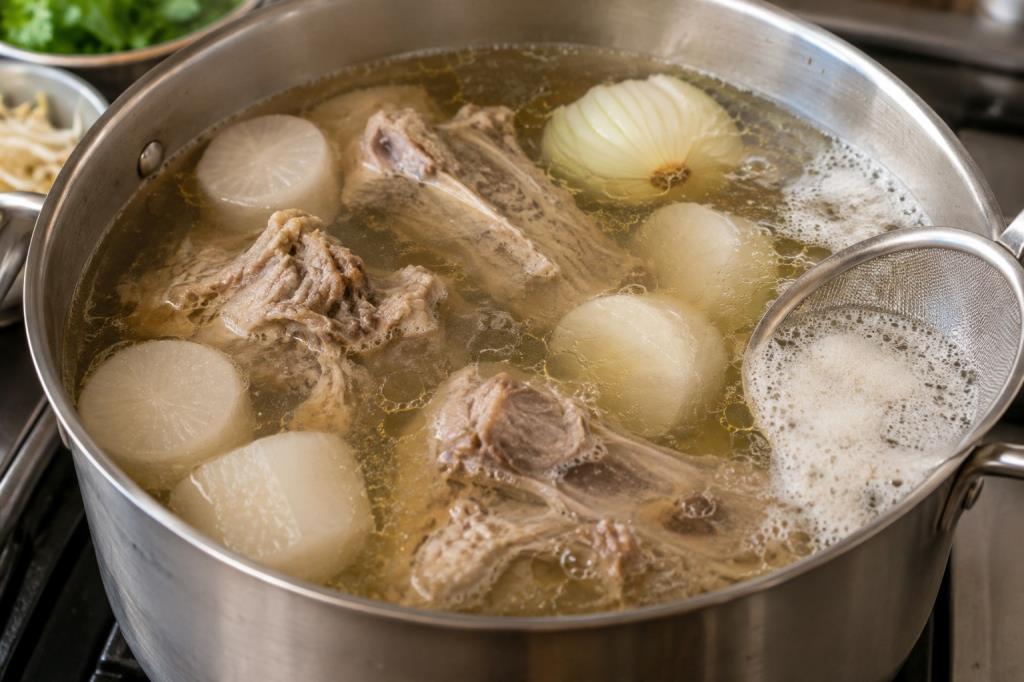
Put the bones, cold water, onion and daikon in the pot. Bring it close to the boil, skim, then keep the surface only trembling and do not cover it tightly. Top up with boiling water when the level drops.
Step 2: cook the pork and prepare the toppings
Put the shoulder into the broth, lift it out as soon as it is done, cool it quickly and slice it thinly. Boil the prawns separately until they are opaque and firm. Fry the minced pork with shallot until cooked; never put raw meat straight into the bowl.
Step 3: strain and season
After 2.5 hours, strain the broth into a clean pot and skim off the excess fat. Season with salt, rock sugar and fish sauce at the end. On its own the broth should be a little stronger, because the noodles and bean sprouts dilute it.
Step 4: blanch the noodles properly
Soak or boil them as the packet says, then blanch them in portions in a separate pot of boiling water. Shake them thoroughly dry and toss them with a drop of garlic oil if you like. Do not blanch them in the broth.
Step 5: build a hot bowl
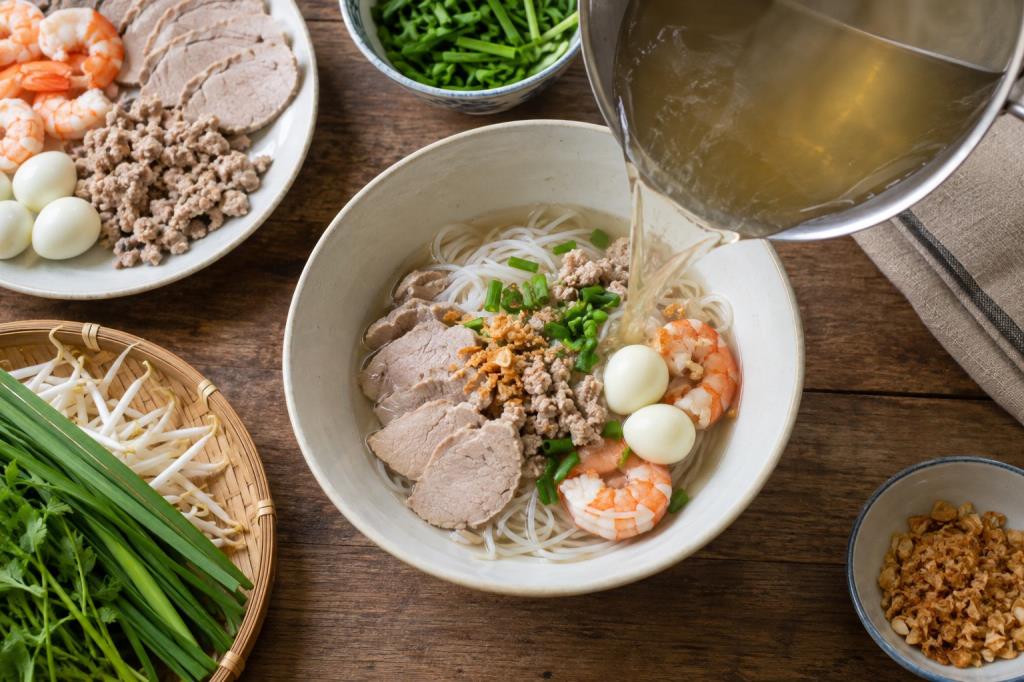
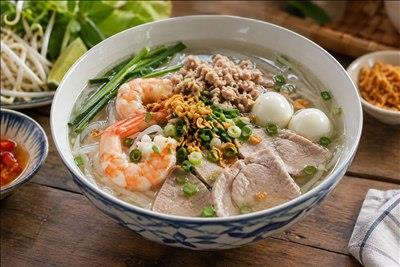
Warm the bowl, then add the noodles, pork, prawns, minced pork, quail eggs and garlic chives. Ladle on the boiling broth and scatter fried garlic. Keep the bean sprouts, lime and chilli on the side.
Ten small tips
- Blanch and rinse the bones thoroughly.
- Keep it at a very gentle simmer.
- Top up with boiling water.
- Lift the pork out at the right point.
- Cook each topping separately.
- Strain the broth before seasoning.
- Blanch the noodles in a separate pot.
- Shake the noodles dry.
- Warm the bowls.
- Add the fried garlic last.
Common mistakes and what to do
The broth is cloudy
Let it settle, then ladle the top through a straining cloth into a clean pot; next time lower the heat and do not stir the bones.
The broth is too sweet
Use less daikon and sugar, dilute it with bone stock made without vegetables, and add salt a little at a time.
The noodles have gone mushy
They were soaked too long or left sitting in hot water. Use a fresh batch and blanch bowl by bowl close to serving time.
The prawns are rubbery
They were boiled too long. Split them in half and serve them with hot broth; next time lift them out as soon as they turn opaque and curl slightly.
Scaling the recipe up or down
For 12 bowls, make the broth in advance and divide the toppings into small trays kept cold. Blanch the noodles round by round; do not assemble all the bowls too early.
When you double the recipe, choose wider equipment rather than stacking the ingredients in layers. Start strong seasonings at about 1.7 times and taste again, because the surface area for evaporation does not scale linearly. When you halve the recipe, switch to a smaller pot or pan to keep the depth of liquid and the rate of heat transfer appropriate.
Organising the work so the dish is ready on time
Read the recipe through, weigh the ingredients and sort them into raw food, the parts to be cooked, vegetables that are eaten as they are, and the finishing touches. Have a separate clean tray for cooked food. A knife, board or pair of tongs that has touched raw food must be washed before it is used again. Do the steps that can be kept cold in advance, and leave the herbs, the frying or grilling and the assembly until close to the meal.
If you are cooking for a crowd, note down when each stage started and check the dish by temperature, tenderness and colour together, not by the clock alone. Taste a spoonful that has cooled for a few seconds, because food that is too hot makes salt and sweetness hard to judge accurately. Adjust the seasoning only in small amounts.
Serving and presentation
Hu tieu with broth is ladled boiling hot, with the toppings clearly arranged and garlic chives and fried garlic on top. You can serve a dry version too, but the mixing sauce has to be made separately.
Preparing ahead and storing
Store the broth and the toppings separately and chill them within 2 hours. Blanched noodles should be used straight away. Reheat the broth and the pork to 74C, and warm the prawns only until hot so they do not turn rubbery.
Cooked food should not be left at room temperature for more than 2 hours. Divide leftovers into shallow containers, chill them and use them within 3-4 days; when reheating, bring the whole portion to 74C. Only reheat what you are going to eat, and throw away anything with an odd smell, sliminess or other unusual sign rather than tasting it.
Allergy and safety notes
The dish contains prawns and fish in the fish sauce; the quail eggs and the packaged noodles may also have components to watch for. Do not share the broth with anyone allergic to prawns.
Pregnant women, young children, older people and anyone with a weakened immune system should eat food that is cooked right through and avoid cross-contamination. Read the label on packaged seasonings, as fish, shrimp, soy, wheat, egg, milk or peanut can appear in ready-made products.
Checking the finished dish
Before serving, check the safe temperature, the tenderness, the colour, the smell and the amount of liquid. Move the dish to clean bowls or plates and add the garnish close to serving time. If it has to wait, keep it hot properly but avoid carrying on with a strong heat, which dries the meat, softens the vegetables or thickens the liquid. Note down how much liquid and seasoning you actually used, so it is easier to repeat next time.
Controlling the heat and the equipment
The equipment should suit the quantity: too wide a pot boils the liquid away quickly, while too small a pot spreads the heat badly and leaves the food piled up. Heat it gradually and watch the size of the bubbles, the sound of the sizzle and the rate of evaporation, rather than just holding one setting on the dial. When you need to top up, use hot water so the cooking is not interrupted.
A food thermometer is a checking tool, not a substitute for looking at the texture. Measure at the thickest point, keeping away from bone and the bottom of the pot, and clean the probe before and after each use. With a dish of several components, check the largest piece or the part sitting in the cooler area of the pan.
A systematic way to taste and adjust
Before tasting, stir or ladle out a representative amount of the liquid and let it cool for a few seconds. Work out whether the dish is short on salt, sweetness, acidity, richness or aroma, and change only one element at a time. Strong seasonings such as fish sauce, shrimp paste, sugar or acid should go in a small spoonful at a time, and you should wait until they have dissolved completely before judging again.
If a dish is too salty, the thing that actually lowers the concentration is adding suitable unsalted ingredients or liquid, not adding sugar to mask it. If it is too sweet, increase the liquid and the salt a little before adding acidity. If the spices are harsh, take the bag or the solids out and let the dish rest; carrying on cooking usually makes the smell stronger.
A checklist before it goes to the table
- The raw ingredients have been cooked to a safe temperature.
- The vegetables eaten raw have been washed and drained.
- The serving utensils have not touched raw food.
- Hot dishes are hot enough and cold dishes are kept cold.
- The seasonings, dipping sauces and allergens have been clearly announced.
- The effect of the waiting time on crispness, chewiness or thickness has been allowed for.


 Hue vegetarian food: why is something so plain still so layered in flavour?
 How to cook hu tieu Nam Vang: a clear broth, sweet from the bones, with noodles that hold
 How to cook bun rieu cua: fragrant, with the crab curd in soft clouds and a clear broth
 Fish sauce on the table across the three regions: from how it is mixed to what it is eaten with
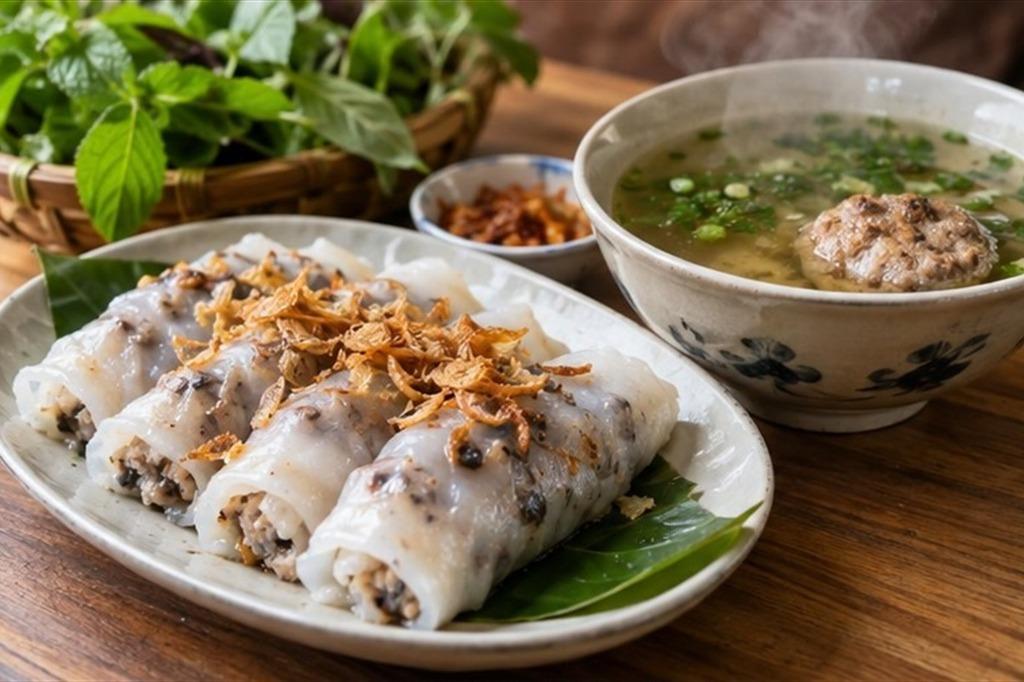 Cao Bang banh cuon: a thin rice sheet eaten with a bowl of hot broth on the frontier
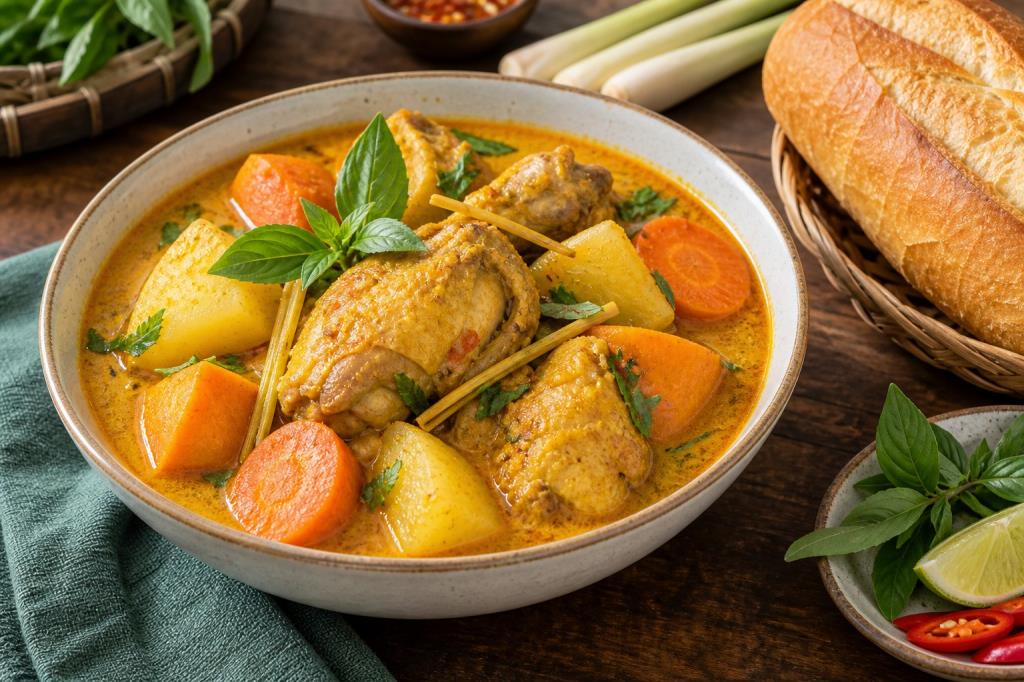 How to cook Vietnamese chicken curry: gently rich, tender meat and potatoes that hold together
 The coastal kitchen of central Vietnam: grilled fish, fermented sauce and getting through the storm season
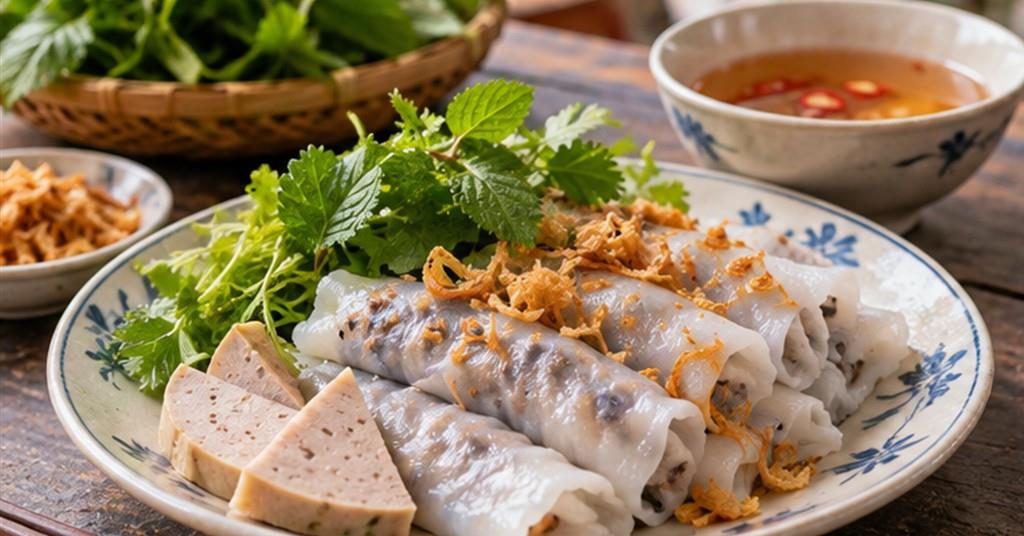 Bánh cuốn across the three regions: the same thin sheet, a different way of eating it
Đăng nhập để bình luận: / Sign in to comment: