



Dwarka underwater: what does archaeology say about the legendary city?
Off the coast of Dwarka and Bet Dwarka lie stone anchors, pottery, and underwater architectural remains. These findings confirm long-standing maritime activity along the Gujarat coast, but the question of whether they precisely prove the existence of Krishna's city in the epic still requires a higher standard of evidence.
Modern Dwarka is an important pilgrimage center overlooking the Arabian Sea. Since the 1980s, India's marine archaeology units have surveyed the coast and seabed, documenting multi-holed stone anchors, masonry blocks, and artifacts from various periods. In 2025, the Archaeological Survey of India continues its program of searching, documenting, and training archaeological divers in the area.
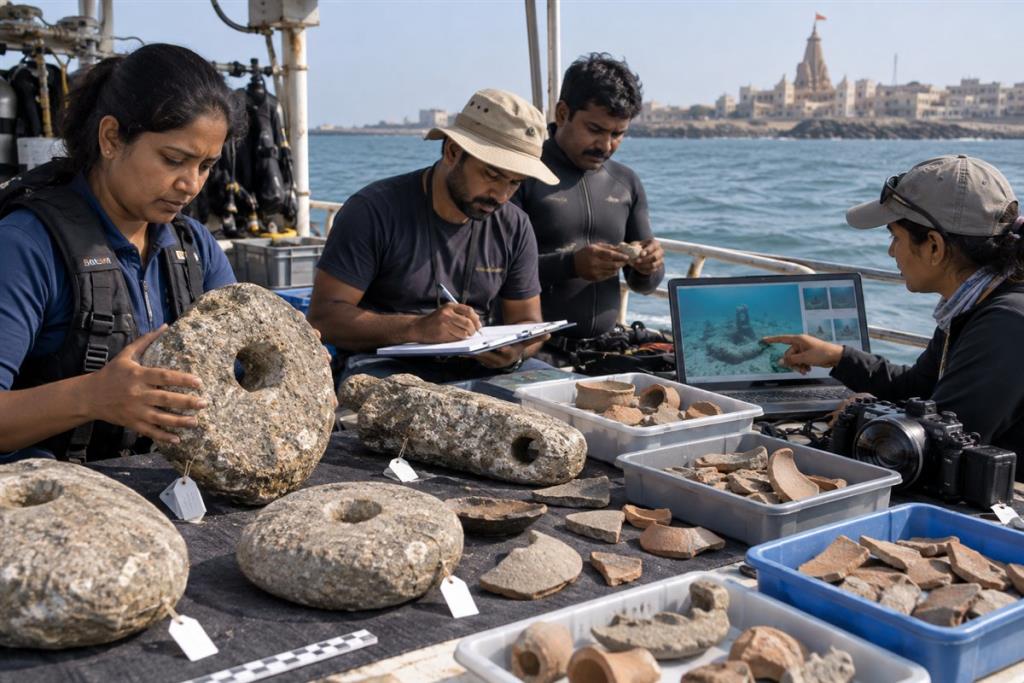
Anchors tell the story of a trading port
Triangular anchors, multi-holed anchors, and pottery shards indicate that vessels once operated along this coast. However, an anchor could be used, reused, or displaced over centuries. To determine its date, archaeologists must place it in relation to sediment layers, pottery, and structures with a clear context.
Do underwater structures mean a sunken city?
The coastline changes due to waves, currents, storms, sea levels, and tectonics. Stone blocks could be architectural elements, harbor structures, fallen materials, or natural topography that has been misinterpreted. Mapping, sampling, and comparison with onshore excavations must precede any claim about urban scale.
The gap between archaeology and the epic
Religious texts preserve cultural memory, place names, and conceptions of the past; archaeology answers with materials, stratigraphy, and dating. An ancient settlement site located exactly in the Dwarka region does not automatically confirm every detail in the epic. Conversely, scientific caution does not deny the spiritual value of the story.
What can the new survey clarify?
Positioning techniques, photogrammetry, in-situ recording, and sample analysis can separate artifact assemblages by period. Transparently published data on coordinates, sediment layers, and dating methods will allow multiple groups to verify the conclusions. This is a better path than relying on a single viral underwater image.
Unresolved questions
- The dating and function of some underwater structures remain debated.
- Fluctuating coastlines cause artifacts to lose their original context.
- A direct link between archaeological layers and the city in religious tradition has not been definitively proven.
Conclusion
Underwater Dwarka is a real chapter of maritime archaeology, requiring no exaggeration to be fascinating. There is currently evidence of ancient coastal activity; however, claims of finding the legendary city intact go beyond what the publicly available data allows us to conclude.



 Korean kimchi and banchan: the craft of fermentation and a table built on sharing
 Persian rice and tahdig: saffron, a crisp bottom layer and the sofreh
 Moroccan couscous and tagine: rhythm, hospitality and the flavours of North Africa
 Brazilian feijoada: a pot of black beans, a weekend lunch and a story with many roots
 The Indian thali: a balanced tray that tells a regional story and a way of eating together
 Danish smørrebrød: the open sandwich and the art of composing a lunch
 Swiss raclette: melted cheese and a shared table in the cold season
 Injera in Ethiopia and Eritrea: the shared platter that binds a community
Đăng nhập để bình luận: / Sign in to comment: