



Atlantis: A Real Sunken City or Plato's Philosophical Story?
Atlantis is famous as a civilization that vanished beneath the sea, but the most certain starting point of the story is not an ancient map or underwater ruins: it is Plato's two dialogues, Timaeus and Critias.
Plato wrote about Atlantis around the 4th century BCE. In the narrative, an Egyptian priest passes the story to Solon, and it is retold through several people before reaching the reader. Atlantis was located beyond the "Pillars of Heracles," possessing a capital of concentric rings of land and water, and was submerged by earthquakes and floods in a single day and night.
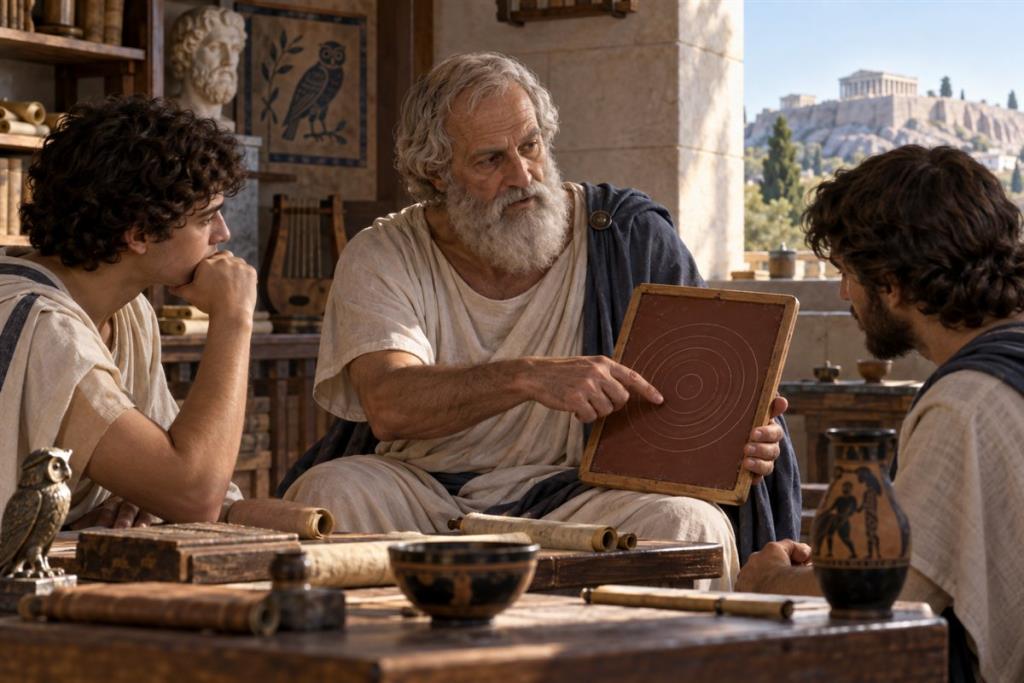
What do the original texts say?
Timaeus introduces Atlantis in the story of a confrontation between an ideal Athens and an ambitious island power. Critias expands on the island's geography, politics, and morality but stops abruptly in the middle. No ancient Egyptian text has been confirmed as the original source of this record, and the chain of oral transmission in the work is part of the literary structure constructed by Plato.
Why are so many places nominated as Atlantis?
Plato's description contains enough geographical detail for readers to try matching it with Santorini, Crete, the Atlantic coast, Spain, and many other places. The Thera eruption and the decline of the Minoan world provide a compelling parallel, but a similarity in disaster does not prove the two locations are one. Each candidate usually has to ignore or reinterpret a part of the chronology, size, or location in the text.
What evidence does archaeology currently have?
Archaeology has recorded many coastal cities submerged due to earthquakes, subsidence, and rising sea levels. However, no site has yet provided the simultaneous chronology, material culture, geography, and texts that match closely enough for experts to accept it as Plato's Atlantis. A circle on a satellite image or an underwater structure is only a starting point for investigation, not proof of the name and history of a civilization.
The most cautious reading
Many scholars view Atlantis as a thought experiment on power, morality, and decay, which Plato may have pieced together from memories of real disasters. This understanding does not force the story to be entirely fictional or entirely historical. It distinguishes real-life material from a state designed to serve a philosophical debate.
Unresolved questions
- It is unclear how much Plato relied on oral traditions or memories of Thera and other Mediterranean disasters.
- There is no unified criteria for an archaeological site to be considered a match for Atlantis rather than just having a few similarities.
- The fact that Critias was left unfinished leaves the ending and the full purpose of the story gone.
Conclusion
Atlantis remains a cultural mystery with extraordinary vitality, but it is not a city confirmed by archaeology. The most accurate conclusion today is that we have Plato's texts, many real ancient disasters, and a great deal of association—there is no bridge of evidence connecting them into a single location.



 Korean kimchi and banchan: the craft of fermentation and a table built on sharing
 Persian rice and tahdig: saffron, a crisp bottom layer and the sofreh
 Moroccan couscous and tagine: rhythm, hospitality and the flavours of North Africa
 Brazilian feijoada: a pot of black beans, a weekend lunch and a story with many roots
 The Indian thali: a balanced tray that tells a regional story and a way of eating together
 Danish smørrebrød: the open sandwich and the art of composing a lunch
 Swiss raclette: melted cheese and a shared table in the cold season
 Injera in Ethiopia and Eritrea: the shared platter that binds a community
Đăng nhập để bình luận: / Sign in to comment: