



How to cook ca loc nuong trui: evenly done, juicy flesh and no taste of ash
Ca loc nuong trui is appealing because the charred skin protects the white, juicy flesh inside, with a light smoky smell and the habit of eating it wrapped in leaves. Doing it at home means paying attention to what you burn, the distance from the heat and checking that it is cooked; this recipe gives both the outdoor straw method and a clean charcoal alternative.
Quick facts
- Serves: 4-5 people.
- Preparation: 40 minutes.
- Grilling: 25-40 minutes.
- Difficulty: medium.
- Only do this in an open place that is safe from fire.
Ingredients
- 1 whole snakehead fish of 1.2-1.5 kg.
- Clean dry straw with no chemicals, or clean charcoal.
- Spring onion, oil, roasted peanuts.
- Fresh rice vermicelli, rice paper.
- Cucumber, pineapple, green banana and herbs.
- Fish sauce, tamarind or lime, sugar, garlic and chilli.
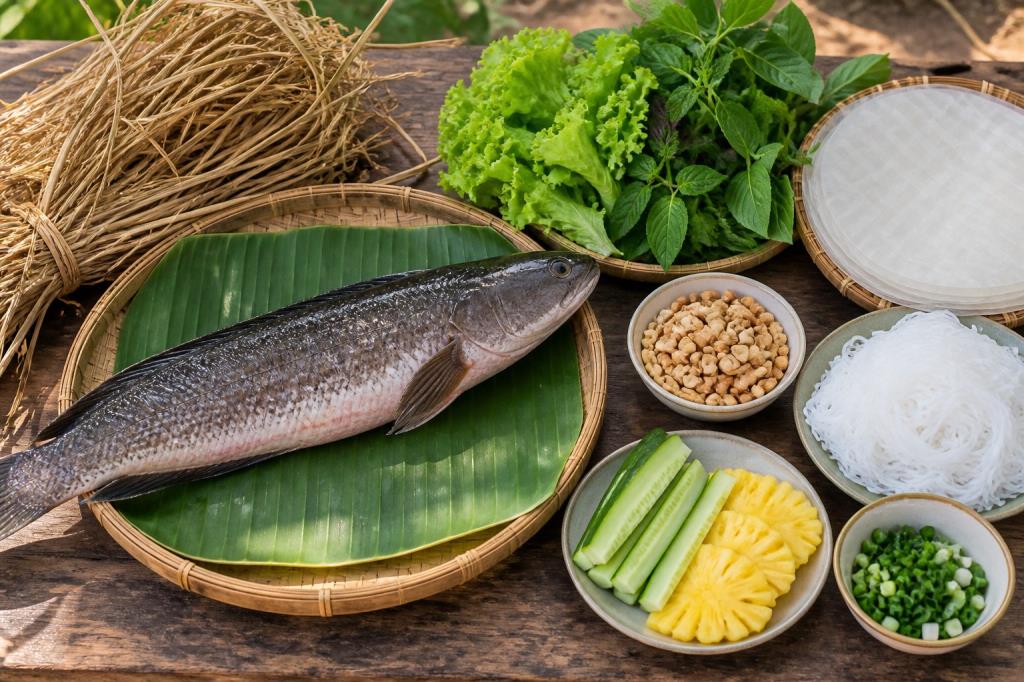
Choosing and preparing the ingredients
A fresh fish has clear eyes, red gills, springy flesh and a natural smell. The fuel must be clean and dry, with no paint, oil or pesticide. Do not use printed colour paper, plastic or chemically treated wood.
Leave the scales on to protect the flesh but clean the slime off the outside, remove the gills and guts carefully, rinse the cavity and pat it dry. You can skewer it lengthways with a bamboo stick that has been soaked in water. Wash the vegetables well and drain them.
Step 1: set up a safe grilling area
Choose a non-flammable surface, away from roofs, dry plants and anything that catches fire easily, and have water or a fire extinguisher ready. Put the fish on a sturdy rack, not directly on dirty ground.
Step 2: build heat all around it
Pile clean straw around the fish and light it in layers so the heat is even, avoiding a strong flame on one side for a long time. With charcoal, grill indirectly and turn the fish from time to time. The blackened skin is a protective layer, not the part you eat.
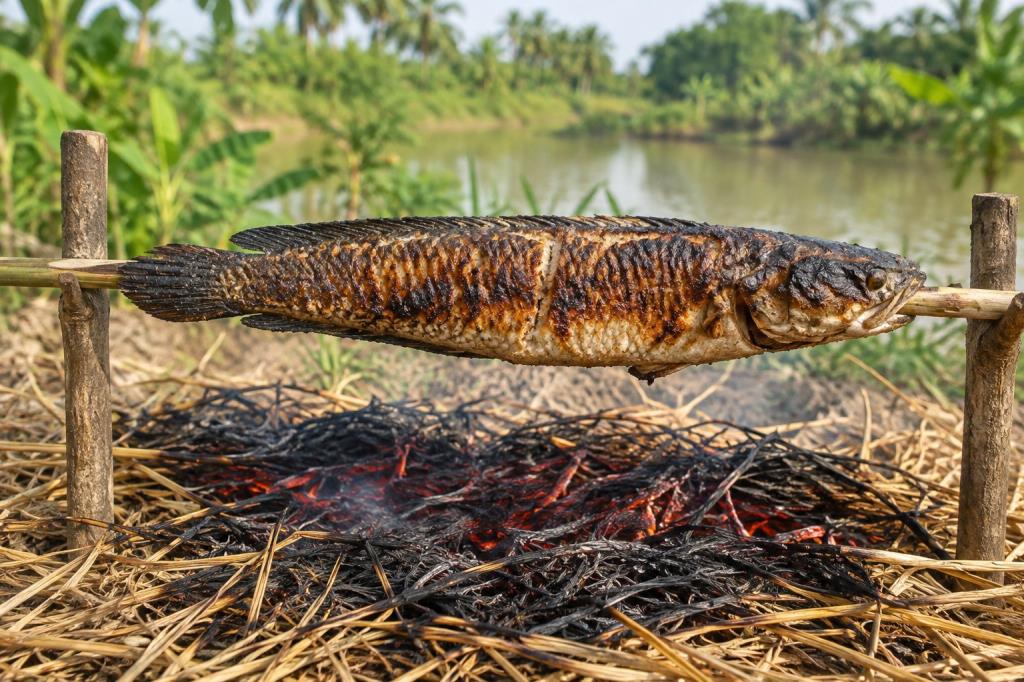
Step 3: check that it is cooked
The time depends on the size and the heat. Measure the thick part of the flesh for at least 63C, with the flesh turning opaque and separating into flakes. If it is not there yet, carry on with indirect heat; do not judge by the charred skin alone.
Step 4: clean off the burnt layer
Let the fish rest for a few minutes, then use a clean knife to cut along the back and scrape the burnt scales outwards, keeping ash off the flesh. The utensils used on the dirty skin must not touch the clean flesh.
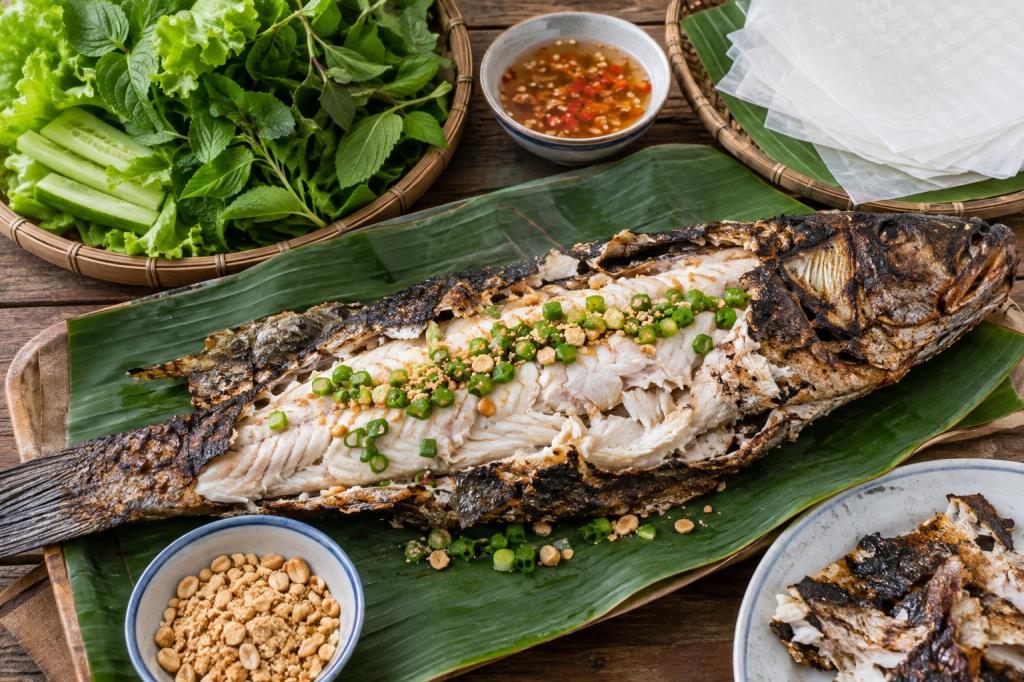
Step 5: add the spring onion oil and serve
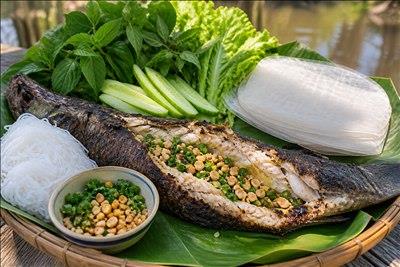
Spoon over moderately hot spring onion oil and scatter the peanuts. Wrap the fish with noodles, herbs, pineapple and rice paper, and dip it in tamarind or sweet-and-sour fish sauce.
Ten small tips
- Choose a fish of moderate size.
- Use clean straw or charcoal.
- Grill on a rack, off the ground.
- Have something ready to put out a fire.
- Build even heat all around the body.
- Turn the fish according to how it browns.
- Take the temperature in the thick part.
- Let the fish rest.
- Keep the utensils for the burnt skin and the flesh apart.
- Spoon on the spring onion oil when you serve.
Common mistakes and what to do
The skin is burnt but the flesh is raw
Move it to indirect heat, cover it loosely and grill it to 63C. Do not eat any part that is undercooked.
The flesh is dry
The fish was too small or grilled too long. Spoon over the spring onion oil and the dipping sauce; next time check the temperature earlier.
The fish tastes of ash
The burnt layer was scraped the wrong way. Use a clean brush and a damp cloth on the outside before opening it, and discard any flesh that has picked up dirt.
The smoke smells harsh
The fuel was damp or not clean. Stop using it; do not try to cover the smell with seasoning.
Scaling the recipe up or down
Each fish should have its own grilling area so the heat surrounds it evenly. Do not stack them. Prepare the vegetables and rice paper according to the number of people, and grill the fish in rounds.
When you double the recipe, choose wider equipment rather than stacking the ingredients in layers. Start strong seasonings at about 1.7 times and taste again, because the surface area for evaporation does not scale linearly. When you halve the recipe, switch to a smaller pot or pan to keep the depth of liquid and the rate of heat transfer appropriate.
Organising the work so the dish is ready on time
Read the recipe through, weigh the ingredients and sort them into raw food, the parts to be cooked, vegetables that are eaten as they are, and the finishing touches. Have a separate clean tray for cooked food. A knife, board or pair of tongs that has touched raw food must be washed before it is used again. Do the steps that can be kept cold in advance, and leave the herbs, the frying or grilling and the assembly until close to the meal.
If you are cooking for a crowd, note down when each stage started and check the dish by temperature, tenderness and colour together, not by the clock alone. Taste a spoonful that has cooled for a few seconds, because food that is too hot makes salt and sweetness hard to judge accurately. Adjust the seasoning only in small amounts.
Serving and presentation
Lay the opened fish on a clean banana leaf with the spring onion oil and peanuts on top. Arrange the noodles, rice paper, herbs, cucumber, pineapple and dipping sauce separately.
Preparing ahead and storing
The fish is at its best straight off the fire. Take any leftovers off the bone, put them in a container within 2 hours and use them within 3-4 days, reheating to 74C. Store the vegetables and noodles separately.
Cooked food should not be left at room temperature for more than 2 hours. Divide leftovers into shallow containers, chill them and use them within 3-4 days; when reheating, bring the whole portion to 74C. Only reheat what you are going to eat, and throw away anything with an odd smell, sliminess or other unusual sign rather than tasting it.
Allergy and safety notes
The dish contains fish, fish sauce and peanuts. Anyone allergic to fish must not use a dipping sauce that has been in contact with the fish, and anyone allergic to peanuts needs them left out entirely, along with any shared utensils.
Pregnant women, young children, older people and anyone with a weakened immune system should eat food that is cooked right through and avoid cross-contamination. Read the label on packaged seasonings, as fish, shrimp, soy, wheat, egg, milk or peanut can appear in ready-made products.
Checking the finished dish
Before serving, check the safe temperature, the tenderness, the colour, the smell and the amount of liquid. Move the dish to clean bowls or plates and add the garnish close to serving time. If it has to wait, keep it hot properly but avoid carrying on with a strong heat, which dries the meat, softens the vegetables or thickens the liquid. Note down how much liquid and seasoning you actually used, so it is easier to repeat next time.
Controlling the heat and the equipment
The equipment should suit the quantity: too wide a pot boils the liquid away quickly, while too small a pot spreads the heat badly and leaves the food piled up. Heat it gradually and watch the size of the bubbles, the sound of the sizzle and the rate of evaporation, rather than just holding one setting on the dial. When you need to top up, use hot water so the cooking is not interrupted.
A food thermometer is a checking tool, not a substitute for looking at the texture. Measure at the thickest point, keeping away from bone and the bottom of the pot, and clean the probe before and after each use. With a dish of several components, check the largest piece or the part sitting in the cooler area of the pan.
A systematic way to taste and adjust
Before tasting, stir or ladle out a representative amount of the liquid and let it cool for a few seconds. Work out whether the dish is short on salt, sweetness, acidity, richness or aroma, and change only one element at a time. Strong seasonings such as fish sauce, shrimp paste, sugar or acid should go in a small spoonful at a time, and you should wait until they have dissolved completely before judging again.
If a dish is too salty, the thing that actually lowers the concentration is adding suitable unsalted ingredients or liquid, not adding sugar to mask it. If it is too sweet, increase the liquid and the salt a little before adding acidity. If the spices are harsh, take the bag or the solids out and let the dish rest; carrying on cooking usually makes the smell stronger.
A checklist before it goes to the table
- The raw ingredients have been cooked to a safe temperature.
- The vegetables eaten raw have been washed and drained.
- The serving utensils have not touched raw food.
- Hot dishes are hot enough and cold dishes are kept cold.
- The seasonings, dipping sauces and allergens have been clearly announced.
- The effect of the waiting time on crispness, chewiness or thickness has been allowed for.


 Bo Dau banh chung: the green square cake at the crossroads into Thai Nguyen
 How to cook ca loc nuong trui: evenly done, juicy flesh and no taste of ash
 How to make Hoi An chicken rice: fluffy grains, juicy chicken and a crisp onion salad
 Me xung from Hue: chewy malt, toasted sesame and the slow rhythm of tea
 The food of Hue: where the royal kitchen, everyday dishes and small street stalls meet
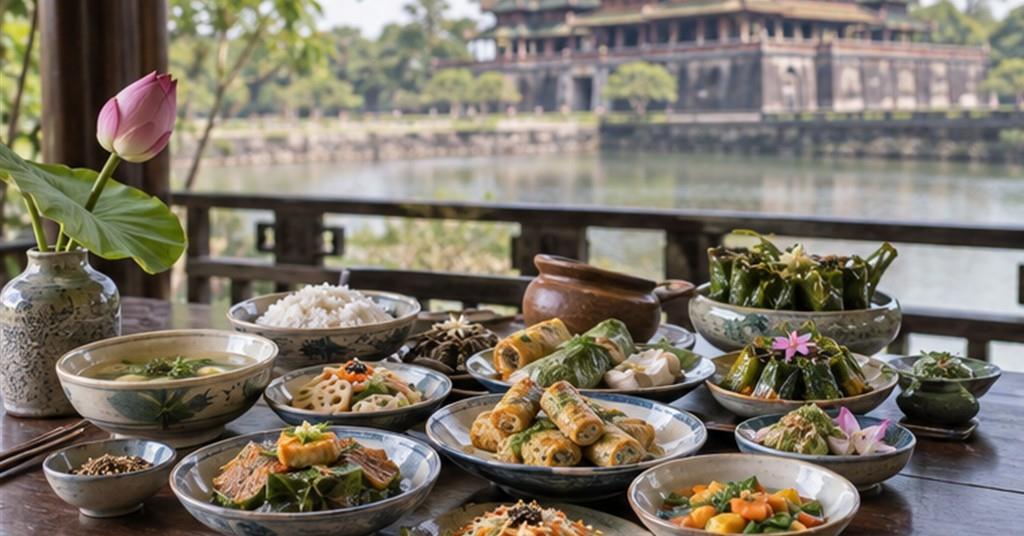 Hue vegetarian food: why is something so plain still so layered in flavour?
 How to cook hu tieu Nam Vang: a clear broth, sweet from the bones, with noodles that hold
 How to cook bun rieu cua: fragrant, with the crab curd in soft clouds and a clear broth
Đăng nhập để bình luận: / Sign in to comment: